

- The Beatles and “Scenius” - October 2, 2026
- Little Help From Our Friends? - September 2, 2026
- A quick yawp from Mr. History - August 24, 2026
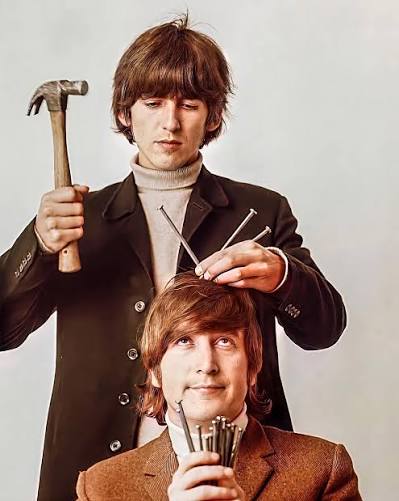
With every nail, a little genius leaks out
The musician Brian Eno has coined the word “scenius,” which in its simplest form is the belief that the Renaissance-era idea of the solitary, isolated, tortured genius is a myth, and that artistic breakthroughs actually come from (in Eno’s words) “a whole scene of people who were supporting each other, looking at each other’s work, copying from each other, stealing ideas, and contributing ideas.”
Obviously true, right? It certainly seems so. What’s more, it FEELS GOOD. Not only does it dismiss all the Dead White Males at a throw, it opens the field absolutely for the rest of us. It seems democratic. It gives every person who loves to write or sing or paint–anyone with enough scratch for a Mac and the desire to “Think Different”–if not a rough equality, at least a kind of artistic lottery ticket. In our weekend noodlings we suddenly have a chance to do something meaningful; we might not be a Beatle, but we could write a little tune that, in some roundabout way, inspires someone who inspires someone who inspires someone to be a Beatle. “Scenius” empowers the fan and hobbyist. It keeps them buying gear and tickets. It promises to spread credit around; instead of one towering (white, male) artist, future humans will celebrate lots of people who had a hand in the creation of a gloriously diverse and endlessly satisfying future culture. “Scenius” is exactly the kind of idea people love these days. It is perfectly tuned to our faux-egalitarian, influencer-driven, social media-saturated landscape.
And I hate it.
I hate it because I lived through decades of claptrap where the internet, that world-bestriding supremely collaborative tool, was touted as something that would 1) make us more free; 2) allow many more artists to be discovered, and make viable livings from their art; and 3) through the wisdom of the crowd, conjure up nothing less than a new Renaissance, not only of artistic expression, but of thought itself, creating a fundamentally freer, fairer, more diverse and more interesting society.
Welp.
Because the concept of “scenius” does not acknowledge capitalism — because it describes something real (the presence of influence, the power of collaboration) with an immature undertone (art belongs to everybody), “scenius” is a kind of Trojan Horse. The beautiful Horse can be summed up in this snippet from the writer Austin Kleon: “Our world is an ecosystem in which our only real chance at survival as a species is cooperation, community, and care, but it’s being lead by people who believe in an egosystem, run on competition, power, and self-interest.”
Nice! I like survival! Cooperation, community and care, all excellent, sign me up. And competition, power, self-interest all seem shitty when you say it like that. Send over one of those wooden horses, would you? Turns out that lurking inside are a million corporate soldiers — executives, programmers, lawyers, most of all lawyers — ready to pour out and slaughter any artist they see.
“Scenius” isn’t wrong — it explains something real, and is useful to keep in mind whenever any Genius Artist is trotted out for our approval. But the idea that no artist creates anything on their own is being systematically zhooshed into the idea that no artist can really own anything. Who was responsible for To The Lighthouse? Woolf? The Bloombury Group? The era? Who was responsible for Eno’s work? Glam rock, the infrastructure of pop music, the revolution in consumer electronics? We could argue for hours.
But the corporations that distribute content, they’re beyond argument. They can restrict access, existing only to exert control. The corporations that create and market performers can also control things. The software and hardware manufacturers that allow a person to consume content, they control things. AI companies harvesting masses of content and producing slop is the natural, and perhaps inevitable outcome of this line of thought. Content wants to be free, and that goes double for good art, but the tech to access it will cost you money.
Nobody would suggest that this Mac I’m typing on isn’t the product of Apple, Inc. But if tomorrow it was declared that the profits from all Apple products needed to be distributed amongst all the people with a hand in having them come to be from Year Dot, Apple would go out of business.
Ownership is how people (read: artists) get paid. And they need to get paid to make art.
This is what I would say about the concept of “scenius”: for a certain type of person — the same type of person who dismisses the Great Man theory of history in favor of people’s history or historical materialism — it feels reassuring, especially if you’re already got yours. It’s the System, man. Who killed the Kennedys? After all, it was you and me, sings the rich rock star. And as I keep saying, scenius does describe something real; creative individuals are acted upon by their times, by their contemporaries, and so forth. But it also misses, or at least devalues, something equally real. And here is where we come to the Beatles.
The Beatles: Genius or “Scenius”?
One of the most distinctive aspects of the Beatles story — certainly when compared to those who came after them — is the fact that they weren’t obviously the product of a scene, or at least not one that existed outside of their own heads. This is shown by how quickly their music changed; scenes don’t evolve so quickly, but heads can. Yes, you can hear influences in the early Beatles, from Buddy Holly to American R&B to the Everlys. And yes, Liverpool had a “beat music” scene, but by the release of Beatles for Sale in December 1964, the gap between The Fabs and say, Gerry and the Pacemakers, is simply immense. The size of the Mersey beat scene is remarkable — 350 groups! — but equally remarkable is the lack of innovation and quick drop into insignificance of every other group but The Beatles, and also how quickly The Beatles jettisoned anything resembling their early sound.
The same can be said about other “scenes” The Beatles were a part of — British groups who cut their teeth in Hamburg, or were influenced by skiffle; fans of The Shadows or Little Richard. Historians and musicologists can come up with a taxonomy—read this Wikipedia entry if you have an endless life—but the gap between “the scene” — any scene — and The Fabs is remarkable.
What caused this gap? What other answer could there be besides genius? John/Paul/George/Ringo were simply better than their Cavern contemporaries.
The more I think about it, the more peculiar it gets — can anyone recall a specific approach or technique invented by, say, Rory Storm and the Hurricanes, or The Fourmost, that The Beatles swiped directly? The Fabs’ had influences, lots of them, and talked about them freely. But this low level of “anxiety of influence” comes from how distant their influences were; it cost The Beatles nothing to give credit to Buddy Holly or Arthur Alexander because, in the hands of the Beatles, that music was clearly very different. Beatles covers are like a French chef’s version of a hamburger, and this often holds even for the workouts recorded for the BBC. Though part of a larger scene, John, Paul, George, and Ringo were not part of a larger scene which caused their success. The flow of influence seems to have gone from them, but not to them, until they met Bob Dylan in August of 1964.
Their uniqueness extends to their management: a young man working in his family’s furniture store/record shop. And their producer, who was known for his comedy records.
So, The Beatles were geniuses? Great Men do exist? Not so fast.
Their Own Scene
If we define The Beatles’ scene as “those four guys,” the picture changes radically. They all influenced each other massively, and each had a massive impact on the quality of the music they created together. John Lennon, despite his protestations to the contrary, wasn’t a genius—because he couldn’t come up to a Beatle-level of quality without the other three. Neither could the others. Why did none of The Beatles’ solo work come up to the level of their work together? The power of four-person “scenius.” Individually, they were very good. Together — as a “scene” — they were one genius.
In the end, I think my issue with the “scenius” theory is simply this: we each experience the world as individuals, and this is true for artists perhaps most of all. The idea I have for a piece comes to my head, not yours; and I write it, not you; and then I edit all my swears out, and so forth. Any piece of creative work is the fruit of a million micro-decisions made internally by an individual, who is then judged, as an individual, on the quality of that piece of work. Recorded music may be different; if Brian Eno was editing this piece, maybe it would be better, probably it would be, but he’s not because that’s not how writing works today. To acknowledge influence — the soup of experiences every consciousness exists in — is right and proper, but until our society figures out a way to pay artists, and really believes in their worth isntead of giving it lip-service, “scenius” is a rather dangerous notion born of incredible privilege. It describes a corporate-funded team-creativity that is becoming less and less common as more art becomes a hobby done for no pay.
I’m currently listening to Eno’s masterpiece, 1974’s Another Green World for free on YouTube. I mean, not for free — I pay YouTube $15.99/month — but I didn’t buy the music. I only know about it because the record company promoted it 52 years ago, and record stores sold it, and people say it’s a work of genius. But no record company or record store is getting any money tonight, and Brian Eno certainly isn’t.
I’d feel bad about this except… it’s the product of a scene, you know? Brian Eno just gathered it, sort of. Isn’t that how art is made? It was a bunch of people’s ideas, everybody stealing from each other in one time and place long ago, and Eno added a bit here and there, and…but I gotta pay for YouTube, ’cause all that coding and backoffice and stuff, you can’t get that for free. That costs money.
Why We Love “Scenius”
In 1963 and ’64, The Beatles demonstrated that there was a vast new worldwide audience for pop music. By mid-’65, record companies in the US and UK had discovered, packaged, recorded and racked into shops an immense number of new groups. And by the beginning of 1967, this meant that millions of people who’d started out as fans of The Beatles were now fans of many groups. This successful expansion of the market by niching looked like The Beatles had lost their popularity (cue the 1966 Shea Stadium news report), but what had really happened was that the industry had expanded, and the cultural stage had become that much more capacious. Just in time for the Fabs to unveil themselves as a singular genius.
A lot of these post-1964 groups were very much products of “scenius,” whether it’s The Yardbirds or Cream or Zeppelin, or the LA Laurel Canyon crowd, or any of the San Francisco groups, etc etc. The Stones could be a product of the London Blues scene, but I simply don’t know enough about their beginnings to speak authoritatively. And rock continued to splinter, with genres (scenes) sprouting up and being monetized as fast as they appeared, punk included. Yes, geniuses did still emerge—Brian Wilson, Jimi Hendrix come to mind—but certainly by the time of Eno, “scenius” ruled. Eventually, as the decades of splintering piled up, the consuming of music lost its connection to commerce. It had to; there was simply too much to choose from (and pay for). So what you bought became the corporation’s streaming service, not the artist’s music.
Scenius is the bedrock of modern corporate pop culture. It is necessary to supply an uninterrupted stream of product, each iteration containing just enough superficial change to market it effectively. Anyone steeped in contemporary pop culture, whether it’s books or movies or music or video games—is used to scenius. It feels normal, fair, and pleasingly democratic. Genius—the inflection points when a business changes and a paradigm shifts—may actually be suppressed by the scenius mechanism necessary to keep content flowing. But that’s what fans want: more stuff. Scenius not only produces that stuff, it gives it a context so we can consume it as efficiently as possible.
But outliers—geniuses—do exist, and I for one try to keep a weather eye out for them. That’s why I listened to Eno’s Another Green World tonight. I knew one of the songs from TV (a BBC documentary series called “Arena”). It was pretty good, but…not really my scenius, you know?
Related posts:
 Little Help From Our Friends?
 Sid Bernstein obituary
 Fest for Beatles Fans Chicago 2015
 The Black Album: Solo Beatles According to Ethan Hawke
 George Starostin on “McLemore Avenue”
 Charles Taylor on A Hard Day’s Night
 Shepard Fairey George Harrison Poster
 Psychedelia in the UK: "A Technicolor Dream"
 Beatles For Sale sessions
 Try it, you might like it
 Allen Ginsberg: “Portland Coliseum” (1965)
Order Failed
Excellent essay. Some scattered thoughts.
‘Genius—the inflection points when a business changes and a paradigm shifts—may actually be suppressed by the scenius mechanism necessary to keep content flowing.’ I know you’re talking about the profit motive more than group psychology as such here, but this reminds me of an incredible essay by Erik Hoel: https://www.theintrinsicperspective.com/p/the-gossip-trap He argues that the fact that homo sapiens existed for tens of thousands of years without really progressing technologically at all can potentially be explained by what he calls the “gossip trap”. That is, until our population increased enough to put our societies significantly beyond Dunbar’s number, tribes were basically high schools in which the most popular kids ruled the roost and bright new ideas were smacked down for going against the grain. He worries that social media’s creation of a “global village” might see us regress to organisation via ‘raw social power’ again, and hobble our ability to nurture the outside-the-box thinking that creates genius and true progress. Very long, but well worth reading every word imo.
So it’s hard to talk about this kind of stuff without coming across as right-wing or even downright Nietzschean, but I don’t think you have to long for the Overman in order to notice that some people are more intelligent, artistically gifted or charismatic than others, and some lucky few possess WAY more than their fair share of one or more of these traits. As you say, it feels pleasingly democratic to downplay this and say that we all have our part to play, and we do, but for 99.9999% of us “genuine artistic excellence” is not that part. I think the urge to elide this stems partly from a genuinely compassionate impulse to let everyone join in the fun, and partly from ressentiment (a concept Nietzsche actually did have a point with, he just didn’t know when to stop). When researching my dissertation, I vividly remember reading an article that talked about the activity of ‘musicking’ as being something everyone in the vicinity of a gig participates in, from the band to the patrons to the person cleaning the floor. Lovely sentiment, but really?
I’d go a little further again and say I think there are individuals who do, in fact, have an outsize effect on history: whose specific psychology and actions moved the needle, who things would look very, very different without. Jesus, Muhammad, Buddha, Alexander the Great, Genghis Khan, Napoleon. A lot of these figures happen to be men because men kind of like hogging all the power; whether or not they’re “great” is very much a matter of perspective. (From an ethical point of view, many of them were very not great.) But I certainly think it’s fair to call them world-historical figures. This strikes us as elitist and problematic today to be sure, but OTOH is it not kinda deterministic, if not fatalistic, to say we’re just pawns pushed about by social forces? Is it not much more life-affirming and ennobling to say that an individual can choose to use their talents and energies to try and make a difference, and sometimes it works? (And is it not the irony of ironies that Marx, the king of historical materialists himself, is perhaps the most world-historical individual of the last 200 years? Shame it wasn’t in the way he’d been hoping for…)
Anyway, about music. I have a romantic woulda-loved-to-be-there fondness for Swinging London, the Greenwich Village folk scene, late-70s CBGB’s and all the rest. But I couldn’t agree more that the true global impact of all this scenius comes from nurturing the talents and ambitions of true geniuses, who take everything they can from these surroundings, then expand way beyond them. (Also couldn’t agree more that no individual Beatle is a genius. I’ve always thought J&P put together equal one, where Dylan is one by himself, but you’re right to point out that G&R played a vital role as well.) A genius isn’t bound by the limits of any one scene; they hoover up inspiration from the whole world, as well as exploring the strange corners of their own endlessly fertile minds. The Beatles took what they could from Liverpool & Hamburg, then moved on. Dylan did the same with the folkies. There’s something kind of ruthless about all this taking things (and people) up and discarding them, but alas, genius so often works that way. It has a habit of swallowing its victims’ lives whole so they can make beautiful things for the rest of us.
Excellent comment with so much to reply to! Unfortunately I am in bed with a cold and the first thing that goes in my 57-year-old body is my ability to think and write (there are reasons for this, I think, based on what healed me), but I just cannot resist commenting. Please ask me to clarify if I’m incoherent.
“ He worries that social media’s creation of a “global village” might see us regress to organisation via ‘raw social power’ again”
I think one of the most malign developments in my field over my lifetime has been the centrality of social media in comedy. The content rewarded by social is very simple stuff that reinforces widely held assumptions. You can see this clearly in one-panel cartoons, where jokes have been replaced by “that’s happened to me, too!” material. And the young people who rule the internet have massive anxiety of influence, so any suggestion that the material is objectively less interesting, challenging or personal is perceived as an attack. There are simply not enough liefunes to argue with @glassanimals420.
“ So it’s hard to talk about this kind of stuff without coming across as right-wing or even downright Nietzschean, but I don’t think you have to long for the Overman in order to notice that some people are more intelligent, artistically gifted or charismatic than others, and some lucky few possess WAY more than their fair share of one or more of these traits.”
I am of the belief that every persons inherent worth entitles them to good food, safe housing, meaningful work, and health care; I believe that educating children and caring for the aged should be civilizational baselines. I believe we should try to pack each life with as much beauty, connection, and meaning as possible, with as little coercion as possible, and that governmental structures seem to be the most efficient way to do this. I have no idea where this puts me in the left/right spectrum.
But I think people really suffer when political systems do not reflect reality, and one of the realities they must reflect is the natural disparity of talent. Corporate structures are perhaps THE WORST POSSIBLE forms for either spotting talent, or slotting it into the place it will thrive. Corporate structures plus social media are perhaps the perfect genius-squelching machine, not least because both are excellent at extruding glutinous rationales for why their preferences are actually JUST.
“ an article that talked about the activity of ‘musicking’ as being something everyone in the vicinity of a gig participates in, from the band to the patrons to the person cleaning the floor. Lovely sentiment, but really?”
My dearest friend (and ex-writing partner) the leftist writer Jon Schwarz has argued for years that the ability to make a living via the arts is absolutely dead, or soon will be, and that the only way countries will have vibrant arts must be through the checking of a little box in your taxes, designating $5 thst you can assign to any arts group of any size. The progenitor of this idea is the leftist economist Dean Baker who I once posed a simple question: “How do we insure this funding mechanism is not political? That it does not turn all art into propaganda for the ruling party?” He did not have an answer for this, and as smart as Baker is and as much as I agree with him on other things, this invalidates the theory, which is the product of a person not within the arts, but the world of think tanks.
“…whose specific psychology and actions moved the needle, who things would look very, very different without. Jesus, Muhammad, Buddha, Alexander the Great, Genghis Khan, Napoleon. A lot of these figures happen to be men because men kind of like hogging all the power; whether or not they’re “great” is very much a matter of perspective. (From an ethical point of view, many of them were very not great.)”
The great man I’ve studied the most is Julius Caesar, whom I’ve studied quite deeply. Even with a man as gifted in several areas as Caesar, what he did, how, and why was completely moderated by his time and place. Did he act? Yes, incessantly. Was he deeply circumscribed by economic political and social forces? ABSOLUTELY. If Caesar had been born 200 years earlier, he would’ve likely been Scipio Africanus, a great general who worked within the structures of his era (and was ill-treated as a result). Caesar’s life and impact was fundamentally shaped by being born in 100 bce and living during the civil wars period, and there are at least two figures that are sort of dry runs for Caesar, Sulla and Pompey the Great. So it’s impossible to pry a Great Man out of his time, and no reason to do so. The point is to describe and understand, not win an argument by “science-ifing” something that is not quantifiable. You see this with sports and analytics.
As to why geniuses are usually men, I think it’s very very simple: genius is an attempt at immortality. If I could birth a child, I would not care ANYTHING about artistic pursuits. They are a poor second, if that.
My eyes are losing focus so I’ll just say one more thing: geniuses are indeed ruthless, because one of the essential traits of genius is single-mindedness. And I will go further and say that geniuses are often unpleasant, or even criminal. A mature, well-run society should be able to acknowledge artistic excellence without demanding “niceness,” not because I don’t wish for both, as we all do, but because it seems you cannot be ruthless and housebroken. Michael Jordan is a genius of basketball, and he is clearly out of his mind (that is, to me, why he is greater than LeBron James). Lenny Bruce and Bill Cosby and Woody Allen are unsavory characters, but to deny each man’s genius—how they fundamentally changed what comedy is for us, and how it is made (I can dig into this if people wish), is simply not factual. Goldman’s book on Lennon paints a character whose ethics and manners are standard for a person on his scale of genius.
I come from a family of scientific geniuses. My grandfather, a total psychotic, was short-listed for the Nobel Prize. My brother, who works on quantum computing, is likely a genius; he is a very difficult man. All the testing I underwent as a small person suggested that I had a mind of the same rank, whatever that’s worth—and what it was worth then was coming from poverty but going to lots of fancy schools on scholarship.
I no longer have the raw horsepower I once had; this was my price for staying alive. Today, my abilities are thoroughly average, and it’s having been so far above average that makes me realize where I used to be; my skills were great, my focus was insane, my timing was poor (I was twenty years too late).
Whether I am a genius is something I cannot know and do not care about — my focus has always been on creating artistic opportunities for others and if that obscures my own skills, so be it — depends on what happens to the things I’ve created after I die; but I really do try to be as nice as I can all the time to everyone, because of my cerebral palsy, which makes me suffer a lot and thus empathize. (My brother is probably on the spectrum, but abled.) the reason I’m telling you this is: “being nice” when it has come to my artistic pursuits, has made them less innovative, less recognized, and less good. I’m okay with that, which probably means I’m not a genius.
Ah, my sympathies Mike! If you’re talking about brain fog, I can seriously relate.
Hard agree on all the pandering comedy. I’m always reading those cartoons and memes thinking ‘Why is all this observational whimsy supposedly so cringeworthy when Michael McIntyre does it, but OK as long as it’s slapped onto a drawing of a dog or a recognisable scene from a movie?’ I mentioned Norm Macdonald in my other reply just now, and one thing I always admired about him was that he’d challenge the audience to laugh at something that they didn’t even remotely see coming – all because he personally found it funny and knew there was some merit to it. Sean Lock and Bob Mortimer being two of my favourite UK equivalents, always demanding that the panel show format rise above the cheap gag and the easy laugh, asking for more from the audience, silently daring the other comedians to step up their game. (Lock used to say he’d refuse to laugh at his peers unless they genuinely earned it, because he didn’t want to encourage them. In making his laughter a rarer commodity, he made it more valuable, and more sought after. Bob…well, he’s just a trickster deity playing among mortals, joy in human form.)
Would LOVE to hear more of your thoughts on Bruce, Cosby and Allen. Of the three I’m only properly familiar with Allen; I went through a massive phase in my teens and 20s and may have seen a couple dozen of his films. I dearly hope the allegations against him aren’t true; even if they aren’t, he’s definitely disturbed.
.
Can I join your political party?
.
I’ve actually applied for Ireland’s Basic Income for the Arts programme this year; they decided to continue with the idea after the pilot scheme found that artists’ mental health improved and the economy improved with it. Funding is allocated entirely randomly once you fit the basic criteria for entry. Getting it means an extra 350 or so euro a week for the next three years, which isn’t a living all by itself, but is definitely something. Going to hear back any day now 🙂
.
Totally agree that we need room for what Big Five types would call “disagreeableness” in our society. Speaking as a recovering people-pleaser myself, I think our era has overvalued agreeableness and moral perfection for a while now. (Well, OK, we verbal-IQ people have. The data people are too busy moving fast and breaking things to give a damn about being nice, and from the POV of planetary survival that’s much the worse extreme to be at.) A sort of erring-on-the-side-of-doing-nothing-much-rather-than-doing-something-and-risking-it-being-the-WRONG-thing, doing less good because you want to make sure you don’t do anything bad. I know from experience how hobbling that can be, and have several friends who suffer so badly from Spotlessness Syndrome that I wish I could shake them all and say ‘You don’t have to be so good all the time! Stop depressing yourself! Get out of the house and live a little!’
I believe being a good person in the broadest sense involves a lot more than harmlessness; you need honour, courage, strength, decisiveness, being a warrior in a garden, all that old-fashioned stuff. I think geniuses often have a lot of the strength and determination and resolve but not much niceness, and end up doing a lot of good for the world, even if they’re not people that the rest of us would particularly want to share a lift with, let alone befriend or marry. So yes, it seems like being a genius requires not just raw ability, but timing, luck, circumstances – and that killer instinct. Makes me wonder if it would be better for the genius’ own soul to hear the call and not answer it.
Now THAT is an interesting question, @Justin — would geniuses be better off not heeding the call? I think one of the markers of authentic genius is you can’t help yourself. You HAVE to do it.
Taking Caesar as an example, I think even apart from the aristocratic Roman’s lust for glory — a social norm which was universal, intense and constant — Caesar was absolutely driven to express all his gifts in the fullest, most public way possible. That’s probably a lot more of what we identify as “genius” than we realize. My brother isn’t just the kind of fellow who at 12 was identified as a person with a certain level of aptitude; he’s also told me, “I don’t take a job unless it comes with the possibility of a Nobel Prize.” And I understand, and respect that. If you can do it, DO IT.
But I know another person, immensely gifted in a very similar way, and educated just as exquisitely as my brother, who suffers from self-doubt so crippling she cannot get a job.
I think that’s another reason why “genius” is so often a male trait; not because women are not just as talented (or more so), but that it requires immense self-confidence, often much more than is appropriate.
PS AGW is overrated; Before & After Science is where the Eno fun really is 🙂
@Justin – What an outstanding post. You have given me much to gnaw on. I particularly like your ending of “There’s something kind of ruthless about all this taking things (and people) up and discarding them, but alas, genius so often works that way. It has a habit of swallowing its victims’ lives whole so they can make beautiful things for the rest of us.”
That alone leaves me much to ponder.
@Michael. Also much to weigh in your OP. As to your reply to Justin, your remarks regarding Cosby, Bruce, and Allen lead me to ask, are there many examples in which the truly talented artist, actor, comedian, etc. is a genuinely nice person? I’m not talking about signing a few autographs or letting the fan take pics, but nice and considerate is most all areas of life?
The most talented people I’ve met—illustrators and writers—have usually been very nice. There has been a rough concordance between talent and kindness, and I think that’s because to be very talented in these fields you have to be very aware of yourself and others.
“But Mike, how does that square with geniuses being unpleasant?”
There are at least two things afoot here—“transformative talent” and the license this buys a person to act out/misbehave.
The guys I work with—even the tv writers with a ton of money—are not FAMOUS. Bruce, Cosby and Allen’s misdeeds (in Allen’s case, alleged misdeeds) took root in the soil of real fame. Famous people seem to be released from normal human strictures, and that license is granted them by us normal folk.
Ah, fame. That classic line ‘the mask that eats the face’ sums it up perfectly, doesn’t it. Agree that, along with money, it’s the world’s greatest enabler. But you have famous people who act like Cosby, and famous people like Tom Hanks who don’t seem to act like that at all, so I think you’re right that the other ingredient is “transformative talent” Mike. If I’m right in thinking that you’re talking about the difference between “being really really good at something” and “true world-changing genius”. Tom Hanks is very good at his job, but he’s not a genius.
In comedy, Conan O’Brien seems to me to be an example of someone who’s “merely extremely talented and hard-working”. Basically well-adjusted – a bit narcissistic, sure, & I know he’s needed a lot of therapy (and I can relate!) – but fundamentally decent, normal and capable of functional relationships. Of course, I’ve never met the guy, so this is all complete outside-looking-in speculation. Norm Macdonald, on the other hand, I would call a genius. But he was one strange dude. I love him, both as a comedian and a person. But a strange dude.
In music, you have Dylan, who was intensely single-minded, ego-driven, treating people as a means to an end, stealing their records so he could learn the songs, all of it, long before anyone had heard of him. Then worldwide fame just walled him off from the rest of us even more. Paul McCartney is a lot more normal, but as a younger man he *absolutely* had that killer instinct that wouldn’t let anyone or anything stand in his way, and he certainly didn’t give a damn about all the tears of the hundreds of women he loved and left. Besides, he isn’t a genius without John, and IMO it’s only when you combined the one’s discipline with the other’s neurodivergence that you got that “transformative talent”.
Full disclosure: I’ve never met Conan, but I know a LOT of people who know/have worked with him. I don’t know if he’s a genius; he’s got some markers of it — he’s the only two-year President of the Harvard Lampoon as far as I know, and that place is a meat-grinder, with respect grudgingly given. Making the leap from the writer’s room to the talk show desk is another marker; I know no other comedy writer of his rank who really could’ve done that at the network level.
On the other hand, Conan’s been astoundingly successful within a very conventional, very collaborative business, and that’s usually not how “geniuses” operate. He’s reputedly a very good boss, and when I was coming up six years behind him, he had a reputation for fairness and seeking out unusual people, both really good attributes. Also, you can’t really point to a “Conan” style of comedy, or a pre-Conan time and a post-Conan time. These all suggest that he is a fantastically talented guy, but not “a genius.”
I think Robert Benchley was a genius; he developed a style mostly his own (with a bit of Stephen Leacock) that people are still copying today; the whole internet sounds a little like Benchley. He sort of fell into professional comedy, first in New York and then Hollywood, and had a very conflicted attitude towards it.
I also think Doug Kenney was probably a genius; his use of nostalgia and parody, his co-founding National Lampoon magazine, and then Animal House, gave American comedy a whole new palette that it is still exploring (trapped in?) today. Kenney didn’t do it all himself, for sure, but I don’t think you have the Harvard Lampoon pipeline into comedy without Kenney — which means that people like Conan O’Brien become extremely funny lawyers, which is largely how it was for the century before.
Norm MacDonald is the type of person — like Albert Brooks — who was/is incredibly loved by comedy people. They saw him doing new things in new ways, but like so many people acclaimed to be geniuses inside the biz, outside the biz his impact was muted. Like one of my favorite comedy geniuses, Peter Cook. Peter Cook did more to create the groundrules for modern comedy on both sides of the Atlantic than anybody else I know, but he was never, ever a mainstream person in the US. He did not have “the common touch” that I think is a hallmark of genius, from Caesar to Bob Dylan.
I think to be an authentic genius, one is often in conflict, either with oneself or with some basic aspects of one’s time. And perhaps its being in conflict so much that inures so many geniuses to the commonsense restrictions we all must abide by. “I sweep away this meaningless convention” works for them, so they get used to doing it too much.