

- Little Help From Our Friends? - September 2, 2026
- A quick yawp from Mr. History - August 24, 2026
- First Thoughts on “The Beatles – A Four-Film Cinematic Event” - August 17, 2026
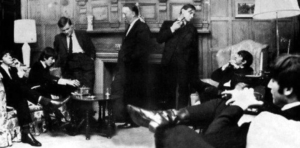
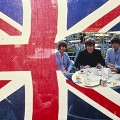
The Fabs at Brasenose College, Oxford, March 1964
Folks, I’m not sure this one is worth posting—I’m not satisfied with it, but sometimes I’m the last to know what will spur discussion. Enjoy.—MG
As part of my freewheeling, exhaustive, and ultimately exhausting attempt to do anything other than what I am supposed to, this morning I ran across a very interesting blog post by a Beatles scholar named Serene Sargent. Coming hot on the heels of yesterday’s attempt at work-avoidance, a Substack about the decay of the university and the death of the humanities, and the increasingly important role of knowledge-gathering outside academe—and in the midst of a flareup of interest in the JFK assassination—this trifecta shook loose some thoughts I’d like to share.
As you can see from the first link, there is on the internet a recent kind of Beatles fandom in which the fans call themselves “scholars.” This expresses itself mainly in extensive fact-checking and -gathering, followed by an ongoing Talmudic disputation of everything involving John, Paul, George, and Ringo. Much brainpower is expended, by many—it is essentially a floating Beatle University. There are websites—podcasts—YouTube channels—all good fun for a certain kind of big-brained Beatle fan. I suspect these fans would bristle at my calling this pursuit “fun,” but I mean no disparagement by either “fan” or “fun”—why I characterize it this way has everything to do with me, and not with them, as you’ll see later in this post.
This type of fandom is very different from earlier types. As a Beatles fan obsessed with the Sixties, I might well have wanted to take a college course in the group in 1989, but the faculty at Yale would’ve considered this idea preposterous. Not so today, where Oxford herself offers such a summer seminar. That low- and highbrow culture has met somewhere in the middle—that no item of pop culture is considered too small to avoid academic-style analysis—is a hallmark of our era; and to me it suggests that the very idea of higher education has changed. A degree, doubly so a fancy one, used to be a gauntlet a person needed to run to obtain entree into certain areas of society. Now it seems at least in part determined by what students already know and want to think about. If students are customers, it follows the customer—even at uber-snotty places like Oxford—is always right. If the space in a kid’s head once occupied by The Aeneid is now filled with the various takes of “Strawberry Fields,” that’s a change, not because one is better than the other, but because it was possible in 1989 for a kid’s brain to accommodate both, creating a useful internal tension. (Ask me how I know.) And speaking as a producer of pop culture, it remains to be seen whether this academification is good for the pop product. The last Star Wars movie—surely created by film school grads well-versed in this new way of engaging with pop culture—is certainly not better and perhaps is worse than either Lucas’ original Saturday serial or The Empire Strikes Back.
None of this is the problem of Beatle scholars on the internet, who can only engage with the world they’ve been dealt. The emergence of this flavor of fandom was also inevitable, as more and more Beatle-data was digitized and found its way online. What do you do when all the unreleased tracks are on YouTube? You dissect them! Online Beatle scholarship may well make the received story fundamentally more accurate; the only downside I can see is missing the forest for the trees. But this kind of fandom is about the trees. Each tree. Each individual leaf. And by examining each individual leaf—so it is believed—and conferring amongst each other, a newer, truer vision of The Beatles story can be built. And that over the years, more and more truth will be accumulated, without end.
This linear progress seems to be how science and engineering work, fields where reality can be measured and tested, with well-defined principles, and hypotheses that can be tested and proven or found wanting. But I’m not sure history works this way; human affairs are fundamentally mysterious, no matter how many facts one accumulates. There always remains interpretation—and our interpretations might actually be getting worse and worse, the farther we extend from the world under review. Santa Monica in 2026 is nothing like London, England in 1965, and there is a humility necessary.
One of the things never directly expressed but nevertheless clear in Ms. Sargent’s essay is the relationship between historical research and a sense of ownership—these scholars guard their Fabs jealously. Errors of fact are serious things; the word “cataclysm” is bandied about. Motives are questioned. Mark Lewisohn comes in for a lot of stick, not just for his habit of conflating quotes, or his errors in scholarship (Tune In Vol. 1 is being scoured, and found wanting), but for Lewisohn’s market-positioning: he alone can tell the story.
This makes me chuckle. Of course this is what Lewisohn says—he can say no other thing because this is what every author says, and every publisher, too. Humility does not sell you books; Spitz before him touted “the real story,” and before him, Norman; and looming over it all, Anthology, “their own story, in their own words.” All selling the latest, surely-finally-absolutely definitive version of the group and its times. But will Lewisohn, with all his research (and apparent Frankenquotes) offer up a story vastly different from the one we know? Not so far. But I am glad for his books and his work and so I nod politely and say, “Go ahead, Mr. L., shoot your shot.” And I say the same to any Beatle scholar.
Was Hey Dullblog present at this birth of this very intellectual way of enjoying The Beatles? ‘spect so, though almost immediately there were other sites (Tumblrs, then; Substacks now) that scratched these itches much more deeply and well than we did. And that is because…well, I have to admit a few things to you.
I am, in general, comfortable with gatekeepers.
“Of course you are, you’re a middle-aged white man! IOW, a gatekeeper!” Well, guilty as charged, when it comes to my little fiefdoms (I run this website, and a magazine). But at least you know who you’re dealing with, and that’s not nothing. As with this post, I try to be clear about where I’m coming from and why. But more importantly, places which embrace distributed, anonymous editorial authority—for example, Wikipedia—have not proven to be superior to an old, editor-run encyclopedia. Don’t believe me? Think of a contentious topic in which you’ve read deeply (say, the JFK assassination). Now go read the Wikipedia page; you’ll find a lot of questionable stuff there—assertions presented as settled fact, debates sanded smooth, et cetera. Some of this is a structural flaw: Wikipedia cannot be wiser or more nuanced than mainstream media because of its sourcing rules, and it can be worse, because bias doesn’t average down—more people can mean more bias, more confusion, and volume or authority carrying the day. Moderating a webpage, especially anonymously, is a social act, subject to all sorts of horse-trading and hidden hierarchies. One “expert” is not necessarily worse than a bunch of anonymous mods, each with much less knowledge. Interpretation is ever-present. Authority still exists and must be exercised; “gut calls” must be made.
Is Wikipedia better than Grok? Yes. Is it better than a properly edited encyclopedia article on the topic? Often not. Anonymity, collaboration, multiple authorship…the holiness of these things is the internet’s secular religion, but perhaps it’s time to step back and see where this faith has taken us.
I have been a sentient adult for the entire length of the consumer internet, and the information ecology today is infinitely worse than it was in 1989. While shining us all on about freedom and access and egalitarianism, the internet has given us monopoly and dystopia, and now AI has come in to deliver the coup de grace. The only things that are not spun, are things too small to make any money. I know what politics and fandom and media was like before the internet, and I know how it functions now, and…man, young people, I am so sorry. Part of the reason I keep doing Dullblog is out of misplaced guilt over the rest of the internet.
In my experience, pre-internet people were not less well-informed; perhaps they were better-informed, because the data had been pre-contextualized—you weren’t making up the whole story yourself, you were building on frameworks provided by experts. Gatekeepers weren’t absolute authorities; if something sounded like bullshit, people could and did read more widely. But you did so with some basic knowledge; you didn’t walk around with a headful of facts, selected by your limbic system for reasons known only to you (and sometimes not even then). There were professors who told you what a lifetime of scholarship on a topic had taught them; there were doctors and scientists who shared discoveries with the world; there were governments which, in addition to being corrupt sometimes, and self-dealing often, and always difficult to improve, actually kept the world from blowing itself up. The gatekeeper world got us through the Cuban Missile Crisis. The non-gatekeeper world can’t even impeach President Corrupty McPedophile.
Does “knowledge want to be free”? Should “the power be put in the hands of the individual”? No clue, but we have to at least entertain the idea that knowledge work may simply require a level of patience, care, and judgment that most people don’t have or wish to develop. Prior to social media, gatekeeping institutions from the fully staffed and functional State Department to the biased New York Times had agreed that Fascism was bad—no matter how simple or intriguing or viscerally appealing its arguments were, especially to young men. The gatekeepers, those smug bastards, firmly closed the gate to Fascist ideas. Few tears were shed over this; few people felt unduly constrained. There were no American concentration camps most of the time, and that was good. Gatekeepers can be unfair and opaque, but they can also be very useful.
I don’t think The Beatles are all that important.
The things that people choose to become scholars in aren’t necessary what the world needs to know about. I adore reading about the Kennedys, and could spin you a tale about how important it is that we learn the lessons encoded in their story, but…you shouldn’t necessarily believe me. I’m an obsessive on the topic, for lots of personal reasons which I can explain sometime. But my fascination, while (mostly) harmless, doesn’t mean finding out who shot JFK is really that important.
The Fabs are fascinating and wonderful, but they’re arguably even less consequential. Unlike many Beatle scholars, I’m perfectly happy with Mark Lewisohn’s books not because I think they are 100% true, but because they represent a good-faith effort to get a workable narrative. I feel comfortable saying that they are broadly accurate, which is probably the best that can be hoped for in a book of their type. They are not fully “what happened”—no book is, regardless of length. But their factuality is only one part of their usefulness, and sometimes not even the largest part of it. Often when I read a book about The Beatles—as when I read a book about the Kennedys—I am launched into a reverie about them, and all the things that touched them, and how that time is different from my own, and how I might apply whatever lessons I have gleaned.
But in the end, the “importance” of these topics to me is located in my own life and experiences. Obsessions are useful to others not in the mutual reinforcement of them—though that is as fun as sharing a crack pipe—but in the deeper personal context, what the interest reveals about oneself, which is only revealed after sincere self-excavation. (Whether one shares that with others is another story.)
Finally, I don’t think the truth is findable, and certainly not through the accrual of facts.
Barbara Tuchman’s The Guns of August came out in 1962; we certainly have learned more facts about the outbreak of World War I in the 64 years since, so why is Tuchman still essential reading for anyone interested in the topic? Interpretation; judgment; usefulness of narrative. Even if her thesis is someday proven wrong (as with Gibbon), The Guns of August will till be useful.
Whatever popular historians might tell you, “history” is not actually the sharing of truth. It is the creation of a useful story, fashioned from a limited set of always-incomplete facts, reflected our time as much as the past. Facts are important, but they are not the most important, which is lucky because the supply of new facts dwindles over time. Murders can be solved via science—the Ripper murders may have been, the JFK murder might one day be—but for larger histories, new facts are likely to matter little. We probably already know all the facts we need to understand The Beatles’ story—after all, what four people have been more documented?
If we say that History is “figuring out what happened” the proportion is probably 75% “figuring out”—meaning, a person filled with biases formed by their own experiences applying judgment, fitting facts together into a story that makes sense to them. The remaining 25% is that portion of experience that are observable facts agreed upon by all, which sketch out the rough outlines, like ships in the fog. We know the Titanic is about there, and the iceberg with the streak of red paint about there…
Facts, facts, and more facts. Will we ever know for sure why The Beatles broke up? Do they?
• • •
So where does all my high-toned blub-blub leave us? Well, I’m glad that some fans care enough about The Beatles to continue to gather more facts about them. I’m glad, too, that they will hold Beatle authors’ feet to the fire, especially as publishers, too, lose faith in those expensive gatekeeping editors. Precision will only get more important, and more challenging, as AI-generated material continues to pollute the data-stream.
“Getting the story right” is a laudable goal, even if impossible. The history of The Beatles is vastly, vastly bigger than the (truly immense, life-swallowing) JFK assassination; the Fabs’ story stretches over years and years, and involves a much larger cast of people interacting with a seemingly infinite number of events. So I don’t think fact-gathering and collation is going to get us closer to the truth, which is often easier to glimpse from a distance. Beatles scholars may, perhaps, develop into a sort of priestly class, professors without Universities, their degrees self-conferred by the time and energy to read and winnow. Is that better than having it done by journalists, or academics? I think it’s probably more similar than different.
In the end, I think one of the internet’s most sacred of cows—that more data is better—is proving to be false. It’s running up against the boundaries of time and attention; as the amount of data flying at people balloons exponentially, readers are defaulting to the role of customer—they are selecting the story which appeals to them, reading that, and calling it a day. Perhaps this is why a world where people “do their own research” is proving to be less-informed, and more susceptible to deception, than the old gatekept one.
We cannot go back, but we do not, as yet, have a clear way forward.
Related posts:
 A sneak preview of Peter Jackson’s Get Back
 Try it, you might like it

 Why Your Favorite Celebrity Isn’t Who You Think They Are
 “Poor old Buddy”
 Shepard Fairey George Harrison Poster
 I’m So Tired: Responsive Notes on the Phenomenon of Beatle Fatigue
 Various musings on Lennon and Addiction
Lights are back on.
Various musings on Lennon and Addiction
Lights are back on.
 Putting HuffPo’s Beatles Test to the Test
 Ian Leslie: “Notes on Peter Jackson’s Get Back”
 A few words about the latest Rolling Stone list…
It’s been 13 years since Tune In was published. Lewisohn is now 67. He’s supposedly been working on part two, allegedly, maybe? I’ve read rumors he doesnt have a book deal for this second book, never mind the third book. I understand that there is 100x more info on the Beatles 1963-66 than 1940-62 but seriously, what’s going on here? Health issues, financial issues, writers block, legal issues (from Apple supposedly not allowing him certain access)? I say all this with love and concern bc I am besotted with Volume 1. Yes, I understand there are faults and various interpretations can be misguided but god damn what a tome! I got the extended edition and the footnotes alone are worth the price. I’ve read it twice and might read it again. I worry it’s the last book he’ll publish.
Great post Mike. Sorry to hijack the thread, carry on!
@Craig, I have a lot of the same concerns.
Lewisohn’s almost exactly ten years older than me, which means that he spent his formative years in a book publishing-and-sales world that doesn’t exist anymore. The writer-as-monk, amply funded by an advance, toiling away alone and in private until one happy day the book is released, is as dead as the dodo. That’s the bad news.
The good news is that Mark Lewisohn could — today — set up a Kickstarter and raise at a minimum $250,000+ in pledges for Book II. With some breaks, he could well break a million. (I say this having funded probably ten projects this way, and raised probably close to $400,000 over the last 20 years via crowdfunding.) He could also hire a team of top-flight researchers, paid or volunteer. With his stage presentations, he is showing precisely the kind of entrepreneurship that authors must show today, even if — as it does in my case — it makes me deeply uncomfortable and I would be much happier toiling behind an institution.
Lewisohn is in the single best position any contemporary author not named King, Martin or Rowling — he is the acknowledged expert on a topic with a worldwide fanbase, some portion of which is made of wealthy Boomers who still love The Beatles. Money should not be a problem, nor adequate help.
I didn’t reply to your comment MG bc when I do that the reply box becomes smaller and smaller to where eventually each line has just one or two words each. Anyways…
All great points! I didn’t even think about crowdfunding – he could easily raise half a million I would think. He is the #1 name in Beatles research (for better or worse for some).
So, with all that said – you didn’t venture a reply to my question, namely: wtf is going on here? Do you think he’s become bogged down in research bc there is basically an endless supply of info with new info coming out seemingly weekly or monthly? Is it bc he loves to work alone and refuses assistance?
I know nothing about publishing but you do MG! Do you think he has a contract for the second book? Wasn’t the first book rather successful?
Sorry @Craig, I get bogged down in my own thoughts 🙂
I started to respond to this, but halfway through realized that it required its own post. Working on that now.
Very interesting. Personally, it’s never occurred to me to think that the Beatles were particularly important, or that it’s imperative that their story is gotten 100.00% right, or that my unreasonably large knowledge about them represents anything more than a handy pool of data I can map my own personal dramas onto, or man back onto the dramas.
I think a lot of what makes the Internet the Internet is that it’s disproportionately used by young people, who are disproportionate about just about everything. Their obsessions become the standard for enthusiasm, their lusts become the standard for romance, & their cancelling fury becomes the standard for righteous anger. They get a little older, calm down a bit, stop posting so much. So all you see online is people at their most extreme. It sounds condescending to say it, but the main feeling I have always gotten off SM etc is silliness (‘You are not serious people’). And with AI things have just got much, much sillier.
It’s easy for all of that to rub off on even older people if they’re too exposed to it, which is why it can be so refreshing to go outside and realise most people over a certain age aren’t online all that much and don’t care so very much about whatever it is you’ve just been jumping down a rabbit hole about.
I think this is very good:
“ I think a lot of what makes the Internet the Internet is that it’s disproportionately used by young people, who are disproportionate about just about everything. Their obsessions become the standard for enthusiasm, their lusts become the standard for romance, & their cancelling fury becomes the standard for righteous anger.”
I would also add something I find particularly intense in younger people today: reshaping the past into something new that they like. People under 35 consider themselves consumers more than anything else, and so to be acknowledged at all, the past must deliver pleasant feelings, or confirm contemporary visions of people and the world that make them feel right. So you get the Beatles and their story remixed as if they are current college students.
Have all generations done this? Well, the concept of generations is itself a new idea; you can’t engage with the past as a cohort before the cohort idea doesn’t exist. And even within the generations some are much more empowered than others. I’m Gen X, and it has never seemed that we needed to claim/remake the fabs in our own image—and indeed to do so would seem fraudulent. I think we are more a chronicler generation.
The other issue is the outsized cultural impact of younger generations caused by the internet and social media. Social media is so much about taking public stands on issues to define oneself. So Lennon’s wife-beating is teased out of his larger life because it’s useful in this way. “I love the Beatles but Lennon was a shit because he beat his wife” is a stance that does a certain kind of work for the poster, so that’s what people say; that becomes a dominant opinion on the group among a certain cohort; McLennon is similar.
These are perfectly fine opinions, as far as they go—but my issue is always that they don’t go very far, and history—that happened and who people were—doesn’t care about “believing women” or “love is love” or any of the many other proper stances on social. Many of these stances are, to me, sensible and appropriate, but if one uses them as a lens through which to look back, one sees less, and less accurately.
For example, if Lennon is simply a wife-beater, you can’t see that his strategy of metered self-revelation is probably quite central to how celebrities use socials, and thus how we ALL use socials. I truly believe if Lennon hadn’t lived, we would engage with celebrity differently today. And as celebrity dominates our culture now and more, his influence grows.
To engage with the past on its own terms is to become an adult; to insist that it reflect YOU is a way to remain a child. And there is a LOT of money determined to keep people as childlike as possible, for as long as possible.