

- The Beatles and “Scenius” - October 2, 2026
- Little Help From Our Friends? - September 2, 2026
- A quick yawp from Mr. History - August 24, 2026
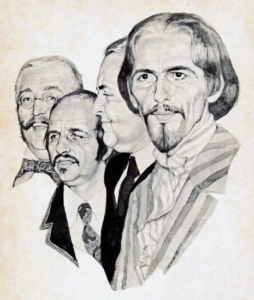
When the Beatles are 64, from LIFE Magazine in 1968.
As the Boomer generation fades into eternity, what does that mean for the standing of Beatlemusic in the culture? And what does it mean for the phenomenon of The Beatles as a cultural force? Will they persist as something like Mozart or Shakespeare, or recede like “Laugh-In” or Herman’s Hermits?
I’m biased, of course — but less than you might think. I’m 56, so what people are digging in one hundred years’ time is really nothing to do with me. But going strictly by what has happened since 1963, I do think people will be listening to The Beatles’ music in one hundred years’ time, maybe longer, maybe much longer. Perhaps more surprisingly, I think people will be studying their lives and story as well. From an artistic perspective, I think Shakespeare is a good analogy; Beatlemusic will still have an emotional pull in the future, albeit one enveloped in an alien style needing a bit of translation—as people still watch (and perform) King Lear, people will still listen to (and perform) Beatles songs. But another analog is the English Romantic poets, Byron and Shelley and Keats and the rest, whose poetry is read and studied, but they are also studied as part of a cultural movement, poetry as cultural history, and individual poets as stand-ins for how the culture was changing.
“I hope to have enough money…by the time we do flop.”
“Honestly, aren’t The Beatles on their way out?”
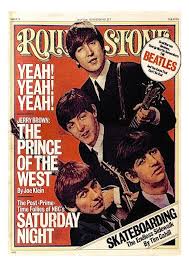
A nostalgia act on the cover of Rolling Stone, July 15, 1976.
People were endlessly trying to write them off within pop; when the 1966 Shea concert wasn’t a sellout like 1965 had been, NYC TV stations sent a guy out to stir up shit. In 1976, the cultural upswell of interest in a broken-up band was considered strange…but was monetized none the less. (1976 was the year of the first Beatlefest.) In 1995, there was widespread comment on “this nostalgia act” dominating the charts and outselling contemporary bands.
And so forth. The Beatles do not dominate the culture like they did in 1964, or even in 1970, but they are still here; one of the most fascinating things about them is how they haven’t receded, and at some point, I think the likelihood must shift from “they’re going to fade, they must” to “they’re going to continue to persist, they’re different.”
Now the counterargument to permanency is that Beatle-love has been driven by the size and wealth of the Baby Boom demographic, and that is assuredly a part of the story. But I think it’s clear that the Fabs’ cultural influence has persisted also because younger people like them, they have been accepted into the academy, and so forth. A lot of what makes it into “the canon” is simply this preferential acceptance by the small group of cultural priests in charge of preservation. The Beatles have been declared historically important by the people we anoint to tell us such stuff.
But it’s not just the preferences of the academy—it’s also what’s required for proper study of history. Western culture changed drastically between 1959 and 1980, and that’s going to be studied forever. And you can’t study that period without mentioning certain things—the Pill, Vietnam, the Cold War…I believe the Beatles are another of those subtopics that were so essential to that essential period. They encompass too much, and are too useful as shorthand to be forgotten. The only way The Beatles will be consigned to the dustbin of history is if The Sixties they kicked off, and then helped shape so dramatically, are suddenly seen as historically unimportant. I don’t think that’s going to happen for centuries.
There’s a final piece, totally unquantifiable, but maybe the most important factor of all. I was born in 1969, and so it’s not surprising that I grew up listening to Beatles music. But what is surprising is how many parents of my generation weaned their kids on The Beatles. In a temporal sense, John, Paul, George and Ringo weren’t ours—yet we claimed them, and passed them on. And now the generation after mine, whatever they’re called I’m not up on the nomenclature, has also introduced The Beatles to their children. Are people playing Radiohead or Wu-Tang or Skrillex to their three-year-olds? Like, a lot of people?
There is a type of person who doesn’t want The Beatles to persist, a keyboard warrior who is determined to dismiss them as a boy-band, and those people will never admit that The Beatles haven’t turned into something other than a band, or even acknowledge them as a historical happenstance. But it’s beyond clear by the point that is exactly what has happened. The Beatles are, it seems, a shorthand, a metaphor, one of the ideas our culture is now built around. Is that good or bad? Who knows? Is it a black mark on contemporary pop culture that a group which disbanded in 1970 still attracts so much attention? These are questions for another post. From everything I can tell, the Beatles have transcended pop music to become modern classical music, certainly equivalent to something like Mozart, and their story has transformed from mere happenstance into legend. Cheer or boo, as appropriate.
PS—Here’s an earlier post which may make you laugh…cultural permanence may be a mixed bag.
Related posts:
 Shepard Fairey George Harrison Poster
 That was your first mistake
 Try it, you might like it
 I’m So Tired: Responsive Notes on the Phenomenon of Beatle Fatigue

 Beatles singles that never were?
 The Compleat Beatles (1982)
 Ian Leslie: “Notes on Peter Jackson’s Get Back”
 Starostin reviews “Abbey Road”
Order Failed
Starostin reviews “Abbey Road”
Order Failed
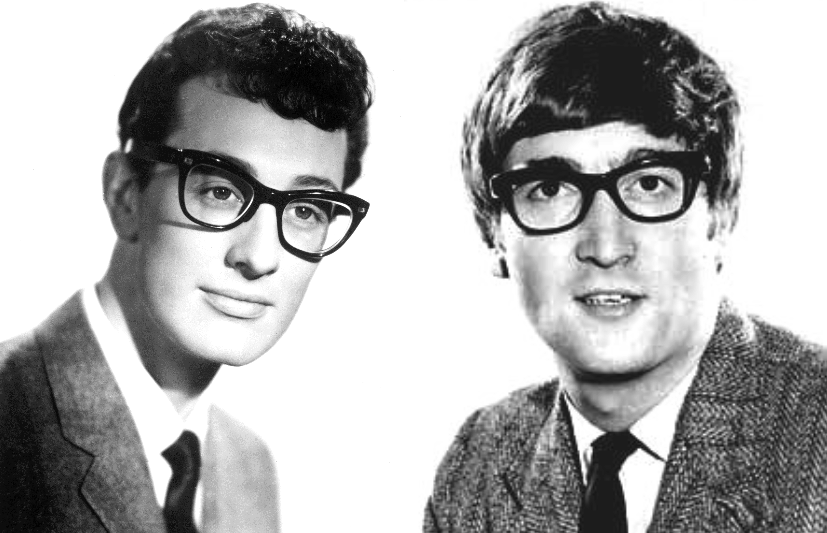 “Poor old Buddy”
 George Starostin on “McLemore Avenue”
I am so glad you’re back.
@Paul, you’re very nice. God knows if I’ll be able to keep it up — my workload these days is truly crushing. But I’ll try!
I wonder if the Beatles (as well as the Stones and almost every other classic rock artist) will get canceled since underage groupie stories have been gaining traction in social media. In the case of the Beatles, the Verge’s “Searching for Susy Thunder” article four years ago (which Paramount bought the film rights to) was the first crack in the facade. Some commentators have wondered why the music industry is the only industry that escaped post-metoo scrutiny so far.
@Unfabbed, your comment tickled something deep in the recesses of my brain and it turns out I DID write a post that touches on your point, at least tangentially:
https://www.heydullblog.com/uncategorized/why-the-beatles-never-had-a-mudshark-story/
I think Lennon basically has been cancelled, because of his own, and especially Yoko’s, accounts of spousal abuse. The problem isn’t what he did with his penis, but his fists, and there’s something I find a little hopeful about that. In general the under-30 online fandom is very judgmental about Beatle sexual behavior (George particularly comes in for a lot of stick: “He SLEPT with RINGO’S WIFE!!!!!”) which I find exceedingly tiresome, for the reasons I enumerate in that earlier post. The Beatles are not guys you go to school with, they were old-for-their-age heterosexual men in an extraordinary situation, sexually speaking; getting too twisted up about their bedtime behavior is like tsk-tsking the Emperor Nero. I mean, do it if you want, but it seems kinda dopey to me. The least interesting way to address the information.
The Beatles’ sexual behavior was concealed for the same reasons that JFK’s sexual behavior was concealed — the mores of the time were so fiercely patriarchal that exposure much less punishment was pushed back upon from every direction. In 1964, it seems that the society around The Beatles and any reporter who might expose them was largely inhospitable to that story. Fast-forward ten years, and the society had changed so that stories of Zep and The Who and Alice Cooper getting up to every kind of mischief on tour were not only publishable, they were sought-after, and there was a flourishing rock press and alt-weekly ecosystem where they could be published. But these post-’68 exposes were not damaging to either the group or the industry, and that’s interesting. The young “Sprout of a New Generation” fans of 1964 turned into the Plaster Casters, and that really says it all.
I can only report as someone alive and aware in the Seventies that…if you were young, sex wasn’t a thing. And it was recognized as a contact sport; if you were pretty enough to hang out with rock stars, and presented yourself at the stage door, you were going to get propositioned — that’s WHY you were there. And if you were going to sleep with rock stars, there might be consequences to that — from marrying one to having your heart broken, getting an STD, getting pregnant, et cetera. See “Almost Famous” for details. I have a friend who saw all this up close back in the 70s, and though she suffered a bit, she looks back on it all very fondly. (And that’s ALL I can say about that. 🙂 There was a refreshing honesty about sex in the Seventies, an acceptance of it as a normal human thing, that I very much miss today. Today the internet has created a society that is both endlessly performatively outraged, but also apparently unable to muster up the political courage to prosecute famous pedophiles. Say what you will about 1965 or 1975 or 1985, a lot of men did a lot of shady shit in the name of sex, but if there’d be credible proof of the President having sex with underage girls, they wouldn’t have lasted a week. (JFK included.)
My guess is that the vast number of Beatle bedmates (on tour or not) were either professionals, or very willing. And in a society where overt female sexuality was still to be hidden, a non-pro sleeping with a Beatle encouraged silence on both parts. Mutually-assured destruction.
My guess is also that because The Beatles invented touring, the groupie-industrial complex hadn’t quite been invented in the years 1962-66. (In the UK, the Pill wasn’t available to unmarried women until 1967.) But if they’d kept touring, we’d have detailed casts of their “rigs,” and lots of juicy stories.
I liked the Susy Thunder piece (and especially the design! Gosh, wouldn’t it have been wonderful if the web had given us lots of magazines doing that kind of old-fashioned thing?), but within it is precisely why there’s been no Beatle #metoo — it seems that around her 70s groupie days, Susy was a “worker,” a dominatrix even, and so the sexual politics involved in her “having sex with all four Beatles” are morally complex. “Groupie has sex with rock star” or “Rock star has sex with prostitute” is strictly dog-bites-man stuff. So much of #metoo is the casting couch, or co-workers, stuff like that, powerful men ambushing women — or guys like Bill Cosby straight-up drugging and raping people. And even in that clearly abhorrent situation, Cosby’s behavior remained an open secret for 60 years. Such is the power of patriarchy, money, and a likable image…and the Beatles had all those things in spades.
The music industry was absolutely not exempt from the me too movement lmao
“Bill Maher Asks Why #MeToo Didn’t Hit Music Industry, Fran Lebowitz Says It’s “’Much More Lucrative’”
https://deadline.com/2024/09/bill-maher-why-me-too-didnt-hit-music-industry-fran-lebowitz-says-much-more-lucrative-1236102419/?fbclid=IwY2xjawRIHQxleHRuA2FlbQIxMQBicmlkETE2ZkswMFpkSlBqeXNoTXdoc3J0YwZhcHBfaWQQMjIyMDM5MTc4ODIwMDg5MgABHk2-FMS4isyKpW_NI46IefxytaBUQ2V7fg2EqzUHeP18WvCMj-UOixctz_P-_aem_2nc-PyAKpUgNn0WZ5uIYqg
“I’ve been asking this question for seven years, since 2017 when the #MeToo thing happened,” he said. “Why… why not the music industry?”
Comment by Jenny Lens on September 28, 2024 11:35 am
“I photographed rock n roll from August 1976-80. IF we were to investigate #MeToo in rock, there would be NO rock n roll.
Most are unaware of rock bands beyond Stones tours. But many rock bands are still out there performing and recording. If we want to hold people accountable for heinous sexual activity, say goodbye to ALL rock n roll and ALL of the music industry, right now.”
Susy was also a teenager who was born in 1959 and California’s age of consent is 18 (which is higher than most US states). She did have a relationship with Beatle buddy Keith Moon that has been confirmed by other sources and a 1975 photo of Keith with Susy (when she was 16) has been posted in Facebook and Instagram. There were other well-known underage “baby groupies” in LA at the time, such as Sable Starr, Lori Lightning and Queenie Glam who have been linked to other big name rock stars. The fact that John, Paul, George and Ringo have now been linked to a baby groupie when they were in their mid to late 30s is pretty scandalous.
As I said, I think the larger picture is so filled with dire circumstances, Susy’s age being only one of many disheartening factors. I suspect a not-small percentage of groupies in 1970-80 were under 18; American society seems to produce a steady supply of young women and men who find themselves out on the streets, and those kids usually use sex for fun, profit or both. “Sleeping with every Beatle” seems like a very groupie (baby- or otherwise) goal to have, and if someone young and pretty was actively soliciting that kind of attention back in the mid-70s, they’d get that kind of attention. Boys as well as girls.
I know for sure that fake IDs were as common as dirt back in the 70s — the legal drinking age in CA was 21. So even if J/P/G/R asked her age (which they didn’t), Susy had “proof,” and could continue on her quest. (BTW, I highly doubt “only three women slept with all four Beatles.” My guess is that there was a lot of swapping from Hamburg to Candlestick Park.)
Then there are the drugs: Was she high when it happened? Likely. Was everybody high? Likely. Is giving an underage girl cocaine or pot better or worse than sleeping with her? Is accepting drugs from an underage girl in exchange for sex better or worse than doing it sober? These are questions for Solomon!
When someone is hanging out with rockstars at the age of 15-16, she has been failed by the entire society AND her parents. Should we scold her for using what she had (sex appeal) to obtain proximity to fame and money? I don’t think so. But if we don’t scold her for offering — and almost certainly having “proof” of legal age — and everybody is drunk and/or high — and laud her for “being one of only three women etc”– I don’t think we can come down too hard on any of the ex-Beatles for accepting Susy’s advances. If she’d gotten pregnant, and they’d denied the baby, or if they were any suggestion of trauma from that encounter, my feelings would be different. But sex qua sex? Don’t think I personally can untangle the moral nuances of that situation. Also, being Gen X, I don’t think the age gap is as determinative as it might seem; a 16-year-old offering sex is acting like an adult with the legal right to consent, and if she had ID saying she was 18…While in a perfect world we might expect a person to try to verify her age beforehand, that’s not how things work.
In general, should 30-35-year-olds be sleeping with teenagers? Nah. But I think we have to key on harm, not on age, and Susy didn’t say she was harmed by the experience — sorta the opposite, right? She sought it out, connived to achieve it (a staged photoshoot to get rid of Linda? Respect!) and was proud of it.
Asking the Big Questions, I love it. That’s what blogs are for. Pasted from my comment on “Beatles Folk Memory”, as it’s even more relevant to this post:
[Every recent music series & film has been heavily sanitised & Disney-fied.] If we’re not careful, the Beatles could end up the “Beatles, Beatles” in the same way that England became “England, England” in the Julian Barnes novel. But personally, I think the music’s ultimately strong, quirky and inventive enough to survive all that. You made an analogy with Shakespeare elsewhere, and I think it holds: enduring institution, conjures a different time, somehow part of the air we breathe, possessed of enough depth, human spirit and transgressive daring that scholarly types will always delight in unearthing the original intent and “making it new” again (‘To understand how new the Moog would have sounded at the time, imagine the part played on an iSynth 203!’).
My twenty something dental hygienist told me she was going to India to visit her grandparents.
I said the only thing I knew about India was the Beatles and their visit to the maharishi and the ashram.
I asked her if she had ever heard of the Beatles, and she said, ‘oh yeah, I listen to them all the time”