

- The Beatles and “Scenius” - October 2, 2026
- Little Help From Our Friends? - September 2, 2026
- A quick yawp from Mr. History - August 24, 2026
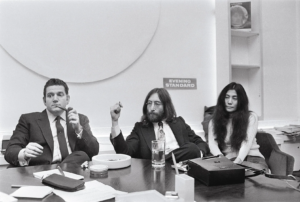
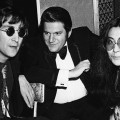
“Hey, we’re in the best position in the history of showbiz. Now watch us fuck it up.” Allen Klein, John Lennon and Yoko Ono, 1969.
Allen Klein has, unsurprisingly, been a frequent topic of this blog (to begin with: here, here, here). This morning I read a Great Thought claiming that Paul McCartney gets too much credit for filing his lawsuit to dissolve the partnership; far from “saving the Beatles’ legacy” as is now frequently claimed, Paul was simply looking out for his own narrow interests, the commenter said, and following the advice of his in-laws, the Eastmans, who were prominent entertainment lawyers.
Paul certainly was doing those things; but he was also concerned about the Beatles’ legacy, and keeping Allen Klein away from it.
If Paul gets praised today, let’s remember that he was certainly NOT praised for any of this in the 1970s. In fact, he was considered a villain, the prime mover behind the breakup of the group, and this opinion was encouraged by the other Beatles, and Klein too. It is to John Lennon’s detriment that he didn’t step in immediately and take the heat off his ex-bandmate. Yes, in Lennon Remembers Lennon talked at length about how he was the first to leave—in a sort of “you can’t fire me, I quit!” macho way—but he never actively shielded Paul from heartsick Beatles fans’ antipathy. I’d guess this was because 1) he desperately wanted to sell more records than his former bandmates, and keeping on good terms with Beatles’ fans was part of that; and 2) it fit his “Paul is a big-headed phony money-obsessed jerk” narrative of the period 1970-72.
As a sidenote, it’s interesting how Lennon seemed to want the fans to think of enjoying his music as “graduating” from the Beatles’ teenybopper sound to his more mature work. But aside from the therapy-0n-vinyl Plastic Ono Band, I don’t experience solo Lennon—Double Fantasy very much included—as “more mature” than solo McCartney or Harrison or Starr. We must remember that John was always spinning stuff. Far from Macca being “the world’s greatest PR man” it was Lennon and Ono who were obsessed with shaping public perception through granting access and getting friendly coverage. And that was the same in 1970 and 1980. To the very day he died, John Lennon never stopped massaging the narrative.
But back to Klein. Where I come down on this is simple: if Allen Klein had been able to convince all four Beatles to allow him to represent them, sooner or later, he would’ve ended up controlling their publishing rights, ABKCO or some Klein-controlled shell company would’ve been set up to interpose between the record company and the guys, and J/P/G/R would’ve ended up broke. I did a little light Wiki-reading on Klein this morning, and it all basically boils down to this: what he did well—negotiating, and ferreting out discrepancies in record company accounting—could have just as easily been done by others. That these services weren’t common in 1963, or 1967, or 1970, was simply a case of the buttoned-up legal/financial worlds being a bit behind the times. To his credit, Klein saw an opportunity, a hole in the market, and he took it. He could’ve simply provided those services, and would’ve made a very nice living doing so.
But Klein came out of the pre-Beatles rock’n’roll swamp, where sleazy Mob-adjacent managers regularly screwed their clients, and his behavior consistently reflects these anti-artist values. Getting a better royalty rate doesn’t count if the royalties end up in your pocket, not the band’s. Setting aside his treatment of Sam Cooke (and the mysterious death of same), his practice of creating intermediary shell companies to collect payouts owed to his artists, then paying them the proceeds over time “to avoid taxes” is sleazy in the extreme. Not only was Allen Klein surely earning a return on those sequestered funds as the years passed, the Stones’ whole “tax exile” situation of the early 1970s occurred because Allen Klein wasn’t even paying their taxes on time.
Yes, he got the Stones a big advance, and everyone was jealous, The Beatles surely most of all. But it came with strings; here’s from Wikipedia: “The Rolling Stones’ $1.25 million advance from the Decca Records label in 1965, for example, was deposited into a company that Klein had established, and the fine print of the contract did not require Klein to release it for 20 years.” Assuming only a 3.6% annual return on that money, Klein was literally giving the Stones back their own money, at no cost to himself. In addition, his “management” of The Stones resulted in him, Allen Klein, not the guy who wrote any of the songs, owning the publishing rights to their songs from 1964-71.
Any fan who has a problem with Brian Epstein’s management of the Beatles should absolutely loathe Allen Klein. Brian was in over his head when it came to merchandising; Klein was actively a crook who employed a distinct, signature, replicated method that screwed his clients.
“He may be a bastard, but he’s our bastard.”
So if Klein was a crook, and by 1969 widely known to be so, why did Lennon advocate for him so fiercely? Well, when you read John’s statements at that time, it’s all very much about Klein’s being similar to John—or who John wanted to be at that time. Lennon cleaved to Klein because he was, like John, “a working class hero.” Klein, Lennon said to George after that first meeting, “knows me better than you do!” Klein was blunt and vulgar and a man of the people fighting the corporations—all of which was a total load of horseshit, except for the vulgar part. Klein was the son of Jewish immigrants (a lot of people in New York in 1969 fit that description) who was smart and worked hard and made good, moving out to the leafy New York suburb of Riverdale, in the Bronx. He flattered John, flattered Yoko, and after one meeting, John was hooked. (It is not recorded what Allen Klein said about heroin, but probably that “it was for artists, in very great pain because they are geniuses.”)
I have always half-suspected that Jagger didn’t warn The Beatles because he knew Klein was poison and wanted to see them split. But maybe that’s uncharitable of me.
Once Lennon was hooked on Klein, the choice was stark. The other three must sign, or have the group split up—the Beatles as they existed before Klein could not have carried on with two managers, for a million reasons speedily proven. George and Ringo chose the former, Paul chose the latter. And I believe Paul chose the latter because he thought that what was happening to the Stones would eventually happen to the Beatles’ too.
That was intolerable to McCartney, but did Lennon even care? The thing one must remember is that during the period of 1969-73—the entire time of Lennon’s relationship with Klein—he was down on The Beatles. People often spoke of Lennon’s tendency to suddenly start a new thing, and totally forget about the old. That can be laudable in an artist, but it’s terrible for anyone charged with protecting a legacy. And we must also remember that during that period, people really did believe that “the Revolution is just around the corner.” I can very easily see Lennon convincing himself that he didn’t care/it didn’t matter if Klein took that old Beatles stuff or not. Especially after he’d signed, and publicly praised Klein to the heavens.
Paul’s dislike of Klein—and his relationship with the Eastmans—gummed up the works so that Klein couldn’t do his usual strategy; and then Paul’s suit made things even more complicated. This bought enough time for the other three to realize that Klein wasn’t anyone’s bastard but his own.
There is nothing to suggest that John, Paul, George or Ringo were more savvy businessmen in 1969 than the Stones had been four years earlier, and so if Klein had not faced resistance, I see no reason to think that he wouldn’t have been highly motivated to screw The Beatles in exactly the way he’d screwed the Stones. Or maybe he would’ve come up with some all-new, bespoke way to do it. And the thing is, if you’re having to sue your manager who’s set up a holding company to collect your royalties as you earn them, you have no money to hire lawyers with. It’s a diabolical bind, and very common in the arts. I’ve been there myself.
In the end, not only did they have to give him $5 million to go away, Klein cost them millions, and perhaps billions, of dollars. How much would five more Beatles LPs have generated by now? Or even ONE more? Without Klein, there would’ve been no impediment to reuniting occasionally—or not splitting in the first place.
Peter Doggett, who has forgotten more about The Beatles finances than I’ll ever know, has written, “Nobody in the Beatles milieu has received a more damning verdict from historians than Allen Klein.” I would say that I’ve never seen, heard or read anything to suggest that Klein’s terrible reputation is anything but completely deserved. Klein was terrible manager of talent, and a crook besides, and anybody who thinks otherwise needs to grapple with something blindingly simple, and irrefutable. Brian Epstein, that “terrible businessman,” knew that the real money isn’t in an increased royalty rate, it’s keeping the world’s most popular group happy and making new music together.
But because Klein came from the pre-Beatles era of disposable pop, created by temporary acts riding temporary crazes, he couldn’t see what his job really was. Klein isn’t a villain in the Beatles story because he swore a lot or wasn’t a hippie or Paul didn’t think he was smooth enough—he’s a villain because he didn’t love The Beatles. To manage The Beatles properly, you gotta love The Beatles; Klein didn’t. A 2016 biography suggests that he loved and respected Lennon—but I would replace those verbs with the word “enabled”; Klein buttered John and Yoko up, so they would do what he wanted. Encouraging your client to leave the biggest act in showbiz history is madness, especially if that client is determined to change the world through situationist stunts. The Bed-Ins were on the news for one reason: because John Lennon was a Beatle. But John couldn’t hear that, and Klein wasn’t going to tell him. (Brian would’ve, I think.) For his own short-term gain, Klein exacerbated the tensions driving the group apart.
Klein sucks, because every big act he managed either died under his care, ended up in court against him, or both. With all due respect to his relatives and the people who loved him, nothing I’ve ever read suggests that Allen Klein was anything more than a sharp accountant who likely hated the people he “managed.” He was certainly no friend to The Beatles, or their fans.
(And I’m not even gonna get into “Bittersweet Symphony.”)
Related posts:
 Try it, you might like it
 Four In Hand by John Lennon
 Psychedelia in the UK: "A Technicolor Dream"
 Beatles For Sale sessions
 Ian Leslie: “Notes on Peter Jackson’s Get Back”
 Allen Klein Playboy Interview, 1971
 Various musings on Lennon and Addiction
 More on the breakup…
 Shepard Fairey George Harrison Poster
 That was your first mistake
 Sid Bernstein obituary
 A John and Yoko movie?
Here here Michael. Klein is without a doubt the biggest villain in the Beatles story. Or am I forgetting someone?
Interesting to hear your quick take on Jagger. While I don’t discount it, I seem to recall that Mick/Stones were still attempting to disentangle themselves from Klein and he (Mick) was thus wary of angering Klein by being the person who dissuaded the Beatles from signing with Klein. Now, I still think a mate should forewarn another mate about a lecherous parasite such as Klein so I think I do fault Mick somewhat for this.
Re: the Eastman’s. I do sympathize with J/G/R being a tad bit concerned signing over their business to Paul’s in-laws. I totally get that. I also think the Eastman’s would’ve been perfectly adequate as stewards/managers of the Beatles but it’s a shame nobody could find a third party who wasn’t Klein or a family member to helm the most important act in show-biz.
So happy this blog is back!
@Craig, Happy to be back!
There were probably a hundred, certainly fifty, business people in NY/LA/London who could’ve untangled Apple, set the Beatles’ affairs on their feet, and negotiated the SHIT out of a new contract with EMI. Everyone and their mother would’ve wanted that gig, and not groovy people, but serious experienced, square businessmen; Paul was right when he said that there was no need to pay Klein 25%. I believe in the Playboy interview, Klein himself said there were people who’d do it for nothing. The important point was that there were so many more options than obvious shyster Allen Klein, and Paul’s new in-laws. Think about it this way: the kind of expertise The Beatles needed was so thick on the ground that the rock photographer Paul married happened to have a father and brother who could do it.
So why didn’t they look around? Partly because it was more fun being a Beatle, partly because of the times. I doubt The Beatles would’ve been bankrupt in six months — but even if Apple had crashed and burned in that fashion, the real money was in future earnings, which was Klein’s leverage on EMI.
Following his return from India, Lennon particularly began parroting the countercultural line that all businessmen were bastards. For example, in the May 11th, 1968, press conference announcing Apple, he says, “It’s a business concerning records, films, and electronics. And as a sideline, whatever it’s called… manufacturing, or whatever. But we want to set up a system whereby people who just want to make a film about (pause) anything, don’t have to go on their knees in somebody’s office. Probably yours.” This last swipe makes no sense; the people who’d asked him the question were journalists, and neither journalists nor the readers of their publication would be having begging artists on their knees in somebody’s office. Lennon’s comment was one of the first media appearances of Everybody’s Always Fucking Me Lennon, a persona he would wear off-and-on for the rest of his life.
With the exception of merchandising, John Lennon in 1968 had not been ill-treated by businesspeople; I’m sure he wished he’d made more money, and we all agree he probably deserved a lot more money, but by the standards of the time, the Fabs hadn’t been screwed. This is so important to remember when discussing Brian Epstein: Bad management, bad record deals, these things DESTROY people. The way the publishing business treated me from 2005-2010 nearly destroyed me; I got out alive, barely, but stopped writing books, my life’s dream. Read about Badfinger, for a bad time. Jimi Hendrix’s manager was so awful one of his roadies thinks he actually killed Jimi for the insurance. No, what we are hearing here is Lennon spouting off-the-rack Angry Hippie Bullshit. Certainly by mid-68, there’s a lot of this floating around the counterculture, causing a lot of bad decisions. It’s why the Stones hired the Hell’s Angels to provide security at Altamont, instead of…literally anyone else.
So, one, Lennon’s paranoid about businessmen because of fashion. Then, after Apple had introduced legions of leeches into The Beatles’ circle, in January ’69 Lennon said this to the press: ““We started off with loads of ideas of what we wanted to do — an umbrella for different activities. But like one or two Beatles things it didn’t work because we weren’t quick enough to realise we need a businessman’s brain to run the whole thing. If it carries on like this all of us will be broke in six months.” Lennon may have hated businesspeople, but the moment he thought he might have to live like a prole again, the cold sweat came.
Klein smelled his fear, and made a meeting, wherein Lennon straight-up told Klein he was afraid of ending up like Mickey Rooney, a broke show-biz has-been. Klein played on that fear.
Lennon felt desperate, which was one source of his bad judgment regarding Klein. But to use him, John (and Yoko) had to convince themselves that Klein was some sort of countercultural ally. John’s fear, and Klein’s sucking up to Yoko, made that easy.
But I also think Lennon picked Klein because he knew it would drive Paul crazy. Because by the time they’d met Klein, Lennon was well into the spiral that caused him to break up the group by mistake. I’ve long held a theory—maybe first put forth in comments on Dullblog, though Mikal Gilmore was working similar territory as of 2009, that John Lennon broke up the Beatles in an escalating series of emotional outbursts designed to get a reaction, but that he didn’t expect to really break up the group for good. Hiring Klein should be viewed as part of this series of actions, which began with his flipping out on the Air India flight, and didn’t simmer down for years.
Sadly, Klein turned out to be the one thing that really did break up the group. Saying “I want a divorce” is a hot-headed thing to say by the group’s beloved hothead, a guy who once announced he was Jesus. But introducing Allen Klein into the mix couldn’t be taken back, and unless Paul was willing to be in business with ABKCO for the rest of his life (and would you be?), he had to sever the partnership agreement, thus ending the group.
Glad to see your thoughts
Can you or anyone give an explainer, or a link to an explainer, about how Klein ended up owning the Stones’ publishing? I’ve never quite understood it
Also you mention the possibility they Paul wouldn’t sign with Klein cos of what was happening with the Stones. Was it known at the time by people outside the Stones, or is that an educated guess?
Thanks!
@Tony, how it seems to have worked is this: Klein would agree to purchase the band’s interest in all their music — like, say, the songwriting royalties due to Jagger/Richards in exchange for some flat fee. Then that money would be held in escrow and doled out to the band in pieces, so that (according to Klein) they would pay less in taxes). Basically ABKCO would be interposed between the label and the artist under management. This was a TERRIBLE idea, because 1) Allen Klein was better at squirreling away money than you were at finding it; 2) you’d have to PAY someone to find it, sue Klein, or both — which made it all a considerable gamble, likely more than the royalties themselves; 3) how could you finance a fight with Klein if all your royalties were going to him?; you had to trust Klein to pay your taxes on time and in full, which he didn’t; and 4) the moment any legal fight would commence, all the major activity of a band would become either impossible (who would fund a tour? who would pay for studio time?) or extremely risky — anybody getting involved with the Stones when they were fighting Allen Klein would likely become a part of that lawsuit. Klein not only arranged for royalties to be paid into companies he controlled, he also was the publisher of the Stones’ music, and he arranged their tours.
I’m not plugged in enough to the music business to know how different this was from what Prince Rupert Loewenstein did for the Stones after 1970, but I suspect the main difference is that the entities formed to collect and disburse the Stones’ money were owned by them, not by Loewenstein. That to me is the big red flag with Klein.
As I said in an earlier comment, London/NY/LA was full of businesspeople who could’ve done what The Beatles needed doing; Prince Rupert Loewenstein shows that. But Lennon especially would’ve never worked with someone like that, a merchant banker, “a fat-cat sitting on his arse in the City.” So that made him, and his group, susceptible.
Since Jagger was disenchanted with Klein in 1968–before Lennon had his meeting–I think it’s rather likely that his disenchantment was known by the Fabs, and among the other members of that set. But a cursory perusal suggests that Jagger, preparing his own group’s departure, did not want to tip his hand by warning The Beatles off. I personally don’t buy that. I personally think that the Stones and Beatles had been friends long enough that Jagger could’ve said, “There are better options” instead of what he was reputed to have said, “Klein’s all right, if you like that sort of thing.” I think Jagger felt that Klein having The Beatles would satisfy him enough to go easier on The Stones. But that’s not the psychology of someone like Allen Klein. Whom I am being very hard on but, c’mon, the guy left a fucking trail of destruction. With Sam Cooke, The Stones, and The Beatles, the common denominator is Klein.
Hey there…I know it’s off-topic for this thread, but did you see where there’s a new mystery novel with John and Yoko in the detective roles? It’s called Imagine Murder and it’s by Dean Thompson, who was a member of John and Yoko’s staff. It takes place in 1972 and depicts John and Yoko investigating the murder of a staff member of their film company. I haven’t gotten around to reading it yet, but it’s on the library app Hoopla if you have access to it. You might be interested in reading it/reviewing it for the blog.
“But Mother, I left the packet of FALSE heroin under the issue of Red Mole. But when I came back, it was gone!”
“Which means—“
“That someone let themselves in, searched the living room, and…IS STILL HERE!!!!”
“..:or you’re hallucinating.”
“Yes, well, obviously. But what if I’m not?”
Okay, I’ve read it. I think the blurb mischaracterized it a bit…John and Yoko are sort of peripheral figures at most. The narrator and main character is named David Johnson, an employee of Joko Films, and he’s an obvious self-insert for the author Dean Thompson. The focus seems to be more on the rather way-out employees of Joko Films. (One regular occurrence is for David to take calls from nutcases proclaiming that the end of the world is going to occur on a certain date unless John/The Beatles perform on that date. Nutcases. Plural.) As local color it’s pretty good, as a murder mystery it’s not all that much to shout about. But I’d still welcome your own review.
The Village in the early 70s has got to be a GREAT setting for a murder mystery.
In the author’s defense, John and Yoko would be damnably difficult characters to write, because to make them interesting, you have to make them change. But if you make them change, they don’t seem accurate to the John and Yoko the reader “knows.” In other words, because they were both already authors of their own (somewhat fictitious?) characters, they don’t leave an author any space to play.
I recently saw the Jason Statham film “The Bank Job” and Lennon (played by Alan Swofford) appears very briefly, and with no dialogue. Maybe that’s the easiest way to portray him.
Although John with nothing to say doesn’t exactly seem historically accurate!
Allen Klein was not a good option, it is clear, but was Linda’s father a good choice instead ? I read somewhere that apparently he wasn’t a white knight either, for example it appears he screwed a band, unfortunately I forgot the name of this band, if someone can help me to find it.
@Ben, I have no special information pro or con on the Eastmans, but I think if you look at Paul’s career from the time he’s been associated with that family, he’s really been golden. I assume they’ve been managing his affairs since 1969.
That having been said, can I understand the other Beatles (especially John) not being keen on having Paul’s father-in-law as their manager? Yeah. But for as long as they were Beatles, what was financially best for Paul was likely financially best for the other three. John Beatle would not have been harmed by following advice the Eastmans gave Paul. The sticking point is that John circa 1969 imagined a bright beautiful future for himself and Yoko, and wanted to be represented by someone hip enough to dig climbing into a bag. That wasn’t Allen Klein either, but he was canny enough to see that was what John wanted, so that’s what he told John.
By 1969, the counterculture was FULL of wolves. Klein, it turns out, was one of them.
Thank you Michael, the thing is, from the start, the death of Brian Epstein must have weakened the cohesion of the band. But I think you are right in the whole, apparently in the new documentary on Netflix, we can hear Lennon says “Maybe Paul was right” or somehing like that (I don’t know when and under what circumstances) but we must not forget that McCartney seemed happy with Klein in the beginning. This story is very complicated and I wonder how Mark Lewisohn will manage to put the pieces together in his book. Sure paul was right to follow Eastman, after all, he’s now billionnaire. Oh, and I recover the name of the band : it was Grand Funk Railroad.
@Ben, perhaps it was like siblings after a beloved parent dies — as long as Mom or Dad is alive, the dynamic is sorta all the kids are equal, and focused upon the push-pull with the authority figure. But when Mom or Dad goes, then it’s just four people, all equal but some more equal than others, each trying to do their own thing, or get everyone to do THEIR thing. A mess.
Given Lewisohn’s meticulousness, his dislike for using assistants, and the economics of the book biz (he’s having to do stage shows as side-gigs to fund his research), I would not be shocked if we never get a Volume 3. We may not get a Volume 2. Seriously, every Beatles fan should be praying for Mark Lewisohn’s health and finances; he’s one final example of that Perfect Beatle Luck.
A quick perusal of their Wiki suggests that John Eastman didn’t actually screw GFR, but may have given them bad legal advice, in that they could’ve waited out their contract with their original manager, Terry Knight. However, this reading is the opinion of their original manager, Terry Knight…so? Relevant bit is down below:
“In VH1’s Behind the Music Grand Funk Railroad episode, Knight stated that the original contract would have run out in about three months and that the wise decision for the band would have been to wait out the time.[14] However, at that moment, the band members felt they had no choice but to continue and fight for the rights to their careers and name. The legal battle with Knight lasted 2 years and ended when the band settled out of court. Knight became the clear winner with the copyrights and publisher’s royalties to every Grand Funk recording made from March 1969 through March 1972, not to mention an enormous payoff in cash and oil wells. Farner, Brewer, and Schacher were given the rights to the name Grand Funk Railroad.”
Just a small comment about this topic : do you think Lennon used the label Beatles to promote his new couple with the song “The Ballad of John and Yoko” as a kind of revenge against McCartney and the fact that the latter prefered to choose the Klan Eastman against the Lennon-Ono’s choice for Allen Klein ? I am not an expert, that’s why I ask these questions. And yes we should all pray for Mark Lewisohn’s health, he may be the only one to set this whole story straight, by the way I think this is what gave him first the impetus to begin this very ambitious project, he was frustrated by all the books written by other authors for being, according to him, too inaccurate, full of errors, unfortunately we may not be able to see the end of it.
@Ben, absent a statement from Lennon or Ono, I don’t think we can make that direct connection. Lennon clearly wrote the song to promote his and Yoko’s political activities, but that’s all we can say. My middle-aged brain could be forgetting something, but I’ve never read that “The Ballad of John and Yoko” was related to the Klein situation.
I generally support looking at The Beatles as a collection of four people, interacting as old friends do, with all the pleasures and pains of same. But there’s a real danger in trying to “decode” the narrative by assigning emotional motivations in a granular way.
This is from the book, ‘many years from now’, by Barry Miles. Definitely biased toward Paul, but believable.
This to me suggests that, as I’ve mentioned before, hiring Klein was part of Lennon’s efforts to break up the group. See also: JohnandYoko, “Two Virgins,” etc etc and ad nauseam, from the Summer of ’68 onwards. Doing stuff McCartney couldn’t agree to, without putting his own work at risk. After Yoko comes on the scene, John treats his Beatle legacy like a mere lead-up to the real genius to come. Paul, for all his flaws, at least recognized that protecting their work was important.
You can already hear John justifying himself in that irritating “man of the people” way he’d use so often before Yoko threw him out. That Klein, friend of the downtrodden, deserved to face his accuser. But that’s just my imagination, so forget I said it.
@Michael I think it was a game of chicken to get Paul back in line as the number two, and/or to fight for John, and/or to break up the group, i.e., several slightly different things often all at once. I don’t see the evidence that between mid-1968 and 1973 John really knows what he’s doing in that calculated a way. I think post-18 months of acid, post-India, post-whatever happened in New York in May 1968, the unease in John’s soul turns into both “I need Paul to choose me, JOHN LENNON, and I also hate how small he has made me feel”, and also “I can’t handle this, I need heroin.” That’s just the impression I have the longer I look at his actions, and it feels like Yoko and Klein both stem from those things — both of them will piss off McCartney, force him to submit in some way to John’s authority, and enable John’s web of addictive behaviors to continue unabated.
Increasingly I see speculation online that something happened not just in India (or in India at all) but in New York, which is where Lennon supposedly first sees Linda and Paul together, in a limo on the way to JFK. It certainly is odd that within 48 hours of returning to London he announces he’s Jesus and then becomes inseparable from Yoko. And isn’t bringing Yoko to the white album sessions (starting that following week!) the same deliberately destructive behavior as insisting on Klein?
“I think it was a game of chicken to get Paul back in line as the number two…”
Something just occurred to me: Was John frightened by what he saw happening to Brian Jones?
I know John watched Mick and the Stones very closely. So when he saw the fall of Jones and the rise of Jagger, did he think (perhaps subconsciously) “I’d rather destroy this thing we built rather than suffer the same humiliating fate” ?
An interesting question, but I never got the impression that John saw any of the Stones as equals, least of all a non-songwriting Stone. Nor did the Beatles have the same kind of ruthless, Lord of the Flies-style band dynamics that the Stones did, where it seems inevitable that either Brian and Keith were going to need to grind Mick into pieces (impossible, when Brian and Keith were junkies), or Mick and Keith do the same to Brian. Paul, John, and George were friends who loved each other. Mick, Brian, and Keith, whatever they were, do not seem to have loved each other like that.
“Paul, John, and George were friends who loved each other.”
…which is why the group broke up when it did, and why The Stones never had to.
“An interesting question, but I never got the impression that John saw any of the Stones as equals…”
Believe me, I know the Stones weren’t in the same class as the Beatles, either music-wise or power-wise, and never ever were.
But John saw them selling records, and he saw what Jagger did to Brian Jones. Obsessed as he was with status and hierarchy, maybe his worst fear was waking up one sleepy morning to a group called “Paul McCartney and The Beatles” by the fans.
Yeah, I bet that was a fear of John’s, @Baboomska, and I’ve never really thought of it that way. Thanks for the insight.
I think post-India John felt a lot more insecure within The Beatles than any of us outsiders could ever imagine. Crazy to think, but he sure does act like a guy who’s insecure.
A good point, and like Michael Gerber, one I hadn’t really thought of. It seems plausible. I think I’ve posted somewhere on here before (or maybe I’ve just *meant to post*) that by 1968, John Lennon is the only one of the people who founded and led major band who isn’t completely sidelined – Brian Wilson and Brian Jones did not really survive 1967, and Bob Dylan at least metaphorically crashed out and was trying to figure out a way forward that didn’t kill him. John’s acid reverie is maybe his version of the “motorcycle crash” but McCartney/Epstein/George Martin/the Beatles family seem to have cushioned him from something as drastic and life-threatening as what happened to Dylan.
Anyway, that’s a long way of saying – thinking about it more, it does sound plausible that he would be. Especially, perhaps, once he gets to India and isn’t constantly trying to destroy his ego.
I think you’re right; John started an escalating game of chicken. With phases based on (devolving) circumstances and John’s state of being.
Post-India Yer Blues White sessions John needed propping up and a buffer between he and Paul. With Yoko as a life preserver more than calculated provocation. But John definitely ran with the provoking.
So we get John yanking Paul off a vocal for Yoko, Yoko inserting her commentary but also lots of time apart in separate studios.
With Get Back, John limps in prodded by Yoko, heroin and mind games—and minus the bag of songs he brought in ‘68.
Now we have everyone in the same room, on camera, with Yoko sitting between John and Paul, Yoko grabbing the mic and Yoko speaking for John.
John plays the sex tape the day before sessions begin, a mic drop of intent: How far back on your heels can I drive you, pal?
Phase II, heroin encroaching, is where John gives himself a second vote and tries to install Yoko in The Beatles with no one’s consent but hers.
By the time John asks for a divorce, does he know from up?
I think John meant to knock Paul down some pegs, not break up the band. After months of deferring to Yoko, heroin and Klein, Paul was such a wavering figure I doubt John could formulate him walking away.
For a crucial period, it looks like John was persuaded any Beatles future should follow his dictates, as the outfit’s messiah.
Which makes it even sadder if the hints John dropped for months in Instant Karma, interviews, etc., were sincere efforts to reel Paul back in.
The more I learn, the more I suspect it was genuine.