- Little Help From Our Friends? - September 2, 2026
- A quick yawp from Mr. History - August 24, 2026
- First Thoughts on “The Beatles – A Four-Film Cinematic Event” - August 17, 2026
(I just wrote some of this in a comment responding to @Paul, and while the sentiments are ones I’ve expressed before, I expressed them particularly succinctly here, and so wanted to surface them as a post, in hopes they’d elicit some discussion.–MG)
I‘m staying with a friend of mine who is getting over a stroke, and she doesn’t know much about The Beatles. I mean, she knows plenty, but she doesn’t KNOW about them like you and I do. So after she told me her favorite Beatle was George, we took a couple of nights to watch Martin Scorsese’s Living in the Material World, which reminded me just how much source material we have on John, Paul, George, and Ringo. How much footage. How many recordings. How many paper interviews in the historical record. It’s a trove of almost limitless richness; I cannot think of any human-sized chunk of contemporary history that has more source material. The story of the men, the group, their music, their times — it’s all available, for anyone who wants to delve into it.
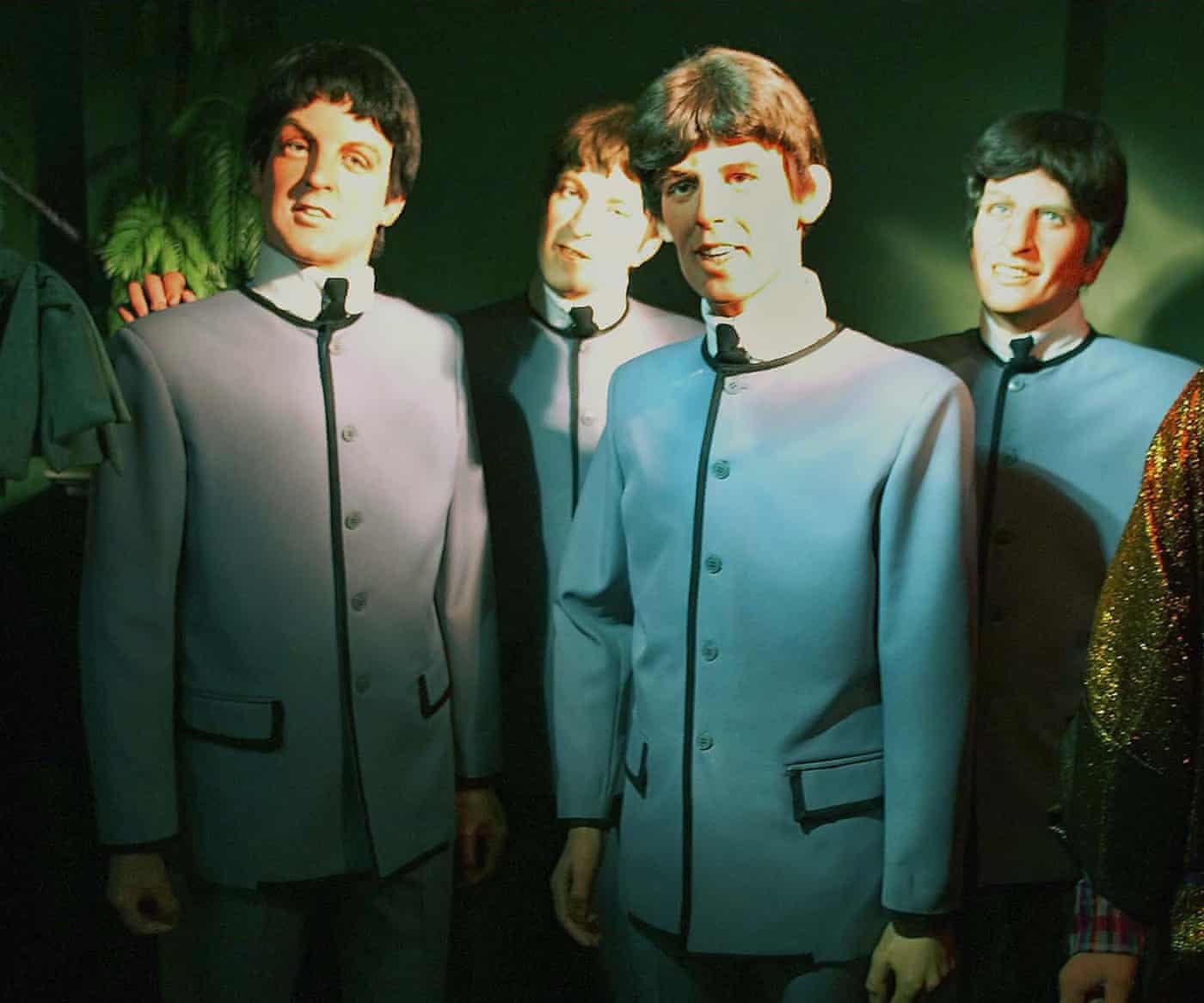
Which brings me to why these upcoming Beatle movies give me the heebie-jeebies. Running “The Beatles” like a bunch of IP that can (and must!) be refreshed for each new generation misses something really important: The Beatles were real. Flesh and blood humans, who risked all and succeeded beyond their wildest dreams, found paradise then found it wanting, and lived for decades trying to figure out what had happened to them. J/P/G/R are not the Marvel Cinematic Universe; they are history. They were people who did things and didn’t do other things; had opinions; made mistakes. Their real selves and real lives we largely know, because they were obsessively recorded for commercial reasons; who they were and what they did isn’t something to be remixed or retconned for money. The data is there, and accessible, and shouldn’t be purposely corrupted simply because we’re bored.
Since I am now 57 and well on my way to becoming history, I spend most of every day thinking/worrying about things like this. Our culture’s turning away from history — both the study of, and the manufacture of via scholarship — in favor of religion and mythology (which now encompasses everything from pop culture to advertising to conspiracy theories) — seems to be leading us into a very, very bloody and short-sighted era, one that AI, CRISPR and nuclear technology may make our last. The US government is actively suppressing history it doesn’t like in ways usually reserved for totalitarian regimes; and universities are being strong-armed in every possible manner. But this is only possible due to the cultural weakening of history which has taken place over the last generation.
History — a shared national and international effort to discern truth via research, then distill it into useful, respectful stories — was central to the postwar world; and one discernible difference between the West and the Eastern bloc was a diversity of historical opinion as close as your local library. I could, and did, read history casting JFK as a bellicose Cold Warrior responsible for the Cuban Missile Crisis; I also read other books which cast him as pretty much a peace-loving martyr nearly on the scale of Jesus Christ. Both could not be true; one had to sift the data, read through the politics, and make up one’s own mind, valuing the quotidian as much (or more) than the sensational. This process was the opposite of how information is handled today, but it was probably the West’s commitment to a idea of “reality” more powerful than politics that made it victorious in the Cold War. When I matriculated at Yale in 1987, History was the single most popular major; this didn’t mean Yale produced 1000 historians every year, most grads went into law and business and politics. But it meant that those lawyers and businessmen and politicians had at least a glancing knowledge of, and presumably respect for, history. Meaning, stories which restrained them, broadened their view, and made them acknowledge things greater than the individual chase for wealth and power.
Today, the most popular major in New Haven is computer science. Because (need I say this?) that is where the money is, both upon graduation and for the Alumni Fund.
I’m sorry to say that my generation has treated history mostly as a cudgel, a weapon to advance this or that political agenda, probably due to the blight of relativism that emerged in the Seventies and was very strong by the Nineties. If there is no sense of the real, of shared reality — if history is all bias and point of view — if it is simply the opinion of the powerful, as it was in the USSR — then history really is no more important than the never-ending battle between Magneto and the X-Men. And we can see exactly where this notion is leading the world.
In an era flooded with propaganda and every other kind of lie–amplified by privately owned social and other media–it falls to individuals to defend the old values. This is a new responsibility, and one that most people really aren’t equipped for. Most people over 50 grew up assuming that was the job of “gatekeepers.” Now, we’re all gatekeepers. Here’s an example: in the course of doing my book based on John Lennon, I found myself developing a quite plausible (to me at least) alternative theory of his murder. It’s not so different from other theories you might’ve heard, but a lifetime of reading in some fairly esoteric areas, allowed me to fill in lots of gaps. I have…talked around…this theory on this site, allowing others to swim in those fetid waters, usually after long phone calls where I have “spilled the goods.” I will continue to do this, because I don’t feel there’s anything to be gained by my adding another voice to the chorus of conspiracy-minded folks. Even though I really reject the whole paradigm — today’s conspiracy is sometimes tomorrow’s fact — I’m going to continue to resist the urge, so amply rewarded by social media, to opine on this particular True Crime. We have grown sick on such stuff, and I consider Beatle-people my tribe. Will I speak on other people’s theories? Sure; to some degree, that’s what this blog is for. But when it comes to the murder of someone who means a lot to me, and probably means a lot to you, the risk of making everything a little crazier, a little more speculative, a little darker — it just isn’t worth it.Not least because how John Lennon died isn’t nearly as important as what he was, and what he gave us.
Feeding The Beatles — the real people, the real story, the actual provable reality — into the myth-making machine is a symptom of a very misguided age, one that, so far, has simply not shown itself intellectually prepared or courageous enough to guide our species. That’s really what history is for, a set of agreed-upon stories that help us navigate the present and future with wisdom. What is short-sighted, greedy, small? What should be avoided? History tells us, and that’s why oligarchs and others determined to act in short-sighted, greedy, and small ways despise it so. You cannot be Elon Musk or Peter Thiel or any of the other brilliant morons infesting our era and read history; because history would tell you what happened to Crassus. (Hint: he did not retire to Mars.)
Far from ushering in a new era of enlightenment, the internet has made our age dumb and grubby, and placed dumb, grubby people at the pinnacle of power. Dumb and grubby is really the opposite of who The Beatles were, and what they stood for. The Sixties were a hair-raising time, full of conflict and species-wide near-misses, and it took all the wisdom we could muster to get through them. In addition to creating amazing music, The Beatles were consistently on the right side of the major issues of their day, and spoke more wisely and clearly than anyone had a right to expect them to.
The real guys were really extraordinary; for that reason alone, we should resist the corporate urge to remix them, as if who they were in their time isn’t interesting enough, or something young people won’t relate to. There is plenty enough truth to craft drama from. We know the real John Paul George and Ringo, and they were absolutely great. That should be enough to keep them as au courant as they need to be.


I agree with you about the replacement of verifiable history with fantasy (I’m getting flashbacks to my old post about Jude Sutherland Kessler’s books about John Lennon, which she touts as nonfiction despite incorporating made-up dialogue and inner thoughts). I’m hoping that the movies et. al. awaken more desire in some people to dig into what is documented to have happened, but who knows.
@Nancy, Jude Sutherland is a perfect example of what I’m talking about. If she’s making up dialogue and inner thoughts, she’s writing fiction. That’s what fiction is. It doesn’t matter how plausible your additional material is — how extensively researched. At best it’s calling a bunch of suppositions “facts,” at worst it’s literally speaking for lots of people you cannot speak for. Her whole literary project — a day-by-day reconstruction of John Lennon’s life — requires fictional material as the mortar between the bricks.
I haven’t read the books, but here’s from her Goodreads: “Written as a novel, this is not a work of fiction, but a “fly on the wall” account of Lennon’s life.”
It’s a bit of sophistry. I think the project is a tremendous undertaking and, as a Lennon fan, am delighted she’s doing it. As fiction, it’s ambitious, harmless, interesting, and potentially revealing. But when you say “it’s not a work of fiction,” either 1) you’re misguided, and using your own idiosyncratic definition of fiction that is not the standard one because you don’t realize the distinction is important, or 2) attempting to differentiate your work in a crowded marketplace by being more than a little dishonest about what it is. Sutherland clearly adores John Lennon, as many of us do, but an intense parasocial connection doesn’t give a person the right to speak for him. No matter how intense or intimate the connection feels.
The sad thing is, if the work is excellently done, it will find its audience regardless of what you call it — the sophistry isn’t necessary. Colleen McCullough’s books set in ancient Rome spring to mind. How are those any different from Sutherland’s books? I think primarily because Sutherland feels her connection to Lennon to be more intimate and personal than McCullough felt hers to Cicero, Caesar, and the rest of the SPQR gang. The claim of “this is history,” is a claim of authority, yes, but also of intimacy, and I think it’s the craving TO KNOW that is driving a lot of these latest generations’ rejection of history. History is a cold art, practiced at a distance. Authors like Sutherland don’t want that, and their fans don’t want it either, and since these books are in some sense about the marketplace, the claims aren’t challenged. It’s similar to fan-fic in that way. What does it matter, right? Cumulatively, I think it matters quite a bit.
I once considered creating an entire online skeleton key to Life After Death for Beginners, showing all the sources and connections that underpinned the novel, the whole paranoid symphony. “X person is this guy, and he says y because in real life he said z.” That would’ve been interesting to some I’m sure, but it wouldn’t have made my book any less fictional. And one of the reasons that I do not promote the book is how at a certain point I got very uncomfortable with precisely this territory — if I was really asserting something, I felt I should stand behind it as history, but if I was just inflating my own parasocial relationship with a long-dead rockstar that I admired, it was “merely” fiction.
Lennon is a particularly difficult person to fictionalize, because he was so changeable and also so prone to using the press to present a line of argument as “the truth.” He neither felt he had to be consistent, nor did he feel that the press or public was owed the unvarnished truth about anything relating to him. He felt that people who believed what they read in the newspaper were idiots. So he was constantly corrupting his own datastream, as it were. My sense after all these years is, were a writer able to channel John Lennon perfectly, the resulting character on the page would be equal parts attractive and unattractive. So from where I sit Sutherland is in a bind — if her Lennon is appealing, as the real guy often was, her books would please fans and sell; but if her character also embodies Lennon’s genuine darkness, fans will throw the book across the room and accuse her of all manner of things. It was the same bind Albert Goldman found himself in, and before we dismiss his book, it’s never been sued by anyone, and its portrait of John, so shocking in 1987, has in large part become incorporated into the historical figure.
I understand WHY a Beatle fan author would wish to novelize Lennon, and buttress that novelization with footnotes; this mirrors our contemporary relationship with these guys. The internet has made footnoting a subset of fandom. And I also understand why a Beatle fan author would wish to market her work by calling it non-fiction, even as it gives information only that fiction can provide. I even know many New Journalist authors that I respect who produced “fictional history.” But that’s a hugely tall order even when, say, Tom Wolfe was doing it for the mostly anonymous test pilots and astronauts of The Right Stuff — with the exception of John Glenn, few if any readers came to that book with any opinions about Wolfe’s subjects. To basically attempt to apply a kind of New Journalism to John Lennon, with the difficulties that specific subject contains, writing as a fan (not a journalist), and for other fans, is…your thumb has to be on the scale to a huge degree. Meaning, you have to make John Lennon look good in the ways that fans like; you have to deliver a kind of unearned intimacy with him (unearned by yourself, and unearned by the readers); and with such heavy restrictions, I think it’s either naive or misleading to claim the resulting work is in any way “non-fiction.”
To pick an obvious example: did Stu die because Lennon kicked him in the head? Sutherland has to make a call on this seminal, but unknowable, event. If the answer is yes, Lennon is a hugely different guy than if the answer is no. And she cannot side with Pauline Sutcliffe, without turning her book series into something most Beatles fans wouldn’t want to read.
Absolutely, Michael — in that post I went on at some length about how legitimate histories or biographies flag when a point is disputed, and while the historian or biographer may adopt a specific view, it’s indicated in the text as a choice. I did read Sutherland’s first book and it is historical fiction. That doesn’t make it bad, it just describes it accurately.
And it’s perfectly possible to write good, illuminating fiction about the Beatles! Your novel and Kevin Barry’s “Beatlebone” spring to mind. Then there are riffs on the Beatles like Mark Shipper’s “Paperback Writer.”
My contention is that it’s best to own up to what you’re doing as fully as possible, and be careful that you’re not deluding yourself or others about what that is.
This is why I love this site: the Beatles are just a convenient springboard for discussing everything else in the world. ‘Brilliant morons’ is a great phrase; perfectly sums things up. What really gets me down about the current wave of unelected technoligarchs, and the wave after wave of STEM graduates who help them shape our world, is how relentlessly philistinic they are. As with the MAGA crowd, it’s not simply a matter of lacking morality, it’s lacking taste, refinement, grace, wisdom, balance, proportion, any largeness of soul, and any sense whatsoever that there could be more to life than what’s right in front of your nose. (And you absolutely do not need to believe in a man in the sky to know that there’s far more to the capabilities of human consciousness than whatever parts of the brain are responsible for doing your taxes or creating cool cars.) The ‘price of everything and value of nothing’, in Wilde’s memorable phrase.
Just as a total lack of concern for aesthetic beauty allows the technoligarchs steamroller over the arts and a total contempt for introspection allows them do whatever they want without considering the consequences, a total ignorance of history allows them to think they can bypass millennia of philosophical debates and simply recreate human morality from scratch (see: neo-utilitarianism, Effective Altruism, longtermism, the rationalist community). It’s not that there are no good actors in the whole Bay Area subculture, but their access to power and money quickly corrupts whatever good ideas they have until the richest and most powerful people of all end up enacting the most hopelessly debased versions of the ideas. The rest of us, lacking the power, money or time to jump in, sit by and watch as we’re all treated as guinea pigs in social experiments that would be ridiculous if they weren’t so dangerous. I’m choosing to hope that commentators like Ted Gioia are right that our combined people power can still make a difference.
And thus the popularity of historical fiction these days, and many people believe they are reading all facts!
I think historical fiction, at its best, can be marvelously revealing. Gore Vidal’s novel about Lincoln is the perfect example — partly because Vidal did his research, yes, but also because he had an interesting perspective on his subject, and he was able to express it in an interesting way. But what Jude Southerland Kessler is doing strikes me as well-researched fanfiction. I read an interview with her, and her take on John Lennon doesn’t seem much deeper to me than that of Ray Coleman’s biography, a sentimental portrait of a seemingly tough guy with a “heart of gold.” I read through a long excerpt from one of the books, and despite the polished faux-Liverpudlian dialogue, something seemed off to me. Then I figured it out — there’s no swearing! A John Lennon who never uses curse words is truly a creature out of science fiction.
@J.D., it’s worse than that. A fictional version of John Lennon who doesn’t swear is like a version of Napoleon who didn’t join the Army.
PS — I too have read and enjoyed Gore Vidal’s historical fiction. Every Gore Vidal book seems somewhat similar to me, but I find his style excellent and his opinions provocative. In his case, the “fiction” label gives him the leeway to go where he wants, and the reader intellectual space to accept Vidal’s distinctive takes on things. I’ve also loved Robert Graves’ and Anthony Burgess’ historical fiction.
I saw Ms. Kessler on Matt Williamson’s fabulous Pop Goes the 60s podcast, but I must admit that I only watched a few minutes as she creeped me out.
Now, I fully realize that is on me, but here is my excuse…
It was when, for whatever reason, I was wrestling with the concept of Fandom and the question of what would some of these super fans do if they actually met their hero/heroine and they did not like them? What if the object of their admiration was dismissive, rude, and generally someone you would tire of after a few encounters?
We all know that even couples who were once madly in love often end up separating. I know for certain that there are those with whom we work that we have avoided as much as possible ( with the opposite, of course, being true).
I had yet to understand that Fandom is setting aside all those nagging details of reality. Fandom, at most, requires us to say “Sure he might be quick with a tongue-lashing to others, but he wouldn’t do that to me.”
I know…Fandom is supposed to be fun. It is meant to be an escape and to allow for flights of fancy, but I have never liked the imbalances inherent in it nor have many of the artists themselves. It is an artificial scaffold that is not meant to support real and meaningful relationships.
So I stand in the dock and can only look at the judge and say “M’lord, I did not mean to speak poorly of the good lady, but that level of Fandom is WAY too deep for me. “
“It is an artificial scaffold that is not meant to support real and meaningful relationships.”
Well said, @Neal.
In the end, I don’t think fandom is for grown ups. I think it’s largely replaced religion, many sects of which aren’t really for grown ups, either — but unlike religion, which is meant to help one grapple with the big/hard questions, I think a fan has to work awfully hard and be awfully thoughtful to get that kind of nourishment from a pop culture hero; most don’t.