

- Little Help From Our Friends? - September 2, 2026
- A quick yawp from Mr. History - August 24, 2026
- First Thoughts on “The Beatles – A Four-Film Cinematic Event” - August 17, 2026
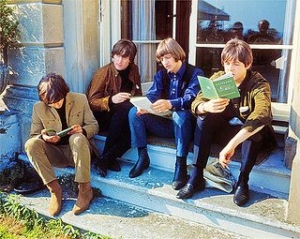
The Beatles liked BOOKS.
I had not been following the publishing trials and travails of the world’s foremost Beatle researcher, Mark Lewisohn (having plenty of publishing trials and travails of my own), so I was surprised to hear from commenter @Craig that he doesn’t have a publisher for Volumes II or III of his definitive Beatles history. Volume I, Tune In, came out in 2013 to much acclaim, and so much fan interest that a truly mammoth 1728pp Extended Edition is available right now for $169.00 on Amazon.com. (It had gone out of print in the States, which caused us to opine about it then.)
To paraphrase @Craig, he asked, “What’s the hold up on Volume II? Is it Lewisohn’s meticulousness, or the immense sea of data he must swim through, or some arcane publishing problem? O book publishing guy, enlighten me.”
In responding to @Craig I found myself typing out a fairly detailed publishing plan, so I thought I’d break that out into its own post. I–along with most of you!–desperately want Mr. Lewisohn to finish his series, not just because I want to read it, but because I believe it will be the rock upon which all future Beatles churches will be built upon.
For those Dull-readers who don’t know, I worked in magazine publishing in the 1990s, and then in the 2000s wrote and self-published a series of parodies of Harry Potter that exploded all around the world. My books have sold over 1.25 million copies in 25 languages, so I have negotiated and read a few big-number, worldwide contracts of the Lewisohn-writes-about-The-Beatles scale. (BTW, I’m in the process of writing another Barry Trotter book, encompassing all that’s happened in the wizarding world since 2003. I’m having fun.) Nowdays, I edit and publish The American Bystander, a more-or-less quarterly all-star print humor mag. Bystander was funded via Kickstarter in 2015 and over the last 20 years or so, I’ve raised probably north of $500,000 using crowdfunding platforms.
So I have a lot of relevant experience here; still, I could be full of shit. The following is offered simply in a spirit of thanks and helpfulness to an author whose work I admire.
I was shocked by the one-book deal; surely people who know lots more than I do negotiated this deal, but doing it in pieces strikes me as a heck of a gamble. Each future book would have to be negotiated from scratch, and would rest on the scale of success of the one(s) before it. And since there are multiple publishers for Volume I, there’s just a hell of a lot of moving pieces, any of which could torpedo future deals. Editors come and go, publishing houses get sold, and books tank for lots of reasons — it’s all about timing — and so if I’d been asked, I would’ve said, “One publisher, all three books, big number.”
From the outside, it seems Volume I did well, but I guess not well enough for any of the various publishers (Crown/RH in the US; Little, Brown/Hachette in the UK, others surely) to lock up the rights to the sequels. To be clear, if Tune In had been an Anthology-like smash, someone already with an interest would’ve scrambled to lock up the other two books. Now, since it has only sold well, you’re in a no-man’s-land. Anyone who owns Volume I has a functional “right of first refusal” for Volumes II and III; no new publisher is going to like being partnered to the publisher of Volume I, and so they will try to buy those rights cheaply, and if they can’t, they’ll probably just pull out. Then will you be forced to take whatever the Volume I publisher wants to give you. It’s all sticky.
What I’d assumed–and what I would’ve instructed my agent to go for–was a large lump sum payable over time, for worldwide rights for all three. This would allow for the buyer to reduce their exposure by being able to sublicense books (and audio) in foreign markets, while also securing my research and living expenses for the decade(s) needed. Say, $2.4 million for worldwide rights to all three books, paid out $120,000 annually for 20 years, with lump sums accelerated upon delivery of MS. An arrangement like this would secure Lewisohn’s time, incentivize early completion, and would not be a horrendous risk for the publisher. Publisher risk would also be reduced by the pace of inflation ($120,000 ten years from now is worth less).
But here we are, with Volume I published by various outfits, and Volume II taking longer, and Volume III–perhaps the most difficult one of all–yet to be started. Mr. Lewisohn is doing stage shows to support himself as he researches, and he’s on the outs with Apple (backstory here?). Given this situation, here’s my suggestions, worth what anybody paid for it.
Mark Lewisohn is in an excellent position…regardless of what publishers will tell him. They will tell him that the main buyers for this book (Boomers) are dying, and that subsequent generations are less interested in The Beatles, and less interested in books, and more difficult to market to efficiently, and so forth. They will tell him that the first book in a series is always the most impactful. They will question his vitality and ability to finish the project. They will force him to take out life insurance for the amount of the contract. They will say anything they think will get that advance number down.
But Mark Lewisohn is the preeminent scholar of a pop cultural phenomenon with fans in the tens of, or even hundreds of, millions. There is no guarantee that readers in twenty years will be reading Harry Potter (especially since JKR’s public persona seems to be actively antagonistic to so many fans); biggies like Stephen King or James Patterson face an even more uncertain future. But it is a certainty that, if there is a world in one hundred years, people will still be reading books about The Beatles, and that goes doubly for THE books about The Beatles. So what Mr. Lewisohn is selling isn’t the usual short-term hit, but a property with longterm legs. There is MONEY in the Beatles, and it’s not drying up anytime soon. Every time Disney launches some new Beatles-thing, his publisher will have a marketing opportunity. When Apple authorizes Beatles: The Hologram in the Sphere in Vegas, Mr. Lewisohn’s books will sell 25% more that quarter. Mr. Lewisohn, and Mr. Lewisohn’s publisher whoever that is, will “draft” behind much bigger corporations for decades to come. “A book about the Beatles written by Mark Lewisohn” is the Holy Grail of book publishing: a book that sells itself. It does not need a conventional publisher to get a pile into the corner bookshop, so browsers can happen across it. It does not even need chat shows to have Mr. Lewisohn on. The fans are the buyers; and because the fans are intensely connected, the marketing will take care of itself.
So I wouldn’t publish Volumes II and III conventionally if I were him. If I were him, the first thing I’d do is start the UK version of an LLC. Then, after rallying all my pals in the Beatle fan world–podcasts, YouTube, Reddit, blogs–and using the mailing list that I hope he’s been gathering from his stage shows — I would set up a 21-day Kickstarter with a funding level of $1 million. And I’d set the following pledge levels. Ish.
$2–gesture of support
$10–PDF of Vol. II
$30–Vol. II softcover
$60–Vol. II Kickstarter-only hardcover (some special feature)
$250–signed, numbered Vol. II in hardcover (250 total)
$250–Extended Edition Hardcover
$500–signed, numbered Extended Edition (50 total)
$1,000 weekly private Zoom lectures for a year (available to academics, too!)
$2500–“Patrons” thanks in both books (100 total)
$10,000–attendance at a Beatles Weekend in London or Liverpool, the “Davos” of Beatle fandom. (25 total)
I firmly believe that this would gather well over $1 million in pledges. Pledges is key here — it’s understood that Mr. Lewisohn can take as long as he needs to finish, with those funds in the LLC invested in 4% government bonds or whatever. And THEN, after Volume II was completed, and the pledges were fulfilled, I’d either sell the books myself until the Sun explodes, netting $12+ on each softcover, and $30+ on each hardcover or, if they gave me a deal too good to refuse, I’d sell some big publisher the right to sell the book in stores, at a price higher than my pledge levels. But either way, I’d have plenty of money and time to finish Volume III.
If Mr. Lewisohn does this, not only will he have plenty of resources, he will have mailing lists of people that he can sell things to (merch; cheap tickets to in-progress research talks; Volume III when it’s ready). The higher tiers may reveal people useful in research or interviewing, or simply a group of ride-or-die supporters that he can call on. It’s always good to know rich people, and lawyers, and rich lawyers.
I am familiar enough with British mores to recognize that all this may seem rather grubby and commercial; but Mr. Lewisohn’s reputation is beyond reproach, and publishing via a self-owned entity would be no black-mark. For someone in his particular spot — needing money to finish a book he then would need to sell — it’s simply the most efficient method. And it flips the power dynamic: a high-profile crowdfunding campaign, if it funded, would likely attract a lot of interest from conventional publishers; it demonstrates scale of market, which is the major bone of contention in any book negotiation. Instead of the usual loggerheads — “Well, you only sold x copies of Volume I, so we’re going to offer you 50% less money for Volume II” versus “You guys marketed Volume I poorly, and Volume II is about the mania, which should sell much better, so you should give me 50% MORE” — there’s a hard number, the crowdfunded number, that’s an incontestable reality. If a $1 million Kickstarter seems too much, do $500,000 or even $250,000. Whatever it ends up earning, that number would be the obvious floor for any subsequent conventional deal. “If you really don’t think you can sell more than me going direct to fans, then I don’t think you have proper confidence in this project.” Money in one’s pocket makes one choosy. 🙂
Fan groups are particularly well suited to crowdfunding, and the Beatles have the biggest permanent group of fans I can think of, as big as the biggest sports teams, but international. Having been an author, and now a publisher, I just don’t see any reason that Mr. Lewisohn should not secure the funds he needs, plus more, directly from his customers in advance, so that he can spend the rest of his life researching and writing — getting the story right. Finally, allowing fans to play such a direct role gives them a stake in his books, a stake that might even change his situation with Apple. Today, Mr. Lewisohn is the single most respected writer on a fascinating pop cultural subject; well-funded, and with a direct line into 100,000+ buyers of Beatlestuff? Truly comfortable, unassailable, and thus able to go anywhere the data takes him. Publishers have their agendas, which are not what fans want; Apple, too, has its own agenda. But in this instance, Mark Lewisohn and millions of fans have the exact same goal — getting these books done, and done right — and crowdfunding might be a perfect solution.
Related posts:
 Are the guitars on Pepper…different?
 Ian Leslie: “Notes on Peter Jackson’s Get Back”
 Try it, you might like it
 The Beatles without earmuffs
 Mad King John
 Critics at Large reviews “The Fifth Beatle”
 Various musings on Lennon and Addiction
 Allen Klein Playboy Interview, 1971
 Beatles singles that never were?
 Shepard Fairey George Harrison Poster
 Phil Rickman’s “December”: Wrestling with Lennon’s ghost
 That was your first mistake
Speaking of crowdfunding Mike, how can we contribute financially to keep the lights on?
Paul, that’s very kind of you. I’ve just installed Google AdSense, in an effort to defray my monthly expenses, so for the moment, browse around and click on some ads.
If you’d like to do more, I’d encourage you to subscribe to The American Bystander’s Patreon or Substack. Both are monthly charges, and I think you can do as little as $1 (and also cancel at any time.
The Bystander is my day job — I run an all-star print humor quarterly full of people from SNL, The New Yorker, the Simpsons, et al. With the insane workload of that, I don’t want to run a Dullblog-specific Patreon at the moment. Even though I set one up years ago.
You’re still running the Dullblog Patreon though, right? (If not, someone else is getting my money…)
@Jarret, THANK YOU.
If the ads on the site prove intrusive, I will take them down and speak to everyone about the Patreon. My only concern is that I can’t do that Patreon properly — like, give you guys more interesting stuff — based on my insane workload right now.
You’re very welcome, Michael; I pledged on Patreon about a year ago during the HD hiatus, and, well, I guess it worked out 🙂 But if you decide that it’s not worth it and supporting AB would be the best way to keep HD going I’ll pay for that instead.
Mark’s comments on recent podcasts etc. suggest it is the writing itself, including distilling the mountains of research already done, that’s taking him so long. He’s also said his publisher is ‘very patient’ but he’s long since spent the advance hence the side projects to pay the bills. This suggests he signed a contract and took an advance for all 3 volumes.
Nevertheless maybe he and his publisher should in any case be doing something like your suggestions. After such a long delay it should be in the publishers’ interest to see it through – including renegotiation if necessary to get Mark more money or support if necessary.
Yes, if Mr. Lewisohn doesn’t want to do it, his publisher could, and reap major, major benefits. Not just money, but that mailing list. That publisher could set themselves up as the Beatle Publisher for a generation, and use that mailing list to publish books that were basically guaranteed to be profitable.
How many Beatle peedles would back a Lewisohn Kickstart? 5,000? 10,000? 25,000? Most books sell nowhere near those numbers. I don’t know when they negotiated it, but if he got less than a million for a three-book comprehensive history on The Beatles, he was robbed. The conversation with the agent has to be, “I’m going to work for 30 years on this. I need to eat for 30 years.” 30k x 30 = $900,000.
The problem is, book agenting has within it a conflict of interest. 15% of one deal, no matter how big, is enough to defray future monies lost by pushing a publisher hard on an advance. If your agent really puts the screws to say, Random, that house — and all of its subsidiaries — is going to be less likely to buy any future book that agent is pitching. So the pressure on any agent is to keep their relationships with the publisher as positive as possible. And once you, the author, sign with an agent, that agent owns 15% of any book they shop for you, even if the agent sells it to a chum of theirs, or gets you a shitty deal, or doesn’t sell it at all. So the important relationship, from the agent’s perspective, has to be the publisher — since most books don’t earn out, that’s where their money comes from.
If Mr. Lewisohn did this Kickstarter, he — NOT his agent, NOR his publisher — would own that sizable, targeted, proven mailing list. And the balance of power would be firmly in his court, for as long as he owned that information, and they didn’t. They would use every tool to get it from him. The smart thing might be to
1) Do the Kickstarter;
2) Make the money, and get that list; and then
3) Renegotiate the deal on top of that, using that list as leverage.
If he did that, he would have a really significant chunk of change, more than enough to live and research and write happily on this topic, for the rest of his life.
I can’t remember where I saw it (it was a very long time ago), but I seem to recall his deal was for $1.4 million? Or one-point-something at any rate. That was in about 2003 or so. It wouldn’t have been at all difficult to have spent all that by the time Vol. I was published, depending on his cost of living. Doesn’t he live in London? Pretty expensive place.
But further to the point, I would absolutely contribute to any crowdfunding effort for Vols II & III. And I think your estimates of how many people would contribute to it are very low. Just enlist every Beatles podcast/Youtube channel in existence to spread the word, and Lewisohn would be absolutely swimming in money.
I agree, @Beasty. Whatever Mark Lewisohn’s problems are, money to write Beatles books shouldn’t be one of them.
Brilliant! I ask one stupid question and am given an opus of an answer. Thank you Michael for providing this kind of illumination on a subject I’m unfamiliar with. I would like to say, I don’t have specific knowledge he doesn’t have a book contract, it’s just something I’ve read and seen about the interwebs. I sincerely hope someone forwards this post to ML and his advisors (although after reading MG’s post, not sure he has any). I’m ready to put down my $250 for the extended edition right now! Although I would want a finish date or however they call it on kickstarter.
Hey here’s a thought: MG you should contact ML and get the ball rolling. You seem to have a pretty good handle on crowdfunding and publishing (not to mention Beatles!) and perhaps Mr. Lewisohn will be receptive to some more progressive ideas re his future books.
Thanks again for your 2¢ on this topic. It does help explain some things for me.
@Craig, I would never be so pushy and American as to contact Mr. Lewisohn, but I hope that what I wrote gives him (and any advisors) some useful food for thought. Just one man’s opinion — based on a lot of lived experience, though.
He seems like a nice fellow, and is certainly doing God’s work. I like all of us want him to be well cared for, and book publishing is set up to care for everybody but the author. His bind is very typical, especially for a non-fiction project, but crowdfunding seems to me to offer him a way out.
I have looked at your bystander website, but never thought of it as a possibility of supporting hey dullblog.
I’ll take a digital subscription, thanks!
Paul, I hope you enjoy it! I think you will. And thank you!
Michael,
I know your schedule must be filled from morning till night, but I just want you to know how grateful I am that you have started to post here again. Actually not so much for the Beatles per se, but rather that your writing is always so good. In fact, you could be writing about lawn care and you would no doubt make it witty, compelling, and interesting.
I was having trouble with my digital subscription to the American Bystander so I cancelled that last week, but will re-subscribe to the actual print edition.
Pro tip to those who might be browsing this comment section, the AB is downright fun. Give it a try.
Again Michael, a big fan of your writing so a hearty thank you for what you do.
@Neal, this is so wonderful for you to say. Thank you! My life is beyond crazy right now, trying to keep a whole bunch of plates spinning (including a big one I can’t talk about just yet), but it is always a pleasure to talk with all of you here.
Speaking of being able to write about anything, I just wrote a little piece about my use of Cuban cigars as an antidepressant. 🙂
I hope Lewisohn is listening! This seems like a workable plan and it would be great if he’d get behind it.
I’m not sanguine about the prospects of ever getting an additional volume, because Lewisohn seems to me like a born researcher who has trouble getting to the writing stage. It would be interesting if he were willing to work with a partner who could help with the writing and editing, not just to get the project moving more briskly but also to help liven up the prose.
Compounding Lewisohn’s deep-dive researching challenge is that the further one gets into the Beatles story the steeper and rockier the terrain. I don’t envy anyone trying to build a definitive history out of so many conflicting and deeply-entrenched readings of events (and disagreements about some of the events).
Glad to see HD back and I may even begin posting myself!
@Nancy, please do post! You are missed.
I agree, especially with your sentiment that the story gets harder to tell accurately (and much more contentious!) the further along one gets. And also, a significantly younger collaborator (say, someone in their 30s) would make sure that all the volumes are written.
@Nancy Carr, I was hoping you would be back! I have enjoyed your writing and well thought out posts.
I look forward to more of your insights, thank you!