

- The Beatles and “Scenius” - October 2, 2026
- Little Help From Our Friends? - September 2, 2026
- A quick yawp from Mr. History - August 24, 2026
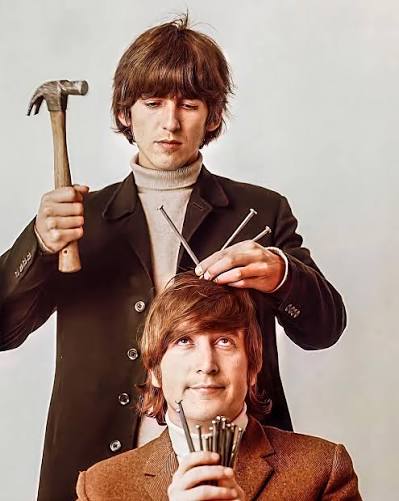
With every nail, a little genius leaks out
The musician Brian Eno has coined the word “scenius,” which in its simplest form is the belief that the Renaissance-era idea of the solitary, isolated, tortured genius is a myth, and that artistic breakthroughs actually come from (in Eno’s words) “a whole scene of people who were supporting each other, looking at each other’s work, copying from each other, stealing ideas, and contributing ideas.”
Obviously true, right? It certainly seems so. What’s more, it FEELS GOOD. Not only does it dismiss all the Dead White Males at a throw, it opens the field absolutely for the rest of us. It seems democratic. It gives every person who loves to write or sing or paint–anyone with enough scratch for a Mac and the desire to “Think Different”–if not a rough equality, at least a kind of artistic lottery ticket. In our weekend noodlings we suddenly have a chance to do something meaningful; we might not be a Beatle, but we could write a little tune that, in some roundabout way, inspires someone who inspires someone who inspires someone to be a Beatle. “Scenius” empowers the fan and hobbyist. It keeps them buying gear and tickets. It promises to spread credit around; instead of one towering (white, male) artist, future humans will celebrate lots of people who had a hand in the creation of a gloriously diverse and endlessly satisfying future culture. “Scenius” is exactly the kind of idea people love these days. It is perfectly tuned to our faux-egalitarian, influencer-driven, social media-saturated landscape.
And I hate it.
I hate it because I lived through decades of claptrap where the internet, that world-bestriding supremely collaborative tool, was touted as something that would 1) make us more free; 2) allow many more artists to be discovered, and make viable livings from their art; and 3) through the wisdom of the crowd, conjure up nothing less than a new Renaissance, not only of artistic expression, but of thought itself, creating a fundamentally freer, fairer, more diverse and more interesting society.
Welp.
Because the concept of “scenius” does not acknowledge capitalism — because it describes something real (the presence of influence, the power of collaboration) with an immature undertone (art belongs to everybody), “scenius” is a kind of Trojan Horse. The beautiful Horse can be summed up in this snippet from the writer Austin Kleon: “Our world is an ecosystem in which our only real chance at survival as a species is cooperation, community, and care, but it’s being lead by people who believe in an egosystem, run on competition, power, and self-interest.”
Nice! I like survival! Cooperation, community and care, all excellent, sign me up. And competition, power, self-interest all seem shitty when you say it like that. Send over one of those wooden horses, would you? Turns out that lurking inside are a million corporate soldiers — executives, programmers, lawyers, most of all lawyers — ready to pour out and slaughter any artist they see.
“Scenius” isn’t wrong — it explains something real, and is useful to keep in mind whenever any Genius Artist is trotted out for our approval. But the idea that no artist creates anything on their own is being systematically zhooshed into the idea that no artist can really own anything. Who was responsible for To The Lighthouse? Woolf? The Bloombury Group? The era? Who was responsible for Eno’s work? Glam rock, the infrastructure of pop music, the revolution in consumer electronics? We could argue for hours.
But the corporations that distribute content, they’re beyond argument. They can restrict access, existing only to exert control. The corporations that create and market performers can also control things. The software and hardware manufacturers that allow a person to consume content, they control things. AI companies harvesting masses of content and producing slop is the natural, and perhaps inevitable outcome of this line of thought. Content wants to be free, and that goes double for good art, but the tech to access it will cost you money.
Nobody would suggest that this Mac I’m typing on isn’t the product of Apple, Inc. But if tomorrow it was declared that the profits from all Apple products needed to be distributed amongst all the people with a hand in having them come to be from Year Dot, Apple would go out of business.
Ownership is how people (read: artists) get paid. And they need to get paid to make art.
This is what I would say about the concept of “scenius”: for a certain type of person — the same type of person who dismisses the Great Man theory of history in favor of people’s history or historical materialism — it feels reassuring, especially if you’re already got yours. It’s the System, man. Who killed the Kennedys? After all, it was you and me, sings the rich rock star. And as I keep saying, scenius does describe something real; creative individuals are acted upon by their times, by their contemporaries, and so forth. But it also misses, or at least devalues, something equally real. And here is where we come to the Beatles.
The Beatles: Genius or “Scenius”?
One of the most distinctive aspects of the Beatles story — certainly when compared to those who came after them — is the fact that they weren’t obviously the product of a scene, or at least not one that existed outside of their own heads. This is shown by how quickly their music changed; scenes don’t evolve so quickly, but heads can. Yes, you can hear influences in the early Beatles, from Buddy Holly to American R&B to the Everlys. And yes, Liverpool had a “beat music” scene, but by the release of Beatles for Sale in December 1964, the gap between The Fabs and say, Gerry and the Pacemakers, is simply immense. The size of the Mersey beat scene is remarkable — 350 groups! — but equally remarkable is the lack of innovation and quick drop into insignificance of every other group but The Beatles, and also how quickly The Beatles jettisoned anything resembling their early sound.
The same can be said about other “scenes” The Beatles were a part of — British groups who cut their teeth in Hamburg, or were influenced by skiffle; fans of The Shadows or Little Richard. Historians and musicologists can come up with a taxonomy—read this Wikipedia entry if you have an endless life—but the gap between “the scene” — any scene — and The Fabs is remarkable.
What caused this gap? What other answer could there be besides genius? John/Paul/George/Ringo were simply better than their Cavern contemporaries.
The more I think about it, the more peculiar it gets — can anyone recall a specific approach or technique invented by, say, Rory Storm and the Hurricanes, or The Fourmost, that The Beatles swiped directly? The Fabs’ had influences, lots of them, and talked about them freely. But this low level of “anxiety of influence” comes from how distant their influences were; it cost The Beatles nothing to give credit to Buddy Holly or Arthur Alexander because, in the hands of the Beatles, that music was clearly very different. Beatles covers are like a French chef’s version of a hamburger, and this often holds even for the workouts recorded for the BBC. Though part of a larger scene, John, Paul, George, and Ringo were not part of a larger scene which caused their success. The flow of influence seems to have gone from them, but not to them, until they met Bob Dylan in August of 1964.
Their uniqueness extends to their management: a young man working in his family’s furniture store/record shop. And their producer, who was known for his comedy records.
So, The Beatles were geniuses? Great Men do exist? Not so fast.
Their Own Scene
If we define The Beatles’ scene as “those four guys,” the picture changes radically. They all influenced each other massively, and each had a massive impact on the quality of the music they created together. John Lennon, despite his protestations to the contrary, wasn’t a genius—because he couldn’t come up to a Beatle-level of quality without the other three. Neither could the others. Why did none of The Beatles’ solo work come up to the level of their work together? The power of four-person “scenius.” Individually, they were very good. Together — as a “scene” — they were one genius.
In the end, I think my issue with the “scenius” theory is simply this: we each experience the world as individuals, and this is true for artists perhaps most of all. The idea I have for a piece comes to my head, not yours; and I write it, not you; and then I edit all my swears out, and so forth. Any piece of creative work is the fruit of a million micro-decisions made internally by an individual, who is then judged, as an individual, on the quality of that piece of work. Recorded music may be different; if Brian Eno was editing this piece, maybe it would be better, probably it would be, but he’s not because that’s not how writing works today. To acknowledge influence — the soup of experiences every consciousness exists in — is right and proper, but until our society figures out a way to pay artists, and really believes in their worth isntead of giving it lip-service, “scenius” is a rather dangerous notion born of incredible privilege. It describes a corporate-funded team-creativity that is becoming less and less common as more art becomes a hobby done for no pay.
I’m currently listening to Eno’s masterpiece, 1974’s Another Green World for free on YouTube. I mean, not for free — I pay YouTube $15.99/month — but I didn’t buy the music. I only know about it because the record company promoted it 52 years ago, and record stores sold it, and people say it’s a work of genius. But no record company or record store is getting any money tonight, and Brian Eno certainly isn’t.
I’d feel bad about this except… it’s the product of a scene, you know? Brian Eno just gathered it, sort of. Isn’t that how art is made? It was a bunch of people’s ideas, everybody stealing from each other in one time and place long ago, and Eno added a bit here and there, and…but I gotta pay for YouTube, ’cause all that coding and backoffice and stuff, you can’t get that for free. That costs money.
Why We Love “Scenius”
In 1963 and ’64, The Beatles demonstrated that there was a vast new worldwide audience for pop music. By mid-’65, record companies in the US and UK had discovered, packaged, recorded and racked into shops an immense number of new groups. And by the beginning of 1967, this meant that millions of people who’d started out as fans of The Beatles were now fans of many groups. This successful expansion of the market by niching looked like The Beatles had lost their popularity (cue the 1966 Shea Stadium news report), but what had really happened was that the industry had expanded, and the cultural stage had become that much more capacious. Just in time for the Fabs to unveil themselves as a singular genius.
A lot of these post-1964 groups were very much products of “scenius,” whether it’s The Yardbirds or Cream or Zeppelin, or the LA Laurel Canyon crowd, or any of the San Francisco groups, etc etc. The Stones could be a product of the London Blues scene, but I simply don’t know enough about their beginnings to speak authoritatively. And rock continued to splinter, with genres (scenes) sprouting up and being monetized as fast as they appeared, punk included. Yes, geniuses did still emerge—Brian Wilson, Jimi Hendrix come to mind—but certainly by the time of Eno, “scenius” ruled. Eventually, as the decades of splintering piled up, the consuming of music lost its connection to commerce. It had to; there was simply too much to choose from (and pay for). So what you bought became the corporation’s streaming service, not the artist’s music.
Scenius is the bedrock of modern corporate pop culture. It is necessary to supply an uninterrupted stream of product, each iteration containing just enough superficial change to market it effectively. Anyone steeped in contemporary pop culture, whether it’s books or movies or music or video games—is used to scenius. It feels normal, fair, and pleasingly democratic. Genius—the inflection points when a business changes and a paradigm shifts—may actually be suppressed by the scenius mechanism necessary to keep content flowing. But that’s what fans want: more stuff. Scenius not only produces that stuff, it gives it a context so we can consume it as efficiently as possible.
But outliers—geniuses—do exist, and I for one try to keep a weather eye out for them. That’s why I listened to Eno’s Another Green World tonight. I knew one of the songs from TV (a BBC documentary series called “Arena”). It was pretty good, but…not really my scenius, you know?
Related posts:
 Little Help From Our Friends?
 Sid Bernstein obituary
 Fest for Beatles Fans Chicago 2015
 The Black Album: Solo Beatles According to Ethan Hawke
 George Starostin on “McLemore Avenue”
 Charles Taylor on A Hard Day’s Night
 Shepard Fairey George Harrison Poster
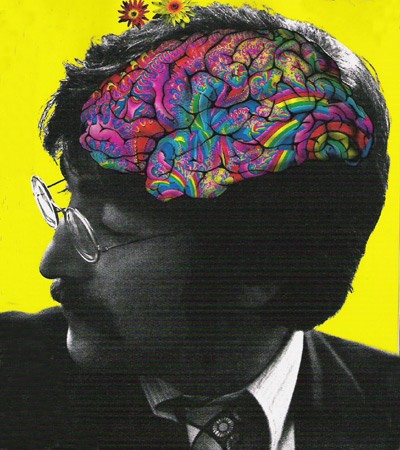 Psychedelia in the UK: "A Technicolor Dream"
 Beatles For Sale sessions
 Try it, you might like it
 Allen Ginsberg: “Portland Coliseum” (1965)
Order Failed
Allen Ginsberg: “Portland Coliseum” (1965)
Order Failed
Leave A Comment