

- Little Help From Our Friends? - September 2, 2026
- A quick yawp from Mr. History - August 24, 2026
- First Thoughts on “The Beatles – A Four-Film Cinematic Event” - August 17, 2026
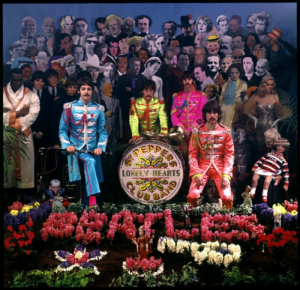 Reading Starostin’s part one analysis of Sgt. Pepper’s Lonely Hearts Club Band, I realized that I’ve never wondered for a second about “the concept” behind that LP; it’s so clear to me I’m a little puzzled when people — John Lennon among them — profess that there is no concept whatever. But I’m finding it difficult to write. I’ve spent the last two days writing paragraphs and discarding them, and this post is a final attempt to blast through, share my idea, and continue hashing it out in the comments.
Sgt Pepper’s Lonely Hearts Club Band is an album designed around a kind of historical longing very specific to psychedelia in general, and British psychedelia in specific. In the most blunt terms, Pepperland — the place you are taken to by the album — is more or less La Belle Epoque, with drugs. Le Belle Epoque refers to a 43-year period of European history characterized by peace, optimism, prosperity, and artistic and technological progress, which was suddenly and brutally ended by World War I.
If you want to date the place in Pepper specifically, maybe you think of a person who is turning 64 in 1967 —but the concept is not as flat-footed as that.
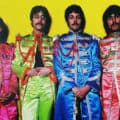
One of the hallmarks of psychedelic art, whether it’s the posters being produced in San Francisco or the clothes sold on Carnaby Street (at I Was Lord Kitchener’s Valet) or Pepper, is the use of historical styles, transformed (or at least heavily inflected) by the specific visual/mental/spiritual experiences caused by psychedelics. Psychedelic art is not simply a set of rules, of random aesthetics — it is an attempt to evoke a distinct experience. So you see a Mucha illustration surrounded by melting letterforms. Or a Victorian-era photo of Sitting Bull, in hot pink metallic ink. Or the 1930s-style drawings of R. Crumb, doing things only hippies do. Or, you see John Paul George and Ringo in band uniforms in peacock colors, two of them tripping, with mustaches and flower epaulets. Or you have heavily processed songs with lyrics literally from a poster from 1843. While it entices us into a Utopian future, psychedelia is obsessed with the past. (That’s one of the reasons I love it so.)
Pepper is the desire for a do-over, expressed by a generation of young people who looks at modernity and sees a death cult. It is a vision of an alternate past, but it’s not simply marmalade-sniffing like The Kinks — the journey back is full of love and magic. Pepper doesn’t say to the listener, “Those were the good ol’ days,” but “The British Empire is dead, let’s build a better one, a whole new kind of one.” This is why George’s Indian detour doesn’t feel out of place — the Raj, too, will be transformed. And then we will laugh.
One of the signature experiences of LSD seems to be “oneness with the Universe” — the perception that everything is natural, everything is alive, and all is One. This is key to the concept of Pepper; this return and remaking is based on oneness, not the atomized, alienated, endlessly analyzed world of modernism.
If you look at the cover, the switched-on Beatles — holding not electric guitars (they didn’t use that take) but Victorian/Edwardian instruments — are quite literally in front of all the heroes of modernism. In front of Freud and Jung (and Hitler, too, if John’s had had his way.) Even their old selves are there, but as waxworks — dead, inhuman, inert. The leading four stand not on a stage, but in a garden, underneath impossibly blue skies. (That last summer of peace was remembered as particularly beautiful and sunny.)
• • •
The legend goes that when Brian Wilson first heard Sgt. Pepper, he pulled over and started sobbing. “They’ve done it,” he said. “They got there first.”
Got where?
For about a year, Wilson and Van Dyke Parks had been laboring over SMiLE. As a framing device Wilson and Parks had collected all sorts of Americana, which they hoped to arrange in some sort of coherent statement about the nature of this country and what it meant, at that time, to be American. But SMiLE is as capacious and chaotic in its way as Pepper is; vast chunks of SMiLE actually seem like a different concept album, one closer to Wilson’s Pet Sounds. It’s all great music—but not about America, Manifest Destiny, or the bittersweet experience of being American.
I believe what Wilson was really trying to do — and eventually did — was use the studio to transport the listener to a past America of his mind, from which his young listeners could make a better future, for America and the world. And when Wilson heard Pepper, he intuitively knew that McCartney and his mates had done something similar, but in an English idiom, not an American one.
A vision this capacious was simply too big for any one musician to envision, even one as talented as Brian Wilson. McCartney needed the help of the other Beatles, and George Martin, and Haworth and Blake. And Lennon definitely did pull his weight putting across Pepper—not just with “Kite,” but also “Lucy in the Sky With Diamonds,” a story of love and longing in a switched-on world.
But Lennon’s greatest contribution to Pepper was the song that Wilson heard, his album ender, “A Day in the Life.” It’s poleaxing, but why? Because of that final chord. That final chord is the end of the summer, the end of the dream, the “lights going out all over Europe,” or the Bomb everyone expected to drop at any moment in 1967. It was the final curtain, Goodbye to All That, to quote Robert Graves’ memoir of World War I.
But those are not the last sounds on Pepper. The last sounds are weird laughter, the words “Never could be any other way,” sped up and reversed. All that had come before—all that we assumed never could be any other way—could be reversed, and sped up, and there would be laughter.
Am I just playing games here, like pointing out Paul’s OPD patch on the gatefold? No—Pepper’s concept doesn’t work like that, and if it did it wouldn’t be nearly as impactful. But if you’re historically sensitive, and well read in the British culture of the time—if you know about things like the musical “Oh What a Lovely War!”— the concept behind Pepper is so obvious that once you see it, you can’t un-see it. But it’s not obvious; you gotta know the context—it is a concept of that time and place, not ours. The concept hit like a sledgehammer in June 1967, but became almost indecipherable after, because it’s not located in a musician’s personal traumas (like Tommy), or some Sixth Form yawping about conformity or the quiet desperation of the career civil servant or some shit.
SPLHCB started out as precisely this typical, tiring concept LP—an album about The Beatles’ childhoods in Liverpool that petered out after “Strawberry Fields” and “Penny Lane.” What we got instead was much, much more interesting. The Beatles intended to write about their own childhoods, and almost by accident, ended up writing about the childhood of the West.
• • •
I’ll end this piece how I’ve ended a couple of posts about Pepper, but this chunk of text is particularly appropriate for this topic. The people who listened to Pepper in 1967 definitely experienced it as a concept album, and that extra oomph was felt at least until 1990 or so, after which it began falling out of the #1 spot. The timing here should tell you something—that was the end of the Cold War, when the USSR collapsed and it seemed that human civilization would make it. The Utopian “do-over” suggested by Pepper wasn’t needed anymore.
But back in 1967, Pepper wasn’t a collection of songs not quite as good as Revolver. It wasn’t the first appearance of Paul’s flaws, his reprises and bubblegum and granny music. Pepper certainly wasn’t hype. For the people who heard it then, it was profound. This is Landon Winner from 1968, writing about Pepper: “The closest Western Civilization has come to unity since the Congress of Vienna in 1815 was the week the Sgt. Pepper album was released. At the time I happened to be driving across country on Interstate 80. In each city where I stopped for gas or food—Laramie, Ogallala, Moline, South Bend—the melodies wafted in from some far-off transistor radio or portable hi-fi. It was the most amazing thing I’d ever heard. For a brief while the irreparably fragmented consciousness of the West was unified, at least in the minds of the young.” (If you want more, this guy gets it.)
That was the concept: the West, unified in electric love, going back to where things went wrong, and trying again. Never could be any other way? For a time at least, it worked. Put the speakers in the window and let’s see what happens next.
Related posts:

 A Few Words on Conspiracy Theory
 George Starostin on “McLemore Avenue”
 David Bailey documentary: Four Beats to the Bar, and No Cheating
 “Poor old Buddy”
 10 Best Beatles Bass Lines?
 Shepard Fairey George Harrison Poster
 Philip Norman’s “letter” to Paul
Custom Styles
Philip Norman’s “letter” to Paul
Custom Styles
 I’m So Tired: Responsive Notes on the Phenomenon of Beatle Fatigue
 Lennon and…John?
 Critic Richard Goldstein’s 1967 pan of Sgt. Pepper
Beautifully stated and I think Pepper and Revolver are the most European of the Beatles LPs, bit just because of the musical idioms but because they seem to be in dialogue with death, rebirth, destruction, Utopianism in a way that they weren’t before or after, and I think it’s most of all these two that make the Beatles as album artists so mystifyingly brilliant to me.
In an effort to keep the album surprising to me, I recently made a playlist the puts Strawberry Fields Forever after …Friends, followed by Fixing a Hole, Lucy, and then the rest of the track order. It’s an interesting exercise. It makes the album feel a bit more like a Beatles album; there’s more Lennon on it, but it also becomes darker and more idiosyncratic because that song has such a strong gravitational pull. The “LSD tea party of the end of civilization” element works a bit better if that darkness only comes to the fore at the end of the album. But at the same time, it’s definitely a stronger listen, song for song. As it stands, of course, the album wasn’t released that way but I think it would have truly devastated Brian Wilson if it had been.
Part 2 just dropped! https://open.substack.com/pub/onlysolitaire/p/review-the-beatles-sgt-peppers-lonely-928?r=8z5zd&utm_campaign=post&utm_medium=web
Where I think we’re totally in agreement on Pepper, Mike, is that we both seem to *like* hippie idealism and utopianism – we’re rooting for the peace-and-lovers and want them to win. Part of the ’90s backlash against the album stems from the fact that grunge’s mainstreaming of punk and gangsta’s cheapening of hip-hop (not to mention South Park etc on TV) resulted in pop culture worshipping selfishness & ugliness for a long time. I remember it well.
But more and more lately, I find myself gravitating towards music that conveys joy and transcendence – a lot of that being soul, funk, gospel and various African genres, because very few white artists can, or want to, pull it off. But in the ’60s joy was temporarily cool, and you got your Hollies, your Van Morrisons, and most of all, your Beatles.
For all that I’m drawn to some darker stuff too – one of the reasons Lennon’s stuff generally excites me more than McCartney’s – it’s always annoyed me when grittier art is praised for its ‘realism’. Why are e.g. hard drugs, jail time and violence more ‘realistic’ than e.g. love, simple pleasures and strong family bonds, when the latter are far more common experiences, not just among the Western middle class but practically around the world? X-rated albums and movies are generally about *exceptional* circumstances, not everyday ones. As they came right out & said themselves in ‘Salt of the Earth’, the Stones are not you and me. And we wouldn’t want them to be.
Calling pessimism and myopia more ‘realistic’ than optimism and unity is cynicism and laziness assuming the outcome they want in advance: the only true ‘realism’ is admitting that we all get the world we bother to build. If you time travelled back to the Ancient Near East in the Bronze Age and told a random warrior there about democracy, human rights, fair trials, free speech, international cooperation, the welfare state, and all the scientific advances & improved health outcomes we currently enjoy, I don’t think they’d find your spiel particularly ‘realistic’. But we got here because we bothered to get here. We have no right to assume that things can’t get better still, that our current backsliding will continue forever, that we had a good run but it’s over now. And love actually-existing hippies or loathe them, we have no excuse for not wanting the same things they wanted.
Love this, thank you.
Your comment makes me remember something I wrote about in one of my earlier drafts: 1967’s Summer of Love was followed by 1968’s revolutions of May, and August ’68’s “Days of Rage” at the Chicago convention. Pepper’s gentle Utopian stance was followed by “Revolution.” And that evolution was seen as “natural” or “inevitable” or “realistic” or whatever. From 1968 to now the dominant idea is that hippie Utopianism, whether it was free love or free medical care or free food, was a ridiculous drug-addled dream, and that the only way to make a better world was through some sort of violence, some sort of geopolitical remedy, some sort of overthrow.
But we know now that this change WASN’T natural or inevitable. Psychedelic utopianism might’ve been fatally flawed, but it wasn’t given a fair hearing. Last month I read a book called Season of the Witch, David Talbot’s history of San Francisco from 1950 to 1985. The crush of kids descending on San Francisco starting around May 1967 was a phenomenon caused by mass media (songs, articles in LIFE); that was unprecedented. But city officials knew this was going to happen months in advance, and rather than accepting it — beefing up social services, arranging for food and housing, trying to reduce harm in logical ways, and treating it as a kind of temporary tourism — the City said, “Stay away, and if you do come, you may get thrown in jail.” Which meant that by August when George Harrison showed up, the neighborhood had been thrown into chaos, and there was lots of visible suffering in the Haight — drunkenness, homelessness, crime, disorder. Because in some sense, that’s what the City wanted.
Now there was PLENTY of money and food and material wealth in America in 1967 for all these kids (many of them runaways from unhappy homes) to be cared for. That wasn’t an option, because conservative forces in San Francisco, and Sacramento (Governor Reagan), and even people on the national level, wanted this all to fail. They didn’t want kids experimenting with new ways to live. When doctors set up a Free Clinic, for example, the city tried to shut it down. The (mostly Catholic, mostly conservative) SFPD went around cracking heads, so the hippies had to turn to the Hell’s Angels to keep good order. This worked better than expected…until it didn’t.
In an era of almost unimaginable plenty, in the richest best-educated country in human history, lots of needless suffering was created, then maintained, so that any kind of “alternative society based on freedom and sharing” (my words) could not take root. So a lot of kids from around the country hitchhiked to San Fran and found themselves dropped into Hell, and were kept there by a society that wanted to punish them, and use their suffering to dissuade others from stepping out of line. We now know that the US government was scared shitless that the counterculture would go mainstream — not the clothes or the music, but the politics. If the next generation didn’t want to have jobs, and felt their government should provide basic services taken from the wealth of the society, to LBJ and the rest that sounded like Communism. (And maybe it was.) The Cold War was not some theoretical thing; it was something that millions were sacrificed to “win.”
Just like the City of San Francisco’s reaction to the kids of the Summer of Love was to throw ’em in jail, or let ’em get STDs, or OD, by August 1967, both the FBI and the CIA had launched programs specifically designed to infiltrate and splinter the counterculture. (The FBI’s program was COINTELPRO; the CIA’s program was CHAOS.) And these programs, aimed at movements that were functionally defenseless, succeeded massively right from the beginning. By the middle of 1968, the mood of the kids in the counterculture had changed drastically, and the happy nonsense of flower power had been replaced by the evil nonsense of the Weathermen. Some of that change was brokenheartedness over the deaths of MLK and RFK; some of it was seeing what was happening in Europe in May ’68; some of it was the changing diet of drugs ingested by the hippies. When the face of the movement was Sgt. Pepper, it had some real chance of taking hold, and making things better; but Abbie Hoffman wasn’t going to lead anybody anywhere. He was politics as entertainment, and we know this because anybody who wasn’t an entertainer — anyone who was a real threat to ANYTHING — was killed. (Fred Hampton for example.)
Anyway: the Summer of Love wasn’t some stupid idea that was tried and found wanting; it was an experiment based on sincere and durable desires, that was methodically crushed, so that the counterculture started playing by the same rules as the authorities — violence and anger. This was a fight the counterculture could not win, and that’s why the authorities forced them into that spot. The moment the song turned to “Street Fighting Man” the game was all over.
YES, Mike. We’re living in a Marcusian nightmare where the Man first crushed all dissent, then nipped all future dissent in the bud by convincing the dissenters that they’d finally stopped being so silly and woken up to reality. It just depresses me to see people of the time, Lennon included, swallow the propaganda and talk about the dream being over and waking up to the cold, hard truths of life – it’s like, no, people just stopped trying to build something better because the system fought back really hard! Same goes when people today express this knee-jerk contempt towards the hippie ideal – what, because now is so great and we’re all so happy with how everything turned out?
On the other hand you have people like Ram Dass, who over time turned from drugs-are-the-answer towards spirituality and service, and *never* stopped modelling an alternative to our fear-and-paranoia-based system and trying to make the world a better place (see: Seva, visiting the dying, etc). OK he wasn’t perfect, but that’s the point, right, you can be imperfect and still get a lot done. If you do the peace-and-love thing right, it’s just the farthest thing in the world from the do-nothing head-in-the-clouds caricature of the lazy hippie – it’s *harder* than the fear-and-paranoia lifestyle, takes more work, requires more courage. And that’s exactly why it’s easier to laugh at it than to actually give it a chance.
Of course, unfortunately a lot of hippies *did* fit the caricature, plus the movement was inextricably tied to drug-addled rock musicians, who were great at singing about selfless love and often not great at demonstrating it. Among the Beatles, George is obviously the most similar to a Ram Dass, but the poor guy strikes me as somewhat of a spiritual bypasser, embittered and grudge-nursing almost to the end, trying so hard to float above Maia but so hopelessly attached to its pleasures and opportunities for self-indulgence. But hey, I don’t know the guy’s heart, and if RD had been in the Beatles, I’m sure he’d have acted just the same way.
Oh this is so fascinating, thank you for it.
“people just stopped trying to build something better because the system fought back really hard!”
Yeah. Also, a dear friend of mine who occupied the President’s office at Columbia in 1968 always reminds me that the hippies were actually a very small portion of his generation. “We just got a lot of publicity,” he says with a smile.
Doing the peace-and-love work — which by the way looks very similar regardless of the tradition around it — is really the only answer, as far as I can tell. This is, IMHO, the real shame of John hooking up with Yoko. Because she carries so much trauma from her childhood in wartime Japan, he absorbed a lot of that fear and anger near the end of his life. I’ve said it before, but if there was one person who didn’t need a wallet for the rest of his life, it was John Lennon in 1980.
I have a lot of sympathy for George. I get the sense that he was very sincere in his desire for, I don’t wanna say “awakening” because that’s got a lot of baggage around it. Let’s say he sensed there was a better way to live, and wanted that. But he was dealing with a kind of super-delusion. I don’t want to speak for any of you, but I think I deal with a normal level of access to distraction and sensory pleasures. George had as much sex as he could want, whenever he wanted, with anyone he wanted. He had money — then lost a lot of it — then had more again. He had an amazing place to live that I’m sure he didn’t want to lose. He had a lot of people praising him, and a lot of people damning him. So much to say that the winds buffeting his spiritual practice were about as strong as I can imagine. And yet, he never lost them for good, and by all accounts seemed to be an alright guy. I sure as heck couldn’t do any better than he did, and probably a lot worse. So I look on him with real appreciation.
That’s a nice way of looking at George! I note with interest that I always come down harder on him than the other guys, even though I know John (and even Ringo) did worse things. I guess preachiness is always hard to take, especially from people who don’t practise what they preach, but I suspect I also project a lot of my own ‘stuff’ onto the guy 🙂 As a fellow introvert HSP, I think my Beatle experience would be the most similar to his out of the 4 of them. Biting my tongue now and resenting later very much included.
& on the subject of gritty realism in songwriting – something Pepper’s very much criticised for lacking – it’s time for everyone to admit that we respond to songs like Happiness Is a Warm Gun not because they’re ‘realer’ than songs like When I’m 64, but because they’re more titillating. They’re thrilling because they’re *less* like the mundane lives we lead, not more, same as Scorsese raises your adrenaline more than Mike Leigh.
I’ll grant that John’s songs contain more ‘reality’ than Paul’s in the limited sense that he (occasionally) reveals himself more in the lyrics, and (basically always) invests his singing with more raw emotion – McCartney’s virtually always at a professional remove that, to me at least, makes his stuff generally less affecting. But at the end of the day, the vast majority of us live lives that are far more like McCartney’s world than Lennon’s. Woke up, fell out of bed. Grandchildren on your knee. Fixing a hole. Bourgeois stuff? Sure. But it’s working-class stuff too. Human stuff.
Life-affirming attitudes that make you happier and more functional, applied to the ins and outs of everyday experience, are just about as close to reality as you can get. And for every time Lennon’s jadedness brought Paul’s sentimentality back down to earth, there were many more times he could sorely have benefited from the latter’s optimism.
Great comment!
DO we respond to songs like “Happiness Is A Warm Gun” more? Some people do — certainly people who are musicians (HIAWG is a million times more in tune with modern pop music than 64), and critics. But sitting here thinking about it, what other contemporary musician can pull off 20s-30s pastiche like McCartney could? I think your analogy of Scorsese is very good, but instead of Leigh it’s more like…Capra? The inability of modern directors to be able to create in that register could be seen as a flaw. Like, isn’t it a flaw that nobody knows how to make movies like “It’s a Wonderful Life” anymore?
Oh I wasn’t saying people respond to HIAWG *more* than 64 – I do, but I don’t see my community choir putting it on the programme any time soon 😉 I was more talking about the WAY we’ve been trained to respond to these very different songs – among the musos & intelligentsia there’s this faint embarrassment about all that granny music, like you’re enjoying this smug escapism almost in spite of itself. Of course it’s exactly the other way round, it’s the guns-&-heroin shtick that’s really the escapism for most of us. (I love Mike Leigh btw.)
And yes, couldn’t agree more that our immature obsession with coolness has stunted the culture. Massively so. You have novelists infatuated with hip, ironic distance; musicians singing only about sex and never about love (the exact opposite problem to the songs of 100 years ago – can’t we have both?); and rappers whose verses about women make Ovid look like a feminist.
Somewhere along the way, the critics & public decided that the values of It’s a Wonderful Life & 64 were irreparably bourgeois / capitalist / sickly sweet / manipulative / fake / you name it. And it’s like, really, there’s nothing manipulative about all the defensive studied distance that’s replaced them? No fear of being judged by your audience? Also, how exactly are warmth, familial love and community spirit fake? They’re the only things strong enough to *stand up* to the anti-human values of unrestrained capitalism! Why be so dead set against artistic representations of the very things that have given your own life meaning? (And if they haven’t, God help you…)
“make Ovid look like a feminist”
LOL OK now you’re just making jokes tailored to me. 🙂
Great read Mike! Thank you for taking the time to put your profound thoughts into words. When I heard Pepper for the first time, I was in awe. But I also wondered, what happened to the Beatles.
Who were these guys, and how did they make it feel so different?
Of course, I was only 9 years old, and it took a long time and a lot of reading to begin to understand.
Thanks, @Paul. Blood on the floor in that one, but I got there eventually.
The BEAUTIFUL thing about Pepper is you don’t need to perceive this concept at all to enjoy the LP. It’s just a feeling of happiness and excitement — of possibility, and The Beatles pretending to be these guys from 1900 or whatever.