

- Little Help From Our Friends? - September 2, 2026
- A quick yawp from Mr. History - August 24, 2026
- First Thoughts on “The Beatles – A Four-Film Cinematic Event” - August 17, 2026
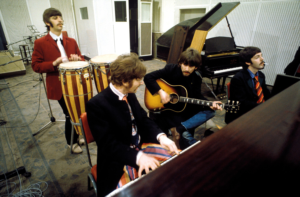
The best part? Ringo’s wearing a goddamn tie.
As an unabashed Pepper-supremacist — a surprisingly contested position these days — I’m always trying to figure out why I like listening to that LP so much more than Revolver (which has better songs), or White (which is so much more musically varied). To me, Revolver is still the new sound in-process; and as I’ve said many times, White to me is the sound of the group breaking up. All I can say for sure is that, of the three, Pepper is simply the place I like to be most.
This evening, the below video crawled across my algorithm. While watching it, I wondered: is it the guitar sound that attracts me to Pepper? Is it…brighter somehow? Listening to the guitar solo for “Fixing A Hole,” something I’ve heard countless times before, I was just knocked out. And the opening track, what a beautiful snarl to open an album!
Can any musicians or other trained-ear folk help me out? I know there are actually pedals designed to mimic the VOX UL730 amps the group used in 1966-67, but Pepper‘s guitars just hit like a Mack truck.
Perhaps this video has some clues? It’s over three hours long, so I’ll be watching it in pieces.
Related posts:
 A Few Words on Conspiracy Theory
 Custom Styles
 “I Think [The Beatles] Are Underrated”
 Lennon and…John?
Geoffrey Giuliano Goes Off
Lennon and…John?
Geoffrey Giuliano Goes Off
 George Starostin on “McLemore Avenue”
 10 Best Beatles Bass Lines?
 Philip Norman’s “letter” to Paul
 Does Ringo Starr have a tattoo?
 Howard Goodall’s Twentieth Century Greats The Beatles
 London researchers say Beatles not revolutionary
 All Hail the Rutles!
Thank you Mike, I really enjoyed that. I was 12 when Pepper came out. My friend called to tell me that his older brother had just brought it home and did I want to come listen. It was 8pm on a Friday night, and I had to beg my parents to let me go, the same way I had to beg them to stay up and watch them on Ed Sullivan the first time when I was 9 years old. What a major impact they had on my life, and that of many others!
I can’t help you with the guitar question but I’ll definitely support Pepper supremacy, as lonely a hill as that has become to defend. It IS a better place to be than Revolver, and though the c.w. holds that Revolver’s songs are superior (as you say), I think if you did a “shootout” between appropriate pairs of songs on Revolver vs. Pepper, it would be a pretty close contest. And the “concept” works whether they consciously engineered it or not (or started to and gave up) — see Gould’s “Can’t Buy Me Love”. Or Faith Current’s “Revolver/Pepper” articles that were reposted here.
I’ve always felt that Revolver was black and white, and Pepper full living color. Yes, that’s the packaging but…can you imagine if Brian had gotten his way and they’d put brown paper bags on Sgt. Pepper?
The thing about Pepper — and this for me is what elevates it over Revolver — is how it was full of correct artistic decisions by the Fabs. The music is wonderful on both, though I ever-so-slightly prefer psychedelic musichall to switched-on pop. Revolver was basically old-style packaging with Voorman’s groovy cover slapped on the front; Robert Freeman’s rosette could’ve (should’ve) been either the back cover or the inner sleeve or the label on the LP itself.
But Pepper…they picked Peter Blake over The Fool, printed the lyrics, added the inserts. They indemnified EMI against lawsuit so they could run all the famous photos. Pepper wasn’t just The Beatles at their most innovative, they were also infallible with it in a way that they never were again. Pepper is Beatle Taste (and Beatle Luck) at its zenith. It’s not for nothing that the film Yellow Submarine was greenlit during this period, too.
Mike! I was just leaving a comment on a Substack about the right and wrong ways to do meditation, where I mentioned your theory about how John’s incautious approach to meditating in Rishikesh might have permanently changed his personality. I gave ‘the old Beatles blog Hey Dullblog’ as my source, hit send, then idly thought I’d look the site up to see if I could find your thoughts on the subject. Imagine my delight when I saw the date of your last post, and immediately went back to remove the adjective ‘old’ from my comment!
On Pepper – I know we’ve had our differences re: it vs. Revolver, hehe (although the point seems to be moot these days, because if Revolver was Gen X’s album of choice, the Zoomers are definitively going for Abbey Road. Time is a funny thing…will Radiohead end up more known for In Rainbows than The Bends, Damon Albarn more for Gorillaz than Blur?). But I’ve really been enjoying Starostin’s latest magnum opus on the Sgt., which he’s only halfway through. Link here for the curious: https://substack.com/home/post/p-195323318
Welcome baaaaaaack
Thank you @Justin! Reading some of that Starostin made me write a bunch about the concept behind Pepper — it’s so obvious to me I can’t un-see it — but I got tangled up and ran out of steam halfway through. I’m just not a critic, you know? Devin and Nancy can do that dance, but I want to just SAY it, and be done with it. “Pepper’s about this, duh. Go read books about the Sixties, you’ll see it!”
My theory, based on my own experience mind you, is that the sudden cessation of drugs (save pot), followed by intense meditation outside of the usual type of instruction and supervision, gave Lennon a severe energetic imbalance. These energetic imbalances manifest in very uncomfortable thoughts and feelings as the energy moves around your meridians (or doesn’t), and you think they’re externally caused. You feel angry, and look for the external cause; you feel scared, and look for the external cause; you feel like you just wanna DIE right NOW, and so forth.
Lennon medicated his condition with even more drugs post-India, including opioids, which makes perfect sense. He was in agony and needed nervous system relief. But being in this state one is very very reactive, and if you’re not getting the root cause treated, you’ll do things in your life that fuck things up. And then you have problems caused by that, which is what plagued Lennon for the rest of his life.
I think his endless searching for diets and such was an attempt to treat this condition. If he’d lived a bit longer, I think he would’ve run across the type of Eastern medicine that saved my life, and it might’ve helped him immensely.
I…think? I’m not a doctor, or a critic. 🙂
If you have a one- or two-sentence version of the theory you want to drop here, that’s good enough for me – if Nietzsche could get away with bald assertions couched in witty aphorisms, so can we all 🙂
Your theory makes sense to me based on my experience too. I’ve done a lot of meditation, inner work, journalling and Gestalt therapy, and while all that sitting with the discomfort has been good for me, it’s also been UNCOMFORTABLE. Very much so. I understand what it’s like to have unpleasant feelings violently coming up before you’re grounded enough to deal with them, I’m intimately faniliar with psychosomatic disturbances in the bodymind, and I also know what it is to feel viscerally let down by someone you’ve not been able to stop yourself putting on a pedestal (transference and codependency are not a happy mix).
Then I consider that John had a way harder life than I’ve had, and was in much more pain – as evidenced by just how manically he consumed anything that could possibly help him shove the feelings down – and then he’s suddenly not consuming any of it, and Brian’s just died, and Paul’s done something to piss him off (usurped him, rejected him, left India early, whatever it is). And the culture of the time allowed him so much less self-awareness than we enjoy today: at least when I experience codependency, shame, transference or idol-building I immediately *know* what’s happening, and can compassionately witness it all from a deeper place in which those things *aren’t* happening. John was just totally at the mercy of his inner child.
In any case, it bothers me that so few Beatle people are willing to seriously grapple with the fact that the band went to India to mellow out and get enlightened, upon which John instantly starts writing songs filled with lyrics like ‘Feel so suicidal’, ‘I’m GOING INSANE!’ and ‘I’d give you everything I’ve got for a little peace of mind’, then starts acting like a crazy person, virtually single-handedly goes about fostering tension and discord, and ends up breaking up the band.
I’ll write my theory up as quick and brutally as possible in a post.
At the risk of getting to a level of detail nobody wants, my theory isn’t “Via meditation, Lennon unearthed trauma or other emotional material that he couldn’t handle.” That’s a perfectly legit theory, and may have happened, but it’s not what I’m talking about. I’m suggesting that
1) There is an “energy body” which Western medicine doesn’t recognize, but Eastern medicine does.
2) Long-term use of drugs causes changes in that energy body.
3) Sudden changes to drug usage patterns can cause disturbances — and even injuries — to a person’s energy body. Beginning or ending certain chemicals, for example. The sensations and states we use drugs for, can come from changes in the flow of qi. It’s not just that LSD does things to your nervous system, but also impacts your qi.
4) Big meditation — or big yoga/qigong, or big acupuncture, or big martial arts — can also disturb/injure the energy body.
5) Injuries — or, if you prefer, imbalances that don’t resolve without professional help — can cause physical and mental maladies.
6) Lennon’s energy body was developed in a certain way from his genetics, his childhood, and experiences. He had taken to using chemicals to soothe imbalances in his energy body, and those chemicals — which were stronger and stronger, from booze to speed to pot/LSD/whatever — had, by February 1968, become a load-bearing pillar in his energy body.
7) The abrupt removal of those drugs threw his energy body out of whack.
8) Lots of meditation and probably yoga threw it further out of whack. Even things that are healthy, like yoga, can cause uncomfortable symptoms as the system “detoxes.”
9) Lennon was damn strong, uncommonly resilient, but by the end of his India trip, these imbalances were making him act strangely. This is why he abruptly turned on the Maharishi. This is why he bitterly fought with Cyn on the flight home. This is why, once he got back to London, he started using again HARD. And it’s why he’s seemingly enraged at everybody in his life and runs to Yoko, and starts H.
None of this is to ignore or downplay the emotional content that he unearthed in India and was trying to metabolize. It is merely to share a very surprising subset of knowledge that I myself experienced a little more than ten years ago. Imbalances in the energy body — in Worsley acupuncture called “blocks” — make you feel physically awful, give you distinctive thoughts (some blocks make you depressed, some make you angry, some make you have repetitive thoughts). Each type has different effects, and you can have more than one going on at once. I don’t know if Lennon was out-of-whack, that would require an examination from a Worsley acupuncturist, but he sure acts like someone with one or several powerful, untreated energy blocks. By 27 he had really mistreated his body/mind/spirit, and had expended a huge amount of vitality. Like I said, he was strong, but it wouldn’t surprise me if he was suffering from this very peculiar kind of sickness.
All the “acting out” he does from 1968-71 or so are symptoms, and not just of childhood trauma. To me it’s much more acute than that, and his disregulation reminds me of periods of my own life. Luckily I was under the care of someone who knew what to do, but even so, I had many really hairy experiences.
I see what you’re saying. I know more than I want to know about psychosomatic disregulation – and am always meaning to get to that ‘here’s how this emotional response of mine may map onto this physical symptom of mine’ post – but nothing about the energy body, beyond the little I’ve picked up from occasional tai chi. As with the chakra system etc, I’m always willing to entertain ideas from outside of Western philosophy and medicine, but have never so far been ready to follow a particular one of them all the way down. Of course people’s personal stories make things far more vivid and real than any theoretical map could, so I’m intrigued to read about your own experience (as well as feeling compassion).
@Justin, if you do tai chi regularly, you’ll start to feel changes in your…self?…which are predictable and cumulative. You’ll start to notice different things, react differently emotionally, and develop sensitivities that you didn’t have before. It’s precisely the same as doing push ups every day and getting bigger arm muscles. The difference is, Western medicine hasn’t yet been able to observe and measure the process. It clearly exists — the only alternative is that it’s entirely psychosomatic, which seems vanishingly unlikely.
My personal experience with Hindu forms of medicine is very limited, but there is some overlap. In doing qigong (Chinese system) I developed an injury which can be treated Ayurvedically (Indian system). But when I talk, I’m only talking with experience in Chinese philosophies of medicine, and as a layperson.
As a layperson, I think what happened with John in India is, metaphorically, he started doing 10,000 push ups a day, and (quite predictably) ended up damaging himself. Because the extremely strenuous effort was directed at his energy system, the negative effects manifested there, too. He could’ve been fixed, probably completely but certainly in part; but did not avail himself of the people/things that might’ve fixed him. New York in the Seventies was full of people like Cheng Man-Ching, who taught extremely advanced tai chi and traditional Chinese medicine to the lovely hippies who eventually saved my life. Eating macrobiotically is fine, but he clearly needed much more, and different, care.
That John was never under an expert’s care is a tragedy, but it’s a tragedy that happens often to extremely rich and famous people. Healing requires a kind of humility (which was very difficult for me, btw).
Interesting. Qi in the Chinese system reminds me of what I’ve heard about shakti and kundalini in the Indian one, via accounts from Ram Dass and other Americans who went to Uttarakhand to study under Neem Karoli Baba. So many eyewitness testimonies from so many more-or-less-normal people about so many amazing things…shame the average Westerner is maybe even less open to hearing about any of it than in Lennon’s time.
Yes, it’s amazing stuff. I am more interested in Eastern culture than most people (in part thanks to the Beatles), but only came to it when I had exhausted all Western options and was near death. Luckily I was not too far gone to save. Worsley acupuncture and qigong are both imperceptible but very powerful, if incremental.
Speaking of kundalini (which I suspect is a form of qi; it seems to combine jing [vital life essence] and shen [spirit]), what I think happened to John is something called “a spiritual emergency,” or “kundalini awakening.” The symptoms come from an uncontrolled, large release of energy that overwhelms the channels/meridians—which I believe are called “nadis” in the Hindu tradition. A lot of people in the late 60s and after experienced this, thanks to heavy drugs and heavy meditation. Both should only be used under the supervision of wise experts.
I suspect your experience with these modalities was different from John’s because you approached them more thoughtfully. You did research and adopted them respectfully. You did your homework, in other words.
John most likely jumped into the experience the same way he embraced gulping down a handful of pills in Hamburg, or grinding up a bunch of substances in Kenwood. He was never a “do your homework” guy (one notable exception: his encyclopedic knowledge of 1950s/early ’60s rock ‘n roll).
The “10,000 push ups” analogy makes sense. It’s like learning how to swim by diving into the deepest part of the pool, and then thrashing.
Thank you for the implied compliment, but since I was absolutely desperate (and I was really seriously jacked up), I had to jump into the deep end of the pool. Which gave me a LOT of hairy symptoms. I went through deep deep discomfort, and was very close to not making it. I spent six solid months feeling “depersonalization”—I felt like I was outside my body; I lost my ability to write or work or really do anything; I was terrified all the time. Fortunately I had a great team and partner and some family resources to draw on.
At the time, if there had been an opportunity for me to use heavy drugs, I probably would have done so, just for some relief. If I’d come from a lifestyle like Lennon’s I would’ve been lost; but I’d been so sick for over a decade that I came to it all without drugs and alcohol (though spiritually quite sick).
It was only after going through this experience and re-reading John’s story, I suddenly thought, “wow, this might have been what happened to John Lennon!” And so was launched a thousand Dullblog posts.
John’s excessiveness, desperation for a guru, and impatience made him very likely to do what he did — run into something strong, do it a lot until he broke something, and then live with that injury. And something that came from the best parts of him, his curiosity and desire to be better, turned into another layer of damage. I only have compassion for the guy.
Oh, and I read somewhere that there’s a good chance the title track was the Beatles’ attempt to keep up with Hendrix (btw Paul is my favourite guitarist in the band, not George – he’s so much more spontaneous and aggressive). Makes sense. Lovely how it all came full circle, with the great man covering the song a few days after the album came out, as the song’s authors looked on.
“he title track was the Beatles’ attempt to keep up with Hendrix”
This sounds right to me.