

- Will the Beatles Last? - March 30, 2026
- I’d Love to Turn You On - March 25, 2026
- Memories of Nicholas Schaffner and The Beatles Forever - January 4, 2026
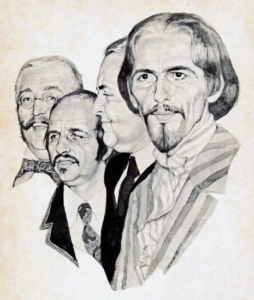
When the Beatles are 64, from LIFE Magazine in 1968.
As the Boomer generation fades into eternity, what does that mean for the standing of Beatlemusic in the culture? And what does it mean for the phenomenon of The Beatles as a cultural force? Will they persist as something like Mozart or Shakespeare, or recede like “Laugh-In” or Herman’s Hermits?
I’m biased, of course — but less than you might think. I’m 56, so what people are digging in one hundred years’ time is really nothing to do with me. But going strictly by what has happened since 1963, I do think people will be listening to The Beatles’ music in one hundred years’ time, maybe longer, maybe much longer. Perhaps more surprisingly, I think people will be studying their lives and story as well. From an artistic perspective, I think Shakespeare is a good analogy; Beatlemusic will still have an emotional pull in the future, albeit one enveloped in an alien style needing a bit of translation—as people still watch (and perform) King Lear, people will still listen to (and perform) Beatles songs. But another analog is the English Romantic poets, Byron and Shelley and Keats and the rest, whose poetry is read and studied, but they are also studied as part of a cultural movement, poetry as cultural history, and individual poets as stand-ins for how the culture was changing.
“I hope to have enough money…by the time we do flop.”
“Honestly, aren’t The Beatles on their way out?”
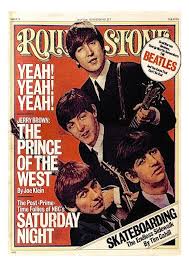
A nostalgia act on the cover of Rolling Stone, July 15, 1976.
People were endlessly trying to write them off within pop; when the 1966 Shea concert wasn’t a sellout like 1965 had been, NYC TV stations sent a guy out to stir up shit. In 1976, the cultural upswell of interest in a broken-up band was considered strange…but was monetized none the less. (1976 was the year of the first Beatlefest.) In 1995, there was widespread comment on “this nostalgia act” dominating the charts and outselling contemporary bands.
And so forth. The Beatles do not dominate the culture like they did in 1964, or even in 1970, but they are still here; one of the most fascinating things about them is how they haven’t receded, and at some point, I think the likelihood must shift from “they’re going to fade, they must” to “they’re going to continue to persist, they’re different.”
Now the counterargument to permanency is that Beatle-love has been driven by the size and wealth of the Baby Boom demographic, and that is assuredly a part of the story. But I think it’s clear that the Fabs’ cultural influence has persisted also because younger people like them, they have been accepted into the academy, and so forth. A lot of what makes it into “the canon” is simply this preferential acceptance by the small group of cultural priests in charge of preservation. The Beatles have been declared historically important by the people we anoint to tell us such stuff.
But it’s not just the preferences of the academy—it’s also what’s required for proper study of history. Western culture changed drastically between 1959 and 1980, and that’s going to be studied forever. And you can’t study that period without mentioning certain things—the Pill, Vietnam, the Cold War…I believe the Beatles are another of those subtopics that were so essential to that essential period. They encompass too much, and are too useful as shorthand to be forgotten. The only way The Beatles will be consigned to the dustbin of history is if The Sixties they kicked off, and then helped shape so dramatically, are suddenly seen as historically unimportant. I don’t think that’s going to happen for centuries.
There’s a final piece, totally unquantifiable, but maybe the most important factor of all. I was born in 1969, and so it’s not surprising that ˆ grew up listening to Beatles music. But what is surprising is how many parents of my generation weaned their kids on The Beatles. In a temporal sense, John, Paul, George and Ringo weren’t ours—yet we claimed them, and passed them on. And now the generation after mine, whatever you wish to call, has also introduced The Beatles to their children. Are people playing Radiohead or Wu-Tang or Skrillex to their three-year-olds? If they are, I’ve never heard of it.
There is a type of person who doesn’t want The Beatles to persist, a keyboard warrior who is determined to dismiss them as a boy-band, and those people will never admit that The Beatles haven’t turned into something other than a band, or even as a historical happenstance. But it’s beyond clear by the point that is exactly what has happened. The Beatles are, it seems, a shorthand, a metaphor, one of the ideas our culture is built around. Is that good or bad? Who knows? Is it a black mark on contemporary pop culture that a group which disbanded in 1970 still attracts so much attention? These are questions for another post. From everything I can tell, the Beatles have transcended pop music to become modern classical music, certainly equivalent to something like Mozart, and their story has transformed from mere happenstance into legend. Cheer or boo, as appropriate.
Related posts:
 I’d Love to Turn You On
 Shepard Fairey George Harrison Poster
 I’m So Tired: Responsive Notes on the Phenomenon of Beatle Fatigue
 That was your first mistake
 Try it, you might like it

 Beatles singles that never were?
 “Poor old Buddy”
 Ian Leslie: “Notes on Peter Jackson’s Get Back”
 Memories of Nicholas Schaffner and The Beatles Forever
 Starostin reviews “Abbey Road”
 Allen Klein Playboy Interview, 1971
Leave A Comment