

- The Beatles and “Scenius” - October 2, 2026
- Little Help From Our Friends? - September 2, 2026
- A quick yawp from Mr. History - August 24, 2026
[Folks: I found this in Drafts, re-read it, and liked it. I don’t know why I didn’t post it before, maybe because i didn’t come to A Grand Conclusion. Anyway, enjoy.—MG]
Commenter D.N. just coined a phrase that I really love: “Beatles folk memory,” which I took to mean “how the Beatles phenomenon, and the experience of being a fan of theirs, was experienced by fans.” I think it’s a tremendously useful concept.
The folk memory of first-generation fans is easiest to track, not only because it left huge traces in the mainstream monoculture, but because it was a truly generational experience. We’ve all seen the wonderful “Sprout of a New Generation” clip above—according to this blog, the lady’s name is Bonnie Von Lobenstein; when I think of first-generation fans, I think of Bonnie. They were young, and utterly unironic in their love of the group. And just as they threw themselves behind the moptop era Fabs as something Big and Important, they did the same with the Psychedelic Fabs, and the post-68 Hairy Fabs. The Fabs are theirs, and they are the Fabs, in a way that the rest of us—okay, I’ll just speak for myself—can find a little much at times. When you talk to a lot of Baby Boomers, it’s as if liking The Beatles conferred some tiny collaborative role in the Beatles’ genius. It doesn’t matter how cool you grew up to be, it seems like everyone who was between 8 and 20 in February 1964 has written about watching the Fabs on Ed Sullivan. And there are even collections of these memories, in books like Beatleness by Candy Leonard (who I met once at Beatlefest and thought was just tops).
But one of the most interesting things about The Beatles phenomenon is how it has persisted over generations, something that really hadn’t happened before. Teen crazes burned bright, then flamed out; The Beatles themselves expected this fate. The Rudy Valentino cult was burned out by 1930; Frank Sinatra’s bobby sox phase was done by the end of the war. Even Elvis, the King of Rock ‘n’ Roll, really only lasted three years. If you were a kid during those times, Valentino or Sinatra or Elvis imprinted on you for good…but it was a rare kid from the next generation or two who became really passionate about those faded icons.
The Beatles have proved themselves to be different, and that’s really remarkable. It’s what makes me think their music is indeed better than the usual high-points of pop culture, and what makes me think that they will last. That’s also why it offends me when Twitter assholes characterize them as “a boy band” or a Sixties relic, because that’s simply not shown by the historical record. It’s great to love [contemporary artist], but it’s simply highly unlikely they will be spawning massive cultural interest fifty and sixty years after their demise. Possible? Sure. But unlikely.
The Beatles’ weird persistence has given rise to eras of fandom, and this is where folk memory comes in. I’m particularly fascinated by two things:
- When new fans seemed to appear, their commercial power creating new Beatle content aimed at their particular emotional needs/interests, and that content fundamentally reshaping the canon; and
- How the eras overlap, or not. My beloved aunt, a fiercely devoted first-generation fan, never understood my 80s-era obsession with bootlegs. I, similarly, do not understand the obsession with McLennon, choosing sides between John and Paul (which is just the flipside of McLennon), or PID. When Dullblog has really cooked, it been a conversation of
Being a Beatles fan in 1964, 1974, 1984, 1994, 2004 and so on seems to be a distinct experience. It attracted different people for different reasons and meant something different to them.
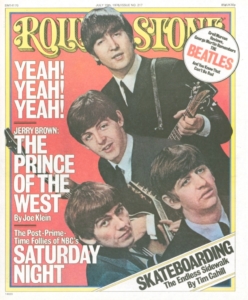
July 1976.
Since 1979-1986 was my deepest period of Beatle obsession, I can comment definitively only on that period. Having grown up saturated with Beatles- and Beatles-related music, I caught the end of a period of Seventies Beatle nostalgia. This had hit fever pitch around 1976, with the re-release of some Beatle material by EMI, Paul’s tour, and persistent Beatle reunion talk after the dissolution of the partnership. Its first glimmers can be seen in the first Beatlefest in 1974, but you can see it’s mainstream by July 1976, when it made the cover of Rolling Stone. That burst gave us “Beatlemania,” “Sgt. Pepper,” etc — including the Star-Club tapes in 1977. And it was all with the hope that the Beatles would reunite.
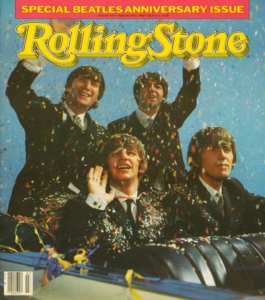
February 1984.
Then, after Lennon’s murder, fandom changed overnight. The Beatles became historical, and loving them became a kind of scholarship, or at least a rejection, implicit or explicit, of the present. I’d date that period from 1980 until, I guess, the release of the catalog on CD (1987). I’d put The Compleat Beatles in that period; Rolling Stone’s endless books and special issues; and the John Barrett Tapes/Sessions/EMI’s Rarities. It also encompasses “Here Today” from Tug of War, “All Those Years Ago,” Milk and Honey, and a bunch of other things. It’s a summation period. It’s much more elegiac than the Seventies period was. Beatlefest ’84 was wonderful, but…I recognize it now as post-coital sadness.:-)
The next period is kicked off by the release of various troves of bootleg material, with CD-quality sound. It all came in a rush: Yellow Dog’s “Unsurpassed Masters” set (beginning in 1990); Artifacts (1993); and Great Dane’s Complete BBC Sessions (1993). The success of these compilations (and Harrison’s need for money after being bilked by Denis O’Brien) practically forced the Anthology project in 1995.
After that, my own life accelerated to the point that I can’t track it. What do you guys think?
Related posts:
 Lights are back on.
 Los Angeles Beatles fans: Wanna go see a movie?
 Critics at Large reviews “The Fifth Beatle”
 “Poor old Buddy”
 I’m So Tired: Responsive Notes on the Phenomenon of Beatle Fatigue
 Why Your Favorite Celebrity Isn’t Who You Think They Are
 A few words about the latest Rolling Stone list…
 Deconstructing The Beatles, the movie
 Mike’s Dream Bootleg: Beatles Complete Anthology Recording Sessions Box Set
 ELO is back
 Charles Taylor on A Hard Day’s Night
 Try it, you might like it
“Wouldn’t it be nice…” to add some of that old music, original footage, sounds, tapes, snippets, notes, has remained on my mind through decades of life and fluctuating fandom. Inciting ideas, trains of thought, and perspectives on Hey Dullblog, have been inspiring. —- .
From a historian’s perspective your notes on ‘Beatles folk-memory’, Michael, are another way to describe historiographic phases. Interestingly you perceive new historiographic phases emerge new material or formats are released. Erin Torkelson-Weber had a similar approach in the only historiography of TheBeatles published so far. Really influential. We’re in need of another one, not just a serious rewrite. Your approach is tempting. —- .
My first Beatles obsession phase was 1968-1980… I remember participating with a one-thousand or more Beatles and John Lennon fans in a commemoration parade for Lennon in December 1980 in Amsterdam, was dull and fake. Lennon was never sacred genius to me, his peace-nick phase surely effectively got in met head. But not life-changing. Lennon’s referencing to the early Beatles live music as the only real thing, has probably inspired if not guided me until today… concert tapes from 1964 and before are ‘grant, keep it’ and ‘tantalising’ … hair-raising experiencing, it really would be nice “to add some of the new old music to my day”.
Hi @Michael G! It’s amazing having you back, and coincidentally just when I started doing a deep dive on you incredible blog (not for anything but this is the best place to read Beatles opinions without the so very common avoidant topics in the majority of virtual spaces – romantic relationships, drugs and other ailments, the elephant that is yoko etc etc etc).
I was just reading your India post and I noticed in the Get Back Halftime you mentioned how John seemed better than you thought, so I was wondering if that affected at all you “kundalini” theory… it’s a good theory, one that could explain John’s massive change in such a short time. His treatment of Cynthia during and after the divorce is something I’ll never really understand. How do you stand on it after these years?
My stance (based on a personal experience I had in 2012-2015) remains that John Lennon’s intense, unsupervised meditation in India, combined with the abrupt cessation of all drugs other than marijuana in February-May 1968, caused him to have a kind of energetic imbalance called “a spiritual emergency” as described by Stan Grof in his book of the same name. (This can also be called “a Kundalini emergency.”) Grof’s book was written because so many young people from the late Sixties onward were having the same sorts of breakdowns and weird behavior, caused by drugs and esoteric practices. When you take stuff that is meant to exist within pretty circumscribed traditions — meditation and martial arts practices handed down in small pieces over time from teacher to student — and then add in drugs, sex, and the whole hubbub of the Western world, it’s a wonder more people didn’t get knocked out of whack.
Most of the time they were committed, medicated, or both. Had Lennon not been a world-famous rock star, he would’ve been institutionalized as soon as he declared himself the reincarnation of Jesus. Since he was a world-famous rock star, he was able to find his way — but his behavior after May 1968 is of a person in intense psychological discomfort, often lashing out, often acting erratically, changing one thing after another in an attempt to seek relief. He didn’t just divorce Cynthia, he was SAVAGE towards her, and nothing we know about their marriage suggest this is justified. Similarly when the break with Paul comes, it is SAVAGE.
I found “Get Back” the pleasant watch I expected it to be, but it’s important to remember that when speaking about this time Lennon always mentioned to the big psychic pain that he was in, and the role heroin played in relieving it. Where was this massive undefined pervasive pain coming from? Whqt was bugging him? I think it was an energetic imbalance, which is indeed profoundly uncomfortable. Even when John was campaigning for Peace, I think he was trying to soothe his internal disorder.
To fix this stuff, you need comprehensive treatment from an expert practitioner. The guys who helped me out were Chinese, but I suspect that any culture with a long tradition of energetic medicine would be able to identify whatever was going on with John, and treat it. I am not sure he ever got the treatment he needed — I’d like to think he did, he was seeing the right kinds of people by the 70s, and lots of good people did practice in NYC. But Yoko’s need to control him, and his medical care (which you can see in her opinion of Janov) may have made that impossible.
I am a lurker who stumbled on the blog again. Glad you are back. I was 5 months old in February 1964, so I didn’t really plug into the Beatles until the Red and Blue albums and the Beatles Forever book. I am the same age as Julian Lennon, so I was really affected by the assassination when I was a senior in high school. I tried to talk the school librarian into giving me the commemorative issue of Time magazine (!) and I bought the paperback version of the John and Yoko Playboy interviews. John was ” sixteen in the head’ himself IMHO, so he really resonated with me then. I would pore over that book and it seemed replete with wisdom and truth to me! I think you are right; people my age were nothing like the “first wave” baby boomers and our Beatles experience was quite different too.
I still have a library of Beatles books, but the concerns of adult life took hold by the 90s. But, I do think they are a band for the ages. The music itself and the stories and personalities behind it have an enduring and peculiar fascination for every succeeding generation , it seems. There are internet discussions about them all over the internet from every demographic. I am sure all the other bands would like to know the secret…
I still have that Nicholas Schaffner book; read it until it fell apart.
Difficult for fans raised on the internet to imagine, but in the late 70s and early 80s, just SEEING a copy of the Butcher cover (for example) was a thrill. In those days, being a Beatles fan was as much sleuthing as it was enjoying. Just like the young Fabs traveling across town to learn a new chord, fans of my generation would go to any record store or used bookstore to snap up some rarity. That’s why conventions had an urgency and magic that they just cannot have today; walking through Vendor Alley, you’d see and hear things that you’d literally dreamed about.
Well, the thrill of watching the live game is incomparable to watching it on the replays…
The Beatles phenomenon hasn’t died out, but it has mutated, and each new generation experiences a different Beatles phenomenon than in the past. For example, even though the music is the same as it was sixty years ago, the way we consume it has changed, so while many of us would love to have lived during the sixties and been part of the mania, few would trade the privilege of listening to their music on a modern, immersive sound system.
I discovered them in 1994, so I knew The Beatles through The Threetles, when bootlegs became official merchandise and musical rarities ceased to be rarities, becoming more mainstream and expensive products.
As a fan, I feel less special than the baby boomers and for some selfish reason I wish the Fab Four to be a niche group and less global cause I believe that the intensity of a fandom is inversely proportional to its size, although Them proved otherwise
Great comment, @Alejandra! Though I would have much rather have lived through the original mania (and the years that followed). I like modern immersive sound systems, but mono on a transistor radio (or car radio) is pretty goddamn satisfying too.
@Michael, SO glad to see you’re back — I had the misfortune to discover HD just when the lights were going out, and I’ve been kicking myself (and reading the ENTIRE blog straight through) for the last two years. Your take(s) on John & heroin and “what happened in India” changed the way I thought about the whole history of the group after 40+ years of fandom, and among so many other gifts I (SO belatedly) discovered “Magic Circles” thanks to this blog.
In the 70s I was a little nerd who liked to read ABOUT the Beatles (even though we didn’t have the records), but didn’t really have my born-again moment till 1984 — completely random timing, the proximate cause only being that a friendly art teacher loaned me the later albums. In hindsight it wasn’t such a great time to be a Beatles fan, unless you really dug “Spies Like Us”…
I’d agree that 1987 was a turning point with the CD catalog release, and to me 1988 seems pretty huge by itself: Goldman’s book and the “official response” of the “Imagine” film, Lewisohn’s “Recording Sessions”, and “Ultra Rare Trax” on CD — those to me are before/after events. for good and ill.
Probably the next big “marker” in the timeline would be the Anthology, and it does get a little fuzzy after that. But whatever “eras” have happened in-between (already), I’ll put this out there: “Get Back” has had the biggest impact of anything released by or about the Beatles in the last thirty years, both within the fandom and with the normies.
@Jarrett, I’m delighted that my (over)thinking on those topics has been interesting to you, and perhaps spurred some insights of your own, which I hope you’ll share. “Magic Circles” is what Dullblog wants to be when it grows up, and I encourage every serious Beatlefan to read it.
Agreed that ’84 was rough; I soothed myself by going to Chicago Beatlefest. But that era was a weird interregnum — so many of the people were still alive (I’m sure I saw/heard Harry Nilsson), but everything happened in the shadow of the one man who wasn’t.
I’m so torn about “Get Back.” On the one hand I’m delighted at the content, it looks and sounds so good, but on the other, it has triggered my Spidey Sense from the beginning. There is a tendency among people who made mischief in the Sixties to downplay their activities — to sanitize the whole affair. But the messiness was the WHOLE POINT. “Get Back” strikes me as the version of the Get Back sessions that Disney (and the partners) wanted to sell the world fifty years later, not what happened or how they were.
The only thing that could possibly kill The Beatles for future generations is making them safe and inoffensive, bloated and optimized. Unfortunately that is precisely the instinct of the corporate owners of culture.
Michael, All of the Beatles seemed very disenchanted and disgruntled about the “Let It Be” sessions in the press and accounts that I read in the in the late 70s and 80s that dated from that time ( I was too young to remember much about the Beatles except “Yellow Submarine” and the Blue Meanies until the resurgence with the Red and Blue albums and “Got to Get You into Life’ on AM radio).
I think I trust their impressions more than the cheery vibe of “Get Back”, though I enjoyed watching it. Clearly, they had more good times than they remembered and those were caught on film, but I think the ship was going down and they all had the same feeling of malaise by then. As you posit, drugs played a part as well as fatigue from being trapped in a silo together. And Yoko, the new and omnipresent studio presence!
@Marie, your comment joggled loose a post I did in 2021 about these issues: https://www.heydullblog.com/uncategorized/let-it-be-get-back-and-history-as-art/
Poke around the site near that date and I think you’ll find more of interest.
As people age, they tend to say/think, “Why dwell on the bad?” I think there’s a lot of that in Get Back; as well as the commercial imperatives. I think it is about as accurate as A Hard Day’s Night, which is less of a slap than it might seem. Both movies embody certain really fundamental truths about the band’s public personae AND private interactions.
Next Big Event after the Anthology / Britpop revival era has to be the Internet, right. Message boards, forums, endless Greatest Album rankings, amateur reviewers like George Starostin, John McFerrin, Piero Scaruffi, Wilson & Alroy. Power to the people. The people speak and…the Beatles get re-canonised all over again.
The fandom’s always been diverse, but in the decades after this, that diversity makes itself heard more than at any point since macho rock critics stole music appreciation from teenage girls. The public’s take on the band is fleshed out by all these different perspectives, most notably the female one. The Fabs’ cred climbs even higher as it finally becomes possible to say that they aren’t just more fun to listen to than Led Zeppelin or Nirvana, they might actually be cooler too. Paul’s star rises.
The SM-driven rise of cancel culture – a phrase that gets thrown almost exclusively at the left, even though the right invented the principle right about the time we discovered agriculture – and a reckoning concerning the Beatles’ conduct. John’s star fades.
The 2012 Summer Olympics. An endless stream of YouTube reaction videos. Rick Beato naming his child Lennon. Paul McCartney’s undying commitment to the legacy: tours, chat shows, Rick Rubin, Carpool Karaoke. The Beatles are firmly part of History, Universally Likeable, thoroughly cute again. Seemingly unassailable International Treasure status. Think the Queen or James Bond.
Lately, the Get Back phenomenon, and now these 4 movies coming out in the wake of the Queen, Elton, Dylan & Springsteen movies. IMO every single one of these projects has had the same sanitised “Disney” vibe, which is a major cause for concern (although the Elton one managed to depress the hell out of me anyway). I’m not even talking primarily about whitewashing the personalities, though that’s in the mix as well – after all, Chalamet’s Dylan wasn’t particularly sympathetic – it’s more this silly Day-Glo aura that flattens the world surrounding these icons and uses every cheap trick in the book to maximise the impact of the performances, which ends up obliterating exactly what made them important and special. If we’re not careful, the Beatles could end up the “Beatles, Beatles” in the same way that England became “England, England” in the Julian Barnes novel.
But personally, I think the music’s ultimately strong, quirky and inventive enough to survive all that. You made an analogy with Shakespeare elsewhere, and I think it holds: enduring institution, conjures a different time, somehow part of the air we breathe, possessed of enough depth, human spirit and transgressive daring that scholarly types will always delight in unearthing the original intent and “making it new” again (‘To understand how new the Moog would have sounded at the time, imagine the part played on an iSynth 203!’).
60s-70s music in general is pretty well remembered and loved, not just the Beatles. Hendrix, Black Sabbath, Pink Floyd, even the Monkees are still fairly popular. This is probably due to the technology of the LP. In the 80s-90s, VCRs meant film became the best art form (I recently watched RoboCop for the first time and couldn’t believe how much better it is than most movies nowadays. That’s not nostalgia, because I never watched it back then.) In the 00s-10s, DVDs gave us prestige television (with commentary tracks!) Today the best art form seems to be YouTube-style lo-fi horror films.
McLennon, I think, is a side effect of millennials and zoomers consuming huge amounts of internet porn from a young age. It’s just assumed that you can hop online and insantly find porn of anything you like, complete with labeled categories. McLennon falls under the categories of “forbidden love” and “pining,” just like that gay hockey show every girl loves.
I also think that McLennon cannot be separated from — I’m having trouble expressing this precisely enough — the emergence of Asian forms of youth culture as the dominant forms? Those which young people were formed by? Talking with some of the young people I know (under 30s), Japanese video games, anime, comic books, Asian horror/monster films, all these genres comprised the majority of what they consumed as kids. Even the biggest pop groups, like BTS, were Korean.
So when I see McLennon, I see yaoi — a specific type of Japanese female fan culture highlighting m/m homosexual romance/relationships.
This is anecdote, not data, but I glancingly knew the creator of one of the first pieces of gay hockey pop culture. She was a very talented student cartoonist, with a style that was heavily influenced by anime.
That makes sense. I’m thinking a lot about McLennon right now, because I’ve finished listening to Another Kind of Mind and I’m working my way through One Sweet Dream. This podcast project started with the thesis that the Beatles broke up because John was romantically in love with Paul and Paul rejected him. But it’s going off the rails. That thesis turned out to be indefensible, so it’s devolving into rage against John for not treating Paul right. Also an odd level of rage or at least contempt against George and Ringo, and Brian, and Mark Lewisohn, and Beatle authors in general. I’m not sure what’s going on here.
I have had my fill of McLennon from our commenters, so I haven’t investigated either of those podcasts. I think HD was on the forefront of applying emotional intelligence to the conventional narrative of the Beatles story, which was basically the fruit of a bunch of middle-aged people with some life experience and some therapy re-addressing a youthful interest. Was it interesting? Seems so, to some. But I think there are at least two pretty substantial differences between how we’ve tried to do it, and others.
The first is, speaking for myself, I’ve been very clear about which of my own personal experiences have informed my opinions, and why. This hasn’t been comfortable, frankly it’s been pretty uncomfortable, but I think it’s necessary information for readers to judge my theories. And I also think if I’m going to, for example, say that it’s highly unlikely that John Lennon kicked heroin, and was probably lying about it, it’s only fair to add that I have this opinion based on my own personal experience with addicts. My belief that Yoko probably used heroin at a maintenance level for her entire post-Lennon life comes directly from my conversations in 2016 with a man in his 70s who’d been using heroin since 1966.
The second is, I’m basically satisfied with the Standard Narrative — not because I don’t want the story to keep deepening and unfolding, because who wouldn’t? or that I don’t want to be a Special Beatle-Boy with Special Secret Beatle-Knowledge, because of course I do — but because it’s already a hell of a great story. It doesn’t have to orbit our contemporary obsessions around identity to be absolutely engrossing. The only way you don’t realize it’s an amazing story is if you come in assuming that The Beatles, or something like them, was bound to happen. And I don’t think that’s true. I think The Beatles were a massive historical accident in the most wonderful sense, and directly and indirectly led to all sorts of fascinating things. I don’t need John and Paul to be sexual partners, and intuit that anybody who does, is reflecting their own erotic needs. Which is okay, until it becomes angry — which it often seems to? It’s one thing to have a sexual fantasy; it’s another to get pissed off if others don’t acknowledge it as truth.
I think that people raised on the internet are used to having information curated to please them. The stories they encounter are stories they are predisposed to react to. When one scrolls social media, or reads a blog, one is in a world full of curated information. It’s difficult to explain to someone who didn’t grow up reading newspapers and magazines how uncurated that experience was — how reading stuff you were interested in or pleased by or which confirmed your priors, came with winnowing through lots of stuff that you wouldn’t have selected, or wasn’t “for you.” Which was broadening, and seems to have created different kinds of people.
I think if you’ve lived in a world of curated information, it’s only natural to look at a story from long ago that has nothing to do with you or anyone you know, and attempt to 1) relate it to yourself and your obsessions and, 2) shape it into something you like, that serves you emotionally, that confirms your priors. If a person really, truly believes that sexuality is fluid and gender is a construct and there’s very little that is essentially male or female, then McLennon is a lot more plausible; it “feels true.” But I personally think it’s quite a stretch to make two guys who were born in Liverpool in 1940 and ’42 act like a couple of contemporary, deeply digital, fan-fic soaked 22-year-olds.
This is why you have to “show your work,” as I try to. So the reader can decide whether “Kundalini emergency” for example is something that could potentially be experienced the same way between John Lennon in 1968-71 and Mike Gerber from 2012-2014.
I started listening to Another Kind of Mind’s critique of Mark Lewisohn but found myself put off right away by one of their stated rules, that they were basing their critique entirely on the shorter version of Tune In, not the unabridged version. Well, okay, the shorter version is the one more people are likely to read, so it’s going to be the more influential version of the book. Fair enough. But it seems to me that if you’re going to level charges like “Lewisohn spends X number of pages on John’s mom’s death but only Y number of pages on Paul’s mom’s death,” then completely ignoring the full version of Lewisohn’s book is critical malpractice. Lewisohn has his faults (he’s not the best stylist, which can make his books a slog to get through), but I find the intensity of some of the attacks on him to be a little bewildering.