

- Little Help From Our Friends? - September 2, 2026
- A quick yawp from Mr. History - August 24, 2026
- First Thoughts on “The Beatles – A Four-Film Cinematic Event” - August 17, 2026
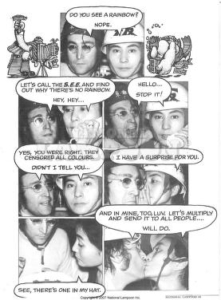
J&Y in National Lampoon Magazine, March 1972. Available, along with the rest of the issue, on Internetarchive.org.
This morning, about a week into the Great AdSense Experiment, I got a notification from Google that ads were being turned off on one of our posts. I went to check it out, and someone had filed a DCMA violation report. What post was it?
Sigh.
DCMA is a claim of copyright infringement, so the first thing I did was remove all external art embeds from the piece. The second thing I did was replace the featured image with a copyright-free image. There’s now just my essay, the copyright which I own, and a copyright-free image, so—although the image portion of the commentary is less enriching—in my inexpert opinion, DCMA is satisfied. Notifying Google of these changes apparently comes with the possibility of perjury and lawsuit, so fuck it. The post will not show up in Google searches, I guess, but I’m not going to tangle with any of that.
I’m not a lawyer, but I have been a publisher since 1989, so I think I have at least a working knowledge of how IP has worked for 20% of US history. All content on Dullblog, to my eye, falls under “fair use” because it is fundamentally “commentary and criticism.” (That having been said, I don’t want to reproduce anything that a copyright holder doesn’t want me to reproduce, hence the language in the footer. No DCMA is needed, just contact me via the form above, and I’ll remove anything you own.) My attempt to monetize Dullblog—on a miniscule scale, approximately $0.94/day—doesn’t change my fundamental relationship to the material—it’s criticism and commentary. And frankly, if a monetized Dullblog comes in for DCMA scrutiny, the same rules should apply to ALL sites, which means we gotta nuke some significant portion of the entire internet. And that doesn’t happen because Google makes money on ads, not because IP rules are clear, just, or equally enforced.
Of course copyright isn’t the issue here. It’s the essay. Someone didn’t like what I wrote about Yoko, and used a bogus concern to suppress my speech. Who was this? It doesn’t matter; what matters is simply this — if Yoko Ono, or even any fan, wrote a song called, “Mike Gerber is a Douchebag,” I would have no way to remove that from public discourse, and we all know it. I couldn’t do anything, even if they did something unquestionably legally actionable, say, sampled a big chunk of an interview, and chopped it up to make me sound like an idiot. (They might not even have to chop it up, I say all sorts of foolish things.) Because I am not rich, the legal system does not work for me. Alternatively, a fan could do it anonymously and enjoy complete invulnerability. I choose not to be anonymous here, because I think anonymity drives enshittification.
Two groups rule the internet: the uber-wealthy, and the anonymous dogpilers. That’s how enshittification works. In 1972, the above page was run in National Lampoon, a gatekept, newsstand-driven print humor magazine. That whole magazine — acknowledged as the wellspring of much of contemporary American humor (something which, as far as I know, most people like) — would be unpublishable online today. Some person would’ve been offended by every single page, and filed a DCMA, or otherwise found a way to take it down. And our culture would not have grown from where it was in 1972. If fans had been empowered in 1972, young fans today wouldn’t know about Yoko. It was gatekeeping and monoculture that brought her to the public eye. (Do NOT write in talking to me about Fluxus or Ornette Coleman. Pre-Lennon Yoko was at best a minor figure in the New York art scene, probably less well-known than the arguably more popular and important Yayoi Kusama, who comes up when you Google “Japanese artist 60s not yoko ono.”)
I have some experience on the other side of DCMA requests, and with opinionated billionaires, too. In 2002, I self-published a parody of Harry Potter; I had to self-publish it, because every large publishing house in the US said, “We love this book and think it’s hilarious, but we don’t want to get sued.” Now I was/am very familiar with the legal precedent regarding print parody, so I had written it with an eye towards that; in the US at least, Barry Trotter would be unlikely to be sued successfully. And either through a legal opinion saying this, or being easygoing about such things, JKR did not sue the book, nor did Warner Bros or Scholastic or any other Potter IP owner. And the book was released conventionally, and went on to be a big success. I liked the Potter books, and thought it was fine that people read and enjoyed them, and had written something that I felt would enhance the fans’ appreciation of them. (What I didn’t like were the books being made into movies.)
To my delight, most Harry Potter fans LOVED Barry Trotter, which sold over a million copies; but occasionally I’d get a letter or an email explaining to me how what I was doing “should be illegal.” There is a certain type of fan that thinks that way. I suspect that was the type of person who scanned every page of my book, then posted the PDF onto torrenting sites. Maybe a hundred thousand people read the book that way, which cost me a lot of money (and, twenty years later, forces me to monetize my Beatles blog). Day after day I’d write DCMA letters to ISPs, but as soon as it was taken down in one place, it would spring up in another. Unless I was a corporation with a team of lawyers, I couldn’t use this remedy. I just had to let my stuff get pirated. And that piracy not only hurt my sales, it also hurt my future ability to sell books.
I’ve been running (and paying for) Dullblog since 2010 or so, when we moved from Blogger. I’ve spent well over $10,000 simply on hosting; Nancy has paid some, too. It has been a labor of love, and while it has been a huge net loss for me financially, it has surely inspired readers to go buy more Beatle-dreck. Apple’s made money off Dullblog; the Lennon Estate has, too. You’re welcome, ladies and gents and enbees, happy to do it! Dullblog has deepened the fandom, and maybe even grown it. That’s WHY “commentary and criticism” is protected under fair use; C&C benefits society and the copyright holders too.
But we live under capitalism, and I have bills to pay just like everybody else, and that need makes me vulnerable. It makes me have to investigate ways to monetize the site; and it makes me unable to defend my IP with equal vigor; and it makes what I say able to be censored. And all these corporate entities are not so encumbered, so what they say, and what they want said, circulates freely, and can be as loud as they afford. And the net result of all this has been a narrowing of speech.
Who is allowed to speak, on what, and how loudly is political. Using DCMA to suppress that post was a political act that does not help artists like Yoko Ono, or musicians, or fans’ ability to enjoy things that they like. Conceptual social critics like Yoko Ono specifically need absolute freedom of speech, otherwise something like her “Cut Piece” can be censored for nudity, when the real issue is patriarchy, or racism, or someone not getting a bribe.
Cannot you imagine a world where ISPs are forced to take down Yoko’s work for bogus reason? You don’t have to imagine it, because that world is HERE, in large part because misguided fans — of Yoko, of Elon, of Donald Trump — don’t care about the niceties. They don’t care about, or can’t tell, the difference between critique and hate speech. Shutting people up turns speech into simply an expression of power. While Yoko might have that power today, her legacy — her standing as anything other than Mrs. Famous Beatle — will be precisely as big or as small as the future’s freedom of speech.
And if it was a corporation who sent in that DCMA notice: your current wealth and power is at risk, but not from me. The more centralized Beatle content becomes — if one entity or a handful tightly controls it — larger authorities, be they governmental or private, can make all that go away with the flick of a switch. Today, right now, Elon Musk could auto-trash any post on X that used the word “Beatles” or “John Lennon” or “Yoko Ono,” and there would be nothing anyone could do. Not Apple, not Disney, not anybody. Suddenly, that massively important cultural material — which encompasses not just the songs and photos and interviews but mountains and mountains of criticism and commentary — would be gone.
Much of what is so upsetting about politics in the U.S. right now is how much of the repression is being driven by Boomers and members of Gen X, two groups that have benefitted massively from the unimaginable OPENING of cultural expression since 1960. But there is nothing permanent about that; freedom of speech requires people to speak, incessantly, at risk, and about topics that other may find offensive. The speaker’s responsibility is to speak mindfully, taking into account the possible damage of the speech. The possible damage inherent in an opinion must be outweighed by its possible benefits.
I think I did that with my Yoko post; and the fact that the roof didn’t fall in — and that the post occasionally has been linked to by other fans trying to untangle their own complicated feelings about this woman so present in the Beatles story — shows that my judgment was correct. To want to “take it down” is actually helping move us deeper into a world where the things that people decry when speaking of Yoko — racism, sexism, and patriarchy — are firmly in charge. Jerusalem, if it is ever to be built, must have people being praised and criticized for what they do, regardless of their relative wealth and power, and that judgment having sufficient reach to give them pause regarding their behavior. A world like our present one, where the rich are insulated from all criticism, and the rest of us better shut up or we’ll send in the lawyers, that’s no place any artist, or any feminist, or any person interested in racial or international harmony, should want to live.
So I’ve turned off AdSense, that experiment is over. I can’t expose myself to this kind of nonsense, certainly not for $0.94 a day. But if you like the site and want to help defray my hosting costs, consider supporting The American Bystander on Patreon. If John Lennon were alive today, I suspect he would be a subscriber. After all, he used to love the old National Lampoon.
Related posts:
 The concept behind Pepper
 Ian Leslie: “Notes on Peter Jackson’s Get Back”
 Various musings on Lennon and Addiction
 Allen Klein biography review by Ruth
 Beatles at the BBC, Volume 2: clearly enjoyable
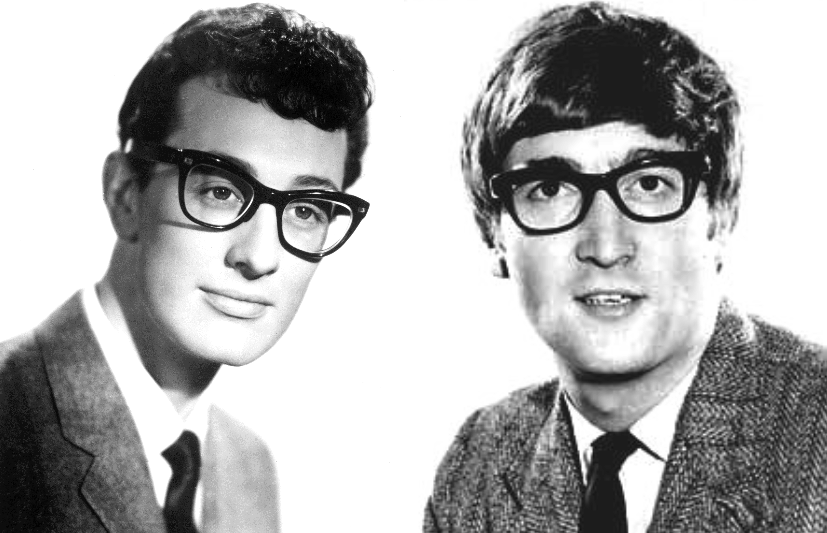 “Poor old Buddy”
 Lewisohn with Conan O’Brien on Serious Jibber-Jabber
 John Lennon: Witness for the (Marijuana) Defense
 Try it, you might like it
 That was your first mistake
 Mad King John
 Jann Wenner and The Beatles
I’m sorry to hear all this Mike, what a mess. If you bring back the dullblog patreon, I’m onboard!
Thank you, @Paul — I’ll fix the Patreon next week!
The silver lining is you’ll hopefully end up making more money this way Honestly, I found the ads very intrusive on my phone and am very happy to pay the 4.50 p/m rather than see them any more (oh, plus there’s the whole supporting the arts thing).
Yeah I wasn’t liking them either.
MANY THANKS for your pledge! Really appreciate it.
Btw I’m sure you’ve considered a Substack Mike? Decent interface, stand up for their writers, free to run, publications with lots of subs can do quite well out of it…Might be an interesting way to have the HD brand start making as opposed to costing money, or at least break even.
I HAVE thought of cross-posting HD to Substack, but haven’t done so because I don’t want to divide the audience. And does the content live on the web for free? Any opinions?
I’ve found it to be a handy way of building a dedicated audience myself – over the years I’ve attracted hundreds of subscribers with next-to-zero promotion and vast gaps between posts, and have seen other homemade publications growing much quicker and gathering a fair few paid subs along the way. It makes me sad to think of a passion project costing someone thousands rather than making them thousands (maybe because that’s exactly what recording music does to me?), so thought I’d throw the idea out there. Curious what you mean by ‘does the content live on the web for free’ – are you talking in a philosophical sense? 🙂 I know Bystander has a Substack presence so you’ve some experience with the platform, how have you found it so far?
I’ve found Substack OK for Bystander — we left after it was discovered to be platforming Nazis, but were forced to come back when Ghost simply didn’t grow our readerbase.
I want Dullblog to remain free on the web, as HeyDullblog.com; but I might test a Substack version to monetize the content. What I’d call “the Dullblog approach” to Beatle fandom is, I think, much more common on Substack. But I would love love love for new readers to be able to dive into our archives/comments.
The question is, will anybody pay $5/mo for something they could also get on the web for free?
Your piece about the Nazis at the time was one of my favourite things you’ve written btw, cut through all the Discourse and hit the nail right on the head.
IMO there’s just something about Substack, where you get all these enthusiastic and loyal readers who are there because they love writing and writers, and see themselves as patrons of the arts more than as traditional consumers (similar to Patreon I guess). I have a subscriber who keeps giving me a fiver a month even though I haven’t posted for months & months now, continuing to even after I offered to reimburse him for his wasted money. (I also kept up payments to the HD Patreon for a good while after the site went on its indefinite hiatus, as a sort of ongoing thank you for the hours of enjoyment I’d already had :-)) I think the Internet has basically shattered the old ‘I provide X product and charge Y amount’ model; in an era where people can get practically *everything* for free they basically give money to people they like because they like them.
All that said, I never paywall on Substack, and know that if I did (on top of posting more in general) I’d attract more payers. So there’s something there for sure.
One idea might be to do a paywalled post at regular intervals of however many weeks, available only on Substack? I know that’d add more to a workload that probably can’t take any more adding to, but what if the paywalled posts were more shoot-from-the-hip, freewheeling, less edited, more personal, hell, even the dreaded listicles…in other words, the kind of thing that’d take 2 seconds to do and you likely wouldn’t want on the main HD site anyway. That very offhandedness might well drive paid subs by being *more* likely to appeal to the kind of person who loyally reads HD and would like to get to know its creator better – seems to me like the slicker mainstream culture gets, the more a certain type of person is drawn to stream-of-consciousness articles and spontaneous one-take videos!
So a Substack could be a “McCartney I & II” to the main site’s “Pepper”. Just a thought 🙂
Oh thank you for liking the Nazis piece; as I recall it was Christmas Week or something, and I was sitting there writing about how knowing the history of Weimar makes me worry all the time. Fascism makes it hard for me to get into the Holiday spirit.
That’s an interesting idea about the additional content, @Justin. Of course I go in the other direction and think, “Can I use my publishing wiles to talk to Significant Beatle Authors as a way to generate exclusive content?”
I do think you’re right that people just subscribe. I am so grateful for that — I am stretched incredibly thin and have so many projects in air that I can freeze up. I am going to take a catnap now (6:00 pm) so I can spend this Saturday night writing. Weekend? What’s a weekend?
I’m coming around to the idea of putting Dullblog on Substack simply to give people a way to support, but also to have Substack readers know about us. I’m honestly a little sheepish about it because the Beatle content over there is…well, it’s very obsessive, and that’s never been my jam. But I take everyone’s continued interest in the site as proof that maybe some people would enjoy Dullblog on Substack.
Exactly why there’s a gap in the market for more expansive writing that situates the band in a broader cultural and intellectual context, say I 🙂
Bless you for the encouragement!