

- The Beatles and “Scenius” - October 2, 2026
- Little Help From Our Friends? - September 2, 2026
- A quick yawp from Mr. History - August 24, 2026
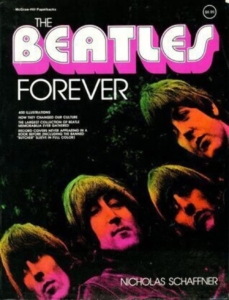
This edition is in a lot better condition than mine is.
Like many a second-generation fan, I thrilled to Nicholas Schaffner’s book The Beatles Forever. (Which can be viewed in its entirety here!) Some years ago, when my mom was cleaning out the family homestead on Forest Avenue in Oak Park, she handed me a box of Beatles stuff salvaged from my old room—LPs, posters, and books all still scented with my desperate teenaged dreams. Of my shelf-full of Beatle books, I kept only five—SHOUT!, John Lennon: One Day at a Time (since pitched), the Hunter Davies bio, Rolling Stone‘s The Beatles (with the Andy Warhol cover, seems to be rare?), and The Beatles Forever.
I’m looking at it now, thirty Christmasses after that, and nearly 50 since my grandma slipped it under our tree. The book is in pieces; I read The Beatles Forever over and over until it literally fell apart. But I loved it so, all the loose signatures are still present, pressed carefully between a dust-jacket that is only slightly torn.
“Pleasantly surprised by the surge of interest in his clients, Martin decided the world was ready for a Beatle album. But the record company was still taking no chances: all the songs had to be recorded and ready in a single day, February 11, 1963.
With Martin at the controls of the two-track tape machine, the Beatles—two of them suffering from mid-winter colds—were obliged to tear through an assortment of Lennon-McCartney originals and six recent American favorites, all of which they had been showcasing in concert…”
Yeah yeah yeah. We all know the story now, down to all its little details like John slugging milk to get his voice through “Twist and Shout,” but nobody knew the story then, In 1978, Beatles music was still everywhere, but it was difficult to piece together exactly what had happened. Imagine that! There was no Anthology; no Lewisohn or Spitz or Norman or even Albert Goldman. There were microfiche of Rolling Stone in your local library, which maybe had the Lennon Remembers paperback, but not much more. It was still an oral story, mostly—my Aunt could tell me what it was like to see the Fabs at Busch Stadium in 1966, but…what happened in India? She didn’t know. Who was Brian Epstein, really? That was all still in the vaults, and in the diaries and heads of the people who lived it. Back in 1978, George Martin still had dark hair.
The Beatles Forever, like The Compleat Beatles (which I’ve posted about here), was one of the first attempts to tell the story in all its sweep and glory. But unlike the McDowell documentary—a portentous, weirdly chilly movie released in the bleak eighteen months after Lennon’s murder, The Beatles Forever was hopeful. It embodied those expectant years between Wings’ triumphant 1976 tour and Lennon’s murder, a time when a Beatles reunion wasn’t only possible, but seemed likely. Being a fan back then wasn’t totally an historical exercise, but an investment in the future.
Schaffner’s book was exactly what my Beatle-crazed nine-year-old mind craved: what happened. The whole story lucidly told, from Sullivan to SNL, with pictures. A couple years later, ambling giddily through the bowels of the O’Hare Hilton, I realized that The Beatles Forever was a Beatles convention on paper.
Looking at the book tonight, I’m struck by how purely it’s a core sample of late-Seventies Beatlefan opinion—something wonderful had happened, we knew that. But we didn’t know how singular it was yet. And we didn’t yet know the story was over.
Today, when lots of fans sniffily reject “the Standard Narrative” in favor of a Beatles story that works better for them, it’s impossible to explain how information-starved fans were back in the Seventies and Eighties, impossible to describe how important this book and a few others like it were, not today where any unreleased track is two clicks away on YouTube. If first-generation Beatle fandom was a lived experience, the second was a mindspace, created by the official disc- and filmography, supported by ephemera (sleeves, pictures, posters, journalism/interviews, even toys and merch), all arranged into a coherent narrative by books like The Beatles Forever. The very idea of a book like 1980’s The Beatles A to Z (which I also owned) is silly today, not just because everything’s available on the internet, but that there’s so much more to discuss. Two clicks and I’m on this site, reading about Magic Alex’s familial roots in Bulgaria. No area of Beatle lore remains unexplored; sometimes it seems like there are hundreds of YouTubers raking up every aspect in exchange for clicks. The Beatles story is now as big as the entire world, and puts more money into more people’s pockets than all the things that seemed so much more consequential in 1978—there is one really substantial YouTube series on The Cold War, but many on The Beatles. Today, we are choking on Beatle facts, but in 1978, the story was still somewhat human-scaled—you could still get your hands around the whole thing, if you were persistent enough. Not for nothing is Mark Lewisohn a second-generation fan, and his massive project is the natural bridge between the book-based second-generation fandom and the internet-based one of today.
But if facts were much harder to come by in 1978, they were also weirdly…pure. Uncontested. Unowned. Not so surrounded and conditioned by other facts that none of them could be seen clearly. Apple was more a hippie relic than a media behemoth; in 1978, the idea that the Orange County Republicans of Disney would touch anything so countercultural as The Beatles seemed absurd. There weren’t yet billions of future streaming dollars riding on sanitizing what the Beatles really did in Hamburg, or on tour, or in Ringo’s apartment in Montague Square. The Beatles Forever is a very pure type of fandom, one smart, knowledgable fan putting the basic story together for himself, and the rest of us. (The Rutles “All You Need Is Cash” is the other side of this same coin.)
Okay, yeah, but why am I writing about The Beatles Forever tonight? Because I just stumbled on Wally Podrazik’s lovely little memory of Schaffner. He lived in my old neighborhood in the West Village, but died of AIDS four years before I got there. Loved your book, man—hope enough people told you how wonderful it was.
Do any of the rest of you know The Beatles Forever? Did anyone else meet Nick Schaffner? I hope you shook his hand for the both of us.
Related posts:
 Ian Leslie: “Notes on Peter Jackson’s Get Back”
 That was your first mistake
 The Nagra Reels
 Various musings on Lennon and Addiction
 Try it, you might like it
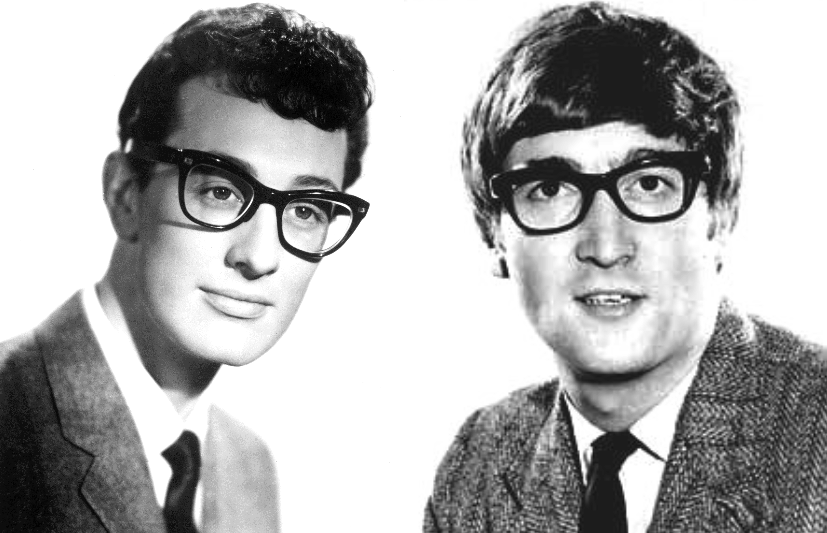 “Poor old Buddy”
 Beatles singles that never were?
 Allen Klein Playboy Interview, 1971
 Mad King John
 Shepard Fairey George Harrison Poster
 Critics at Large reviews “The Fifth Beatle”
 Mike’s Dream Bootleg: Beatles Complete Anthology Recording Sessions Box Set
Thank you for this post and for the link to Podrazik. I was happy he mentioned the Shotton book. That one had some unique stories but it’s been forgotten, hasn’t it?
I became a hardcore fan in 1981 at age 14. I still have my copies of: SHOUT, the RS/Warhol, the Hunter Davies bio, and The Beatles Forever.
I was shocked and upset when I opened the paper on Labor Day weekend 1991 and saw Schaffner’s obit. I pulled out “Beatles Forever,” opened my copy to the last page and wrote “we are losing our best and brightest to this f-ing disease.”
Never read Shotton; should I someday?
Re Schaffner’s death: The world of the arts — and the world in general — veered off in a totally different, demonstrably worse direction as a result of AIDS. It was a cultural and spiritual cataclysm which has never been properly calculated. A lot of the things that you can see in The Beatles — the attitudes that created the Sixties, the attitudes the Sixties helped create — were stopped cold by AIDS; “the West” of 1990 was vastly different from the one of 1980, and AIDS was a huge part of that story. Much of our current conundrum, politically and spiritually, comes from the people that filled in the gaps left by the better, more interesting, more humane people carried away by AIDS. For example: Keith Haring died, and Jeff Koons didn’t — two guys about the same age, both from PA. (Not that I’m rooting for Koons to die, but IMHO his art, and his vision of art, and the direction his success took the art world in, is bad.) A culture that worshipped artists (a lot of whom died) became one that worships money and power. Imagine if AIDS had been transmitted by junk bonds instead of sex…
“That seems harsh, Mike. Surely — ”
Hear me out: AIDS was a disease which devastated the particular subsets of our culture most responsible for arts and learning — the soul of our culture. And its manner of spread, through sexual contact, was particularly tragic. It was precisely the most open, most daring, most iconoclastic, who were most vulnerable to the disease.
So…not a fan. Glad they seem to be close to a cure.
Re: Shotton book.
It’s the only place you’ll get stories like this: “We must have been about eleven the day John accosted me with the dramatic announcement: ‘I’ve had a wank, Pete, I actually came! It’s f-ing great, the most amazing feeling ever!’ We repaired at once to our abandoned Vale Road garage, where John did it all over again for my benefit — but try as I might,I wasn’t to achieve a climax myself until several months later.”
Re: AIDS
Thank you for the very thoughtful reply. Very well said. The empathetic ones passed away and the greedy ones lived. I was a young gay man just entering adulthood in 1990, frightened beyond belief. There aren’t words harsh enough to describe my feelings for the Reagan administration.
Joel,
Re: Shotton: I LOVE stories like that.
Re: AIDS: as a straight man I was plenty scared myself — I cannot imagine what that must have been like for you, or any other gay man. When I lived in the West Village from 1995-2001 (due to some early personal circumstances, I always like to live in “gayborhoods”), there was something of the necropolis about it. Pretty, empty, full of a few lucky “old-timers” freighted down with sad memories.
The only thing I can possibly equate it to is COVID; because I have a compromised immune system, it was imperative that I not catch the disease. When people complained about masking — such a little thing! — I realized how little my existence mattered next to their attitudes. Even my own family. I suspect LGBTQIA folks feel this feeling a lot.
Glad you survived. Enjoy life today.
Yes, you should definitely read the Peter Shotten book written with help by Nicholas Shaffner. It is great. He was a gifted writer who died way too young.
Also, for me, two other touchstone books of the time were:
“The Beatles A to Z” (by Goldie Friede, Robin Titone and Sue Weiner) that was an encyclopediac breakdown of the career and singles. Besides being a good reference for b-sides, it was just a lot of fun to pore through. A kalideoscopic way to look over the 60s and 70s.
and
“The Beatles: An Illustrated Record” by Roy Carr and Tony Tyler (1981 edition) which is full of vicious hot-takes on the solo years that friends and I used to laugh at and disagree with.
Oh, I had — and loved — The Beatles A to Z! I lost my copy somehow, but it was an endless delight.
I’m of the same generation as you. Beatles Forever was the third book I picked up about the fabs somewhere around 1979-1980 after The Beatles Illustrated Record and the Podrazik and Castleman discography. Along with the LP’s and singles, these books were the launching pad for my lifelong fascination with the Beatles.
I did meet Nicholas Schaffer along with Pete Shotton at the 1983 Beatlefest in New Jersey upon the release of their Lennon book, In My Life. I still have that original version I purchased that day to which they personally signed to my then 13 year old self. I believe I did shake his hand.
By the way, I’m glad you’re back!
“By the way, I’m glad you’re back!”
Thank you, @Mike N.! My writing and editing load for The Bystander are just crippling, but I’m hoping to post regularly to HD. I’ve come to realize that it’s fifteen years worth of informed discussion about a lot of things I love, and feel are so important. Not just The Beatles, but the Sixties and Seventies, the counterculture, the Cold War, history and historians, the creative process and collaboration, addiction and so forth…too much to leave permanently.
Thanks for resurfacing this book, Michael. Schaffer’s The Beatles Forever was a revelation to me as yet another second generation 1970s fan. Not only did it reveal an entire world around The Beatles that wasn’t otherwise accessible, but it exposed 12 year-old me to a careful and contemporary writing style that was foundational to my future communication skills (such as they are). I read it so many times that I ended up taping the binding and holding it together with a book cover made from a brown paper grocery bag.
As an aside, I found a used copy of DiLello’s “The Longest Cocktail Party” shortly after I read The Beatles Forever and it completely broke my impressionable mind. Despite the lack of actual Beatle content (or perhaps because of it), it’s still my favorite fab-related book. I can’t believe no one has made it into a film.
I have an old paperback copy of “The Longest Cocktail Party” and I’m afraid to read it because the binding WILL crack. Maybe I’ll search for a PDF on archive.org.
One really great thing about Schaffner’s book was how illustrated it is–as you say, it revealed an entire world around the music you heard, and the few photos you’d already seen. This allowed one’s knowledge to accrete slowly, and with effort; the glut of information available to modern fans seems to give some a different relationship to the actual historical phenomenon. Things like “Paul Is Dead” require being steeped in too much Beatle stuff for too long — the brain gets bored with the old story, so it makes up a new, more interesting one out of the millions of shards of data.
https://i.redd.it/2xvctbijthgg1.jpeg
We’ll be getting four more movies soon, in addition to all the reading material.
I have an old book on my shelf. It’s an annotated version of the “Let It Be” documentary. Still photos from the film with some of the dialog in print form.
It’s such a fragile old book I’m afraid to touch it. I imagine it disintegrating like those volumes in The Time Machine movie from 1960.
Do you remember anything in particular from that book, @Baboomska?
I remember reading it in 1970 and then believing somehow that Paul took the bus every day to the sessions. There’s a quote somewhere in it “I get the horrors every morning on the bus” (I’m paraphrasing). Kids believe the darndest things.
I’m looking at it now. First thing I notice is how minimalist it is. Completely black front & back cover. No text anywhere on the front or back, just pure black with the famous 4 “Let It Be” photos on the front, but small.
The book is a transcription of some of the movie’s dialogue. It reads like a stage play. Along with the text are photos, many photos from the sessions. Some group shots, some extreme close-up photos.
I see “text by Jonathan Cott and David Dalton, photos by Ethan A. Russell”. This is very much a classy coffee table book, circa 1969. It’s a lovely layout, actually, a nice mix of photos and dialogue.
Back it goes with the other Beatles books on my shelf. I’ll leave them to my heirs to either cherish or discard, however they see fit.
This book is “Get Back;” it was issued in Britain and Canada (but not the US) as part of a boxset with the “Let it Be” album. I live in the US and had never heard of it until around 1976, when I found it on a clearance table in a book store. The were selling the box with the book (but not the LP) for a dollar! I bought a copy; if I had been thinking like an investor, I would have grabbed a lot more. I’m sure they’re worth more than a buck now.
Doug, I got excited for a moment when I saw your comment about the “Get Back” book. I thought I might be sitting on a gold mine. So I looked online, and the book is available at places like Abe Books and eBay for about 50 to 70 bucks. Certainly more than the dollar or two I paid in 1970, but not enough to lift me out of my genteel poverty.
Happy you’re back Mike, I hope you can keep it going!
This blog got me through covid, and for that, I owe you a lifelong debt. As one who is also severely immune compromised, I can relate to your concerns, especially with family, of all people!
@Paul, I’m very sorry to hear that you also have some health issues. But I am VERY gratified to learn that this labor of love was helpful to you during COVID. As I’ve said, I came within a couple of clicks of nuking the site entirely, but my hand was stayed by a sense that perhaps someone somewhere who was ill and could not function as they wish to in life — a reasonable description of my adult life — would be given entertainment or comfort by the writing, images and thinking here.
May your health improve!
So happy you’re back, Michael!
Of the 143 Beatle books I’ve read so far (he tosses off casually), The Beatles Forever is one of my favorites.
Glad to be back, Paul! What are some of your other favorites?
Michael, I believe I may be the “smart” (debatable) Redditor you mentioned in the “turning the lights back on” post, and I’m fantastically glad you didn’t just nuke this site.
I’m sure the maintenance and moderation is at times a nightmare, but this is the home of the most civilised, nuanced and deep Beatles discourse I’ve ever encountered.
And I’ve read just about all the books, trawled the forums since I was ten or so in the 90s, and seen everything Reddit has to offer.
As either you or somebody else on here once posted, “The Beatles lead everywhere”, and it’s entirely true.
Shifts in culture, gender norms, media,” and politics, before we even get down to the music itself.
I’m afraid it seems impossible to comment on the post I’m referencing, so apologies for doing it here. But this is a great resource and even in its inactive state, my number one recommendation to fans wanting to delve beneath the surface.
@Chris, you certainly sound like that person! Your esteem for the site played a not-small role in my revivifying it. Thank you, and I look forward to fielding your questions. To the degree we have been civilized, nuanced and deep, it is our commenters that have allowed this to happen.
Dullblog was begun as a way for me to keep writing when I was too sick to do my actual career, kept me company as I deteriorated, and then continued as I fought my way back to some semblance of health; I have always been pleased that it also amused Devin, Ed, Nancy, and the others — the idea that it could be “a great resource” is even better.
As someone who has been fortunate enough to engage with audiences on a massive scale — at SNL and The New Yorker, then Barry Trotter — it’s amusing to me that people might well be interacting with my posts here years after I have joined the big skiffle combo in the sky. I will try to remember to set aside money for hosting fees in my will. 🙂
I suspect you mightily underestimate your contributions here, much as you rightly heap praise upon your peers.
Due to absurd level sleep deprivation, I have very little to say at present besides thank you for reactivating the site, and (however odd it doubtlessly sounds to you), I am genuinely proud to be part of this community.
Is there a way to register or do we all just have to manually write our names and email addresses with every comment?
@Chris, I thank you — I am such a creaking, choking, grasping perfectionist about my writing, and the thinking behind it; comedy writers are like that!
Because my Beatles-related writing is so emotive — personal essay with historical fillips — I tend to discount it. I’m an exceptionally poor critic — my own self is too present at all times to allow for the necessary analytical distance; and my adult life has been so circumscribed by illness that I don’t have much journalism to contribute. I’ve always felt Devin’s post on Dizz Gillespie to be the Platonic ideal of Dullbloggery, and that’s just not something I accumulate much of in my life. I can tell you what a bunch of Simpsons and SNL people are like, though! 🙂
I’m obsessed with the era 1959-1980, and so bring an ever-enhanced (though definitely idiosyncratic) knowledge base to this topic; I am pretty profoundly UN-interested in Bob Wooler’s shoe size, which is where most internet fandom seems to be going, but very interested in John’s beating him up and what that might’ve said about both men in their era. I think the one place I really do shine is in empathy; I’m uncommonly good at imagining what life must have been like for the guys, and applying whatever experiences I’ve had (for example growing up in an alcoholic family, or having a Kundalini Emergency) to the Beatles story. That type of writing is pretty useless if one wants to become a Beatles Authority, but it does seem to enrich others’ enjoyment of the band, and I’m happy to contribute it here when I can.
My goal with the site seems to have become to increase empathy for the band and surrounding characters — to humanize them, to get into their nooks and crannies in a way that someone like Lewisohn, using the tools that Lewisohn uses so well, simply cannot. Lots of fans don’t want that, they want their icons; but I think this human comparison is essential to engage with them and their work as an adult. Especially Lennon. Lennon is so often dismissed by people under 30, and it’s really a shame, because so much of how they consume media and artists comes directly from John Lennon. My entire purpose with Life After Death for Beginners was to empathize, and it took a mighty, mighty bite out of me, because not everybody in and around The Beatles is safe to interact with; Lennon himself was so damaged. As a result that book is really two books — the jokey story I wrote, and the perhaps true story underneath that story, which was much too dark and grim to tell. And as I wrote that book over a period of years, and the real story revealed itself to me, I became very conflicted; it was not anything I wanted to write, or people wanted to hear. But out of respect I finished it. Having finished it, though, I turned down an agent who thought he could sell it. I sometimes consider rewriting it, telling the real story in there, but just as often consider pulling it off the shelf as a souffle that didn’t rise. Perfectionism again. 🙂
Other commenters: can you answer @Chris’ question about logging in? I’ve never commented as an outsider, only as blog owner.
On commenting: I was asked to put in my name & email address the first time, after which my browser has been auto-filling them without any further instruction from me. It’d be nice to have the ability to edit comments after leaving them – especially as I’ve discovered that if you try to insert phone emojis they don’t survive the posting process, leaving you with a weird-looking sentence without a full stop, haha. But hey, gives me a chance not to indulge my own perfectionism.
On Lennon: yeah, I’m just weary of the cancellation at this point. This Tolkien quote means more to me than anything in his books: ‘For myself, I find I become less cynical rather than more – remembering my own sins and follies; and realise that men’s hearts are not often as bad as their acts, and very seldom as bad as their words.’ And of course these things are always so selective. I had a friend justify his Beatles dislike by invoking John’s wife-beating, in the same breath as saying he preferred the Stones, i.e. a band with Brian Jones in it. I mean, are you kidding me? Of course Ringo was a wife-beater as well, but it’s never become a meme, and no-one seems bothered to look it up; Paul and George: not violent like the other two, but nowhere near feminists by modern standards; The Who and many other contemporaries: don’t even get me started.
You’re right that Lennon’s legacy will survive regardless. You’ve pointed out before that he’s a master communicator to Paul’s master musician, which hits the nail on the head. (Obviously these things are relative: John’s musicality and Paul’s ability to convey meaning are top-tier compared to 99.9% of songwriters ever, at least when they have each other as editors.) Towards the end of that Starostin Pepper review, when he finally gets to “Day in the Life”, he points out something I’ve never properly noticed before – that *John is a master of writing songs where the lyrics flow conversationally without sacrificing the melody*. He says exactly what he wants to say, without compromising for the sake of prettiness on the one hand, or lapsing into Dylanesque speak-singing on the other. Sometimes that means verging on rapping (“Walrus”), or making the meter do all kinds of crazy things (“Good Morning”), but catchiness and a basic likeability are *always* maintained. Balancing just enough playfulness with just enough seriousness; grit with warmth; form with message; pop with rock. It’s just occurred to me to put it this way: Lennon is what happens when you put the other two greatest songwriters ever, McCartney and Dylan, in a blender. The one isn’t gonna write “Lucy in the Sky”; the other couldn’t do “If I Fell”.
Can’t resist quoting Starostin at length: ‘One thing that’s striking is the phrasing. He blew his mind out in a car, he didn’t notice that the lights had changed. A crowd of people stood and stared — they’d seen his face before, nobody was really sure if he was from the House of Lords…Throw in a couple of you-knows and uh-ehs in there, and you got yourself a realistic piece of dialogue, something you’d be liable to hear from anyone simply describing the event. That was John’s fairly unique gift — to take something like this and present it not even just as poetry, but as song, where each next line smoothly and logically flows out of the other and forms a perfect rhythmic and harmonic contour. This explains why so many of John’s vocal melodies feel odd and challenging (but so impactful) from a conventional point of view: he is not trying to squeeze the words into a preset pattern (like McCartney, who usually works from the musical melodic line), he is molding the pattern to fit the words, even when it does not seem to fit at first. Who else but John would have come up with that fast ascending line (”…nobody was really sure if…“) to end the verse? It’s the kind of stuff you typically encounter in classic progressive rock — say, Peter Gabriel, or Peter Hammill — but John does a better job of adapting that style to catchy pop music patterns. From ‘She Said She Said’ to ‘Mr. Kite’ to ‘Sexy Sadie’, it’s always the same thing; ‘A Day In The Life’ is simply the most portentous of examples.’
Thank you for the detailed response.
As someone with both a personal and professional life deeply enmeshed in mental health issues and addictions, I definitely think that’s an extremely interesting way to view The Beatles story, but only if done with empathy.
It makes me wonder what kind of book Goldman could have written if he’d been more empathetic and less hell bent as portraying John as Bond villain level evil.
The cancellation of Prisoner of Love was massively disappointing, as I suspect it was exactly the kind of unflinching yet empathetic view of John that has been sorely lacking since before the man died.
I certainly wasn’t writing for SNL, but my background in academia makes me absurdly perfectionist and I’m always surprised when ideas that are rawer and more persona resonant far more with people than those that I’ve redrafted and edited for months on end.
Truth be told, my main questions for you pertain to the “real” story you brushed up against while writing Life After Death for Beginners, but based on your posts I imagine you’d rather do that privately, if at all.
Lemme post about the addiction/mental health issues in the Beatles story, and why they are so essential.
I always give Goldman a lot of slack, because I really do believe that he came to the project admiring John (as most people did then) and what he found shocked him. So he over-corrected. And besides, what will endure about Lennon is his music and his cultural impact, neither of which can be changed by a muckraker. The “Lennon-as-abuser” line of argument has turned him into a non-entity to the terminally online under 35s, but eventually he will be seen by future-folk for the amazing unique genius he was, warts and all. He’s just too important within pop cultural history.
The last-minute cancellation of Prisoner of Love makes me 99% sure that there were real bad things going on 1975-80 — not just junkie behavior, either, but stuff that would fundamentally change how the public views several powerful people. They really don’t want that story to be told in full, and given what we already know, how much more damning can it be? Quite a bit more damning, I guess! It might even be possible that the public would read it and shrug, but someone(s) with a guilty conscience or a corporate-type obsession with narrative control would see it differently. It even could’ve been Apple, worried that PoL would depress future sales of things like “Get Back.” The Beatles are now elemental, the movement of vast sums into some wallets and not others. All this is pure speculation on my part, but the question must be asked: what’s important enough to suppress, after 45 years? On the other hand, the suppression could’ve been reflexive: “…because I/we can.”
If you have specific questions about the book, email them, I will read them and answer them if I feel comfortable. I’m sorry to be uncharacteristically cagey, but it really was an awful psychological experience and I so I treat it all with a great deal of wariness. As a sort of general statement, I will say that over the years I was writing I began to see the outlines of a very plausible plot, shockingly cynical and truly upsetting if you cared about John Lennon. I am fully willing to admit that this was probably my own story-making brain, which by that point was quite paranoid. This didn’t merely come from my Beatles-knowledge, but also my deep reading about the intelligence community — both of these interests are decades-long. So I found myself in a truly terrible spot: I could write the book that these data-points were suggesting to me, which might cause a stir but felt thoroughly awful and was nothing any Beatles/Lennon fan would want to read, or I could veer totally comic, which had been done excellently by Mark Shipper and The Rutles. To finish the project I charted a middle way, which was very unsatisfying to me, and why when third parties have attempted to embiggen the project via republishing or TV, I have gone limp.
Apologies for the delayed response.
I agree entirely about Prisoner of Love. If it was purely a matter of behaviour on John’s part and the public already knows about domestic abuse and heroin, then it must be unimaginably depressing stuff.
If you give me an email address (apologies if it’s public here somewhere and I’m just not seeing it), and you have the time, I’ll send some questions.
I’m not trying to make you go into horrible detail about stuff that was evidently very distressing to even think about, but it seems like my amateur notions are mirrored by a real scholar here so I’m definitely interested in anything you’re willing to go into without causing yourself any pain.
Chris, just sent you my email. Happy to field questions and answer them privately.
I’ve got a soft spot for this, it being one of the earliest Beatles books I read after discovering the group in the summer of 1984, when I was eleven-going-on-twelve. Before this, they’d mainly been that group somewhere in the background…a song or two on the radio that I recognized and liked, one of them had been murdered when I was eight, I vaguely remembered seeing some bits of Yellow Submarine on a syndication channel some rainy afternoon…those were my only impressions of them. But sometime in the spring of 1984, a local paper ran excerpts of Hal Morgan’s book Rumor!, about rumors and urban legends. One of these was about the Paul Is Dead myth. I read it and was both utterly freaked out and utterly fascinated as only an eleven-year-old can be. From there on, I started taking more notice of Beatles songs on the radio when I ran errands with my mother. I bought and read The Love You Make (which came out right around then), but a lot of it went over my head as a very sheltered kid. Late that year, I bought this book for a Beatle-fan friend who’d invited me to a birthday party, and read it beforehand. I loved the photo inserts of all the Yellow Submarine merchandise, and the perspective of someone who’d lived through that time period. This was one of those books that was rather poignant, given that it was written before John’s death.
As was the most memorable book I read as a budding fan that summer (before I read Schaffner’s book), Growing Up With The Beatles by Ron Schaumburg. That same friend had that book, and had put the insert poster up on her wall. I connected with that book written from the perspective of a sheltered suburban eleven-year-old discovering the Beatles because I was, well, a sheltered suburban eleven-year-old discovering the Beatles. And it was fascinating to see his perspective as someone who, like Schaffner, had lived through those times but as an ordinary middle-American (he was from Kansas City), who straddled the line in his formative years between opening his mind to new forms of art/music/creation and going the full hippie route. I enjoyed the chatty tone and warm, often funny reminiscences, and still do. (Though there’s one bit that hits hard…he has four chapters towards the end on the solo careers of each Beatle, and ends John’s with, “Survive well, John.”) And I got a kick out of some of his quips. His memory of his reaction to the Beatles’ TM kick was, paraphrased since I don’t have the book in front of me, “As long as they kept making music of Sgt. Pepper’s quality, it was fine with me if they wanted to sit on an Alp and contemplate their toes for the rest of their lives.” This was also the first place I encountered the phrase “wink wink, nudge nudge”, long before I got into Python.
I don’t understand why GUWTB gets scorn in some fan circles. Someone on the old Google Groups called it “silly” and the author of Fab Four FAQ calls it “embarrassing.” Maybe if it had come out after The Wonder Years had premiered, that wouldn’t have been the case…the book’s basically a proto-Wonder Years. Another, more generous online reviewer said that in some ways, with its array of photos and its observations, that it was an early blog in print. For me, both this and Schaffner’s book were fascinating insights into the Beatles from people who’d lived the time period…one who, as I said, didn’t go full hippie but was open-minded to the group’s innovations in music and art, and one who DID embrace the hippie lifestyle enough to have gone to Woodstock.
I had a brief social media conversation with Ron…he goes easy on social media, but appreciated my reaching out and sharing my memories of his book. He has it together professionally and personally…he works in the medical communications field and has a solid family life. (He’s also created and marketed a card game satirizing Donald Trump.)
And one more tidbit…Nicholas Schaffner also wrote The Boys From Liverpool: John, Paul, George and Ringo, which was a tween-friendly book covering much of the info in The Beatles Forever.
I don’t know that book, but I love this comment!
One of the nicest things about The Beatles is the role they’ve played within people’s lives. For me, it’s impossible to think about The Beatles without also thinking of my favorite aunt, who was a first-generation fan, and introduced me to their music (as well as Stevie Wonder and Harry Nilsson, two other faves). Did I come to love The Beatles because I love my aunt so? Or does associating my aunt with the wonderful Beatles make me even more affectionate towards her? The answer is, of course, both.
The Beatles are truly an unalloyed good, and that confuses and irritates a certain subsection of the internet.
I think you can read Growing Up With The Beatles on the Internet Archive, if you’re interested.
Aw, good on her. Stevie Wonder is joy. He is life. He is love.
The early Beatles, to me, are car rides to school and orchestra practice with my dad. Those who listen to Beatles for Sale and hear only silly old-fashioned pop songs aren’t getting all the darkness and light and sadness and joy and mystery and magic I got at 11 years old on the Wicklow N11 at night.