

- Little Help From Our Friends? - September 2, 2026
- A quick yawp from Mr. History - August 24, 2026
- First Thoughts on “The Beatles – A Four-Film Cinematic Event” - August 17, 2026
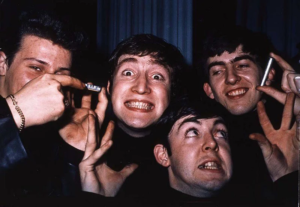
The Beatles and friend in Hamburg, May 1962 Getting to those 10,000 hours at double speed.
In the course of (as the kids say) “chopping it up” in the comments, I stumbled on a topic that I’d like to (re-) address. It’s one that I’ve talked about incessantly on this blog, but it suddenly occurred to me that after all the posts and all the comments over the years, I might never have explained why.
At one point I was fascinated by the intersection of The Beatles and addiction, and wrote about it a lot here. Even though you could see the outlines of it in the biographies—even the Anthology—addiction was always sort of talked around, and hope was that my painfully gained layperson’s experience would embolden professionals to look at the Beatles’ story through this lens. For example, applying alcoholic family roles to The Beatles really works—Paul as the Hero, John as the Scapegoat, George as the Lost Child, Ringo as the Mascot—and a fit that close doesn’t happen by accident. Could it be that the Beatles story is really an alcoholic family with Brian as the addict? Was that what John was feeling when he said, “We’ve fucking had it”? Not because they couldn’t continue making great and profitable music, they obviously could and did, but because some psychic equilibrium had been shattered? This avenue of inquiry does solve an obvious problem. There’s a lot of evidence that the Fabs were growing apart from Brian in 1967, and some fans even think they were preparing to sack him. Yet when he died, the Chief Beatle thought their ride was over. If Brian is merely the manager of a no-longer-touring band, that doesn’t make much sense. But as the keystone of a psychological structure…
Drug use, and for some addiction, is central to the story of the West from 1956-1980. So it is central to the story of The Beatles, too. The fun and the disorder; the freedom and the madness. The Beatles story would be unrecognizable without the role recreational drugs played, and I think, worse.
For the purposes of this post, I’m defining “addiction” in its narrow sense, how it is used colloquially—as abuse of drugs. I’m not talking about, for example, how Paul McCartney might have become “addicted to fame”—though that is an interesting idea, and one that’s probably at the heart of issues that Dullblog readers love to discuss. In 1968-70, when it was clear that if The Beatles were going to continue, it would have to be on new, different terms, did Paul’s undeniable craving for conventional stardom make him less willing or able to accommodate the others? Was an addiction to fame what made him think “we’ll bring a film crew into the studio, that’d be fun” rather than letting everybody take a much-needed vacation? It’s a question worth asking.
But not here. Here, I’m saying that the Beatles’ relationship to chemicals—what they took, how much, and when; and most importantly how that impacted their relationships and collaboration, and even the ideas they had—is central to the whole story. It has to be. My big contention—based on my own life in an alcoholic family, and as a creative person, and as a professional collaborator, and as someone who makes a living through artistic work—is that drug use, and addiction to drugs, isn’t just part of the Beatles’ story, it is the story, because it determined who each of them were to themselves and to each other, moment to moment. What they were on determined how they acted. For good as well as ill; would The Beatles have even become The Beatles without Preludin? Would they have been able to persist after 1964 without the psychic cushioning of pot? Drugs drew them together, and pushed them apart, took them new places and left them nowhere, showed them Utopia and cast them into despair, again and again and again.
You ever try to improvise with someone who is high? It’s like trying to talk underwater. That’s why The Beatles were careful about taking drugs while in the studio. It’s the time outside the studio I’m talking about.
Okay, so why talk about it here? Why not gather the sources, and write a book: I’d Love to Turn You On: The Beatles and Drugs? Because all of this is very difficult to pin down, even more so than sex—after all drug-taking was illegal behavior, or at least illicit. Journalists and biographers can get at the drug story to some degree, but they’re never really adversarial or tough about it, because they need access, and are part of a music business where drug use was (and probably still is) so common and intense that most people won’t even notice until a person is quite incapacitated. RIP Brian Jones, Jimi, Janis, Mr. Mojo Risin. “Squares” do not get far in music journalism. That having been said, we missed an opportunity in the decades when once über-groovy Sixties people were still hale and hearty and their memories reasonably trustworthy. The best time to write the story of the Beatles and drugs was—perhaps not surprisingly—in the mid- to late 80s, right when Goldman was writing his book. In 1975, the effects couldn’t yet be seen; in 1995, The Beatles were big business again. Time sanitizes; so too, corporate interests.
As the Beatles story has turned from journalism into history, we need to acknowledge that historians are particularly hamstrung when discussing such things; I expect Lewisohn to shed more light on every facet of the Beatles’ story…except this one. One, drug use is not concrete, not quantifiable, and can happen without external trace, and mentioning it can feel rude. Yet, was John Lennon addicted to some chemical for his entire adult life? Seems so. What relationship did heroin have with his creative output? He outlook on life? His reliability? His relatability? What about booze? Pot? Acid? All different chemicals, creating different conditions inside Lennon’s brain. What role did drugs have in his immense productivity in 1966, and his hermit-like existence ten years later? Could they be the simplest explanation for both?
All these questions must be answered by the historian, yet how can any of them be answered by someone looking to quantify and define, and build a useful story out of the hardest data they can find? So all the histories proceed as if drugs were cornflakes, a neutral neural act. Yes, it was a thing they did, but—except in the grossest terms, like discussing “Lucy in the Sky with Diamonds”—drugs and concomitant addictions aren’t really discussed. Yes, Apple was a mess; could it be that having four Directors who were high all the time was a big part of how it got that way? None of them went broke (though George perhaps came close after Denis O’Brien); all of them seemed to be able to manage things okay, and Paul and Yoko each have more than a little tycoon in them. So was the Apple story not just youth and no Brian, but also being stoned? Letting the Hell’s Angels into your Christmas party is not the act of a sober person.
The second hurdle is best summed up by a question: how the heck does someone who wasn’t a rock star from 1962-1980—a period of mainstream cultural shifts in chemical use, with musicians being at the forefront—understand their relationship to chemicals? Most people today do not believe cocaine is good for you; lots of groovy folks in the Sixties honestly did. Most people today do not “eat LSD like candy,” as Lennon put it. What did that even mean? We can’t analyze Lennon as a normal, unaltered individual—the drugs can’t be ignored, but how can a contemporary scholar understand the impact of that much lysergic acid on the human nervous system? For all his flaws, and there were many, Goldman at least attempted to address this. Rather than endlessly discussing the “emotional history” of John and Paul, someone somewhere please God try to figure out what John and Paul were using, respectively, during the 1968 trip to New York, the one where they really fell out, because the drugs may well be why things got weird. Drugs make people weird, and the closer you are to someone on drugs, the weirder they feel.
Of course the user is often the last one to realize how much they are altered. Being able to handle one’s drugs was a kind of machismo in the counterculture, and that too is partly why the effect of drugs have been written out of the story, save for harmless stuff like getting high and painting George’s garage. If drugs were truly more powerful than The Beatles, the whole hippie mythology collapses. But…might the Fabs gotten back together, if the Seventies hadn’t been awash in cocaine, making each of them mean, and egotistical, and paranoid? Look at George in 1974-75, or Lennon in his house-husband years; those guys are doing a lot of coke. Lennon, it’s said, was scheduled for septum surgery when he died.
As someone with a front-row seat to countercultural mores between 1973-80, I can tell you that what drugs someone was using, when, and how much, was one of the main drivers of their personality. What you used and how much determined a lot; where you went, and who you hung out with, and what you all thought. The drugs put you in contact with much sleazier people than otherwise, and sometimes even criminals. The drugs created tribes, and the tribes weren’t always friendly. “She’s not a stoner, she’s a juicer. She used to be straight-edge, because she found God, but then she hooked back up with an old boyfriend—you know, Gilbert the pill dealer—and lost God I guess. Anyway, your stash is safe from her, but whoo boy, lock the liquor cabinet.”
Especially if you were under 30, the Sixties and Seventies were awash with mind-altering chemicals. More people were taking more stuff—that is why the culture produced then still pops, so excessive, so bright, so fun. The music, movies, books, and art of those decades wouldn’t be what they were, without drugs. Even the Sexual Revolution was intensified by drugs. Families were made, then broken, by drugs and addiction. John might’ve been a terrible father without his little magic mortar and pestle, but they surely made him much worse.
The drugs made people different, that’s why people took them. I’m not just talking about the burnout cases, though those were definitely around, or the cokeheads; by 1980, whether someone smoked pot or preferred liquor was…who they were? And this wasn’t just the effects upon their neurology over a decade, or the life that said flavor of neurology allowed them to build—cokeheads flourished on Wall Street, potheads as farmers in Mendocino—it was also that which drugs you used was deeply political, and the drugs intensified your politics. How much of Lennon’s political activities were ideas he had on drugs? “We’re going to protest the war by staying in bed”—classic druggie politics.
“We’re going to buy a Greek island and all live there”—classic druggie scheme.
“Yes, my heroin-addict friend, you may have my wife, whom I gift you like chattel so we can remain buddies”–classic druggie marriage.
Whenever named, admitted drugs pop into the Beatles story, things clear up. I remember when McCartney revealed that he’d been using cocaine around the time of Pepper—ah yes of course! Frenzied activity; check. Absolute confidence; check. Alienation from one’s bandmates, who kinda think you’re a bigheaded asshole; check. Whenever the drugs are acknowledged, the story suddenly becomes much, much clearer.
Which brings me to the third hurdle: drug use is hidden, and drug abuse, even more so. For a million reasons, the majority of these kinds of secrets get kept. Ask a Boomer if you don’t believe me; they’re all high on life and Starbucks now, but someone had to be taking all that windowpane.
The entire texture of the Sixties and Seventies was, especially if you were in showbiz, determined by drugs. Peter Sellers used poppers so intensely he nearly died from a heart attack in 1964; what the hell was he up to by 1969, when he was hanging out with Ringo? The counterculture got precisely as far as the drugs could take them, and what dragged them back and dashed their hopes—also the drugs. What chemical was John on when he said he was Jesus Christ, or stormed over to Cavendish Avenue and put bricks through the window? Was Ringo drinking heavily when he left the band for no good reason in 1968? And on and on and on.
One, you can’t see it. Two, it feels rude to talk about. Three, there’s a polite conspiracy to keep it hid. Historians will stick to their letters and interviews. Yet, at the very heart of this story we love are these chemically driven imponderables. We take our caffeinated, nicotinized consciousness, sealed in the envelope of another era, and attempt to understand. We can’t, of course—but neither can we stop trying.
It’s enough to drive a guy to drink.
Related posts:
 Try it, you might like it
 Memories of Nicholas Schaffner and The Beatles Forever
 Sid Bernstein obituary
 Ian Leslie: “Notes on Peter Jackson’s Get Back”
 Allen Klein Playboy Interview, 1971
 Shepard Fairey George Harrison Poster
 That was your first mistake
 Various musings on Lennon and Addiction
 The Black Album: Solo Beatles According to Ethan Hawke
 “Poor old Buddy”
 John Lennon’s hair…
 Mike’s Dream Bootleg: Beatles Complete Anthology Recording Sessions Box Set
Excellent, thought-provoking analysis! “Beatles as alcoholic children” is going to stick in my head forever.
@Michael Gerber, I think cocaine is an interesting test case of this problem: we know Paul was using it from late 1966 until…when? He said in one interview that he used it for “about a year,” I think. I’ve seen that get repeated as fact. Is it fact? Did Paul McCartney stop using cocaine in late 1967 or early 1968, and not use it again after that (at least while the group were together)? Do you think he wasn’t using it during the White Album sessions, when all of London was, and his relationships with Jane and John were falling apart, and seemingly every account of him in the studio that year is of someone being bossy, demanding, and egotistical? I don’t.
And what about John and George? Just because John was using a lot of LSD and, later, heroin, that doesn’t mean those were the *only* drugs he was addicted to. Rather, those were the drugs he was abusing the *most*. But there was a cocktail of other drugs – amphetamines, downers, cocaine, marijuana – to smooth the path. We know this from details in accounts – Yoko saying John kept a jar of pills on his nightstand and indiscriminately swallowed a few at the start of each day; Peter Brown giving us the detail about the mortar and pestle in Weybridge that kept a combination of speed, cocaine, and LSD that John used to keep trips going. How do all those drugs interact with each other? What happens if you’re using them all of the time? What happens if you and your co-writer/best friend are both using marijuana and cocaine regularly, and then *you* go and get addicted to heroin, and he doesn’t?
It does seem like the two times the Beatles are most fractured before 1969 are when Paul and John are not taking the same drugs – in 1966 with LSD, and then in 1968 with heroin. We don’t know what we don’t know; did John, who is well documented was always interested in the next available new drug and therefore surely interested in heroin once Clapton/Keith/Hendrix/Brian Jones were trying it, resent Paul for not trying it with him? Did that contribute at all to choosing Yoko as his new best friend? Why did all of that happen in 1968, when Robert Fraser was trying to get Paul addicted to heroin 18 months earlier and surely offered it to John, too, at that time? And what about George – we simply don’t hear about him in this regard, as though we are to believe that the Beatle who took almost as much LSD as John simply renounced drugs in 1967 and meditated through the end of the breakup.
@Michael, I agree that McCartney and cocaine is a great window here. My second-hand knowledge of cocaine suggests that in creative people it makes them more productive, but ruins their judgment, and eventually makes them much harder to work with — “bossy, demanding, egotistical,” as you say. In the early era, when their brain is MOSTLY a non-coke brain, the drug gives them the energy to create extremely well-focused things like Sgt. Pepper. But if they keep it up, they start making things like Magical Mystery Tour. “We don’t need a story! It’s down on this piece of paper! We’ll just go out and film it! And direct it ourselves!” Lots of productivity, lousy quality control.
The same thing happened at SNL in the 70s; brilliance in 1976, and by 1979 a snakepit of egos producing less good work.
Truth be told, I don’t know much about Paul in 1968 except that he helps start a whole corporation AND writes “Hey Jude” AND breaks up with his fiance AND gets close to Linda AND makes a zillion songs for the White Album AND at year’s end he looks at his main collaborator who is obsessively hooked up with a new girlfriend and zonked on heroin and thinks, “What this situation calls for is a new album! Which should be filmed!”
That doesn’t seem quite sane, to me.
I believe Paul when he says he didn’t much like the drug, but that he liked the paraphernalia/ritual, and I am sure he loved the effects. If you love having ideas (which he does) and making songs (which he does), stimulants are great. I also believe him when he says that he frequently balanced it with weed. Lots of productivity, poor quality control, mixed with a kind of unfocusedness — that sounds like Paul in the 70s and 80s as well. (With the caveat that he had a family, and that probably vastly curtailed his drug use.) But when Paul McCartney came into his potential as a musician and creator, that was the time he was doing coke and balancing that with weed, and those chemicals surely changed how he developed.
George’s drug history is fascinating. It seems he, like Paul, prefers stimulants to depressants; he’s a heavy smoker from an early age, so he’s definitely hook-able, with the right drug. When George is using coke, it’s obvious — as in the mid-70s — so I DON’T think he’s using coke regularly at any time during the Beatles. I don’t think he ever seriously considered heroin, either — though it’s fascinating that he was so close to Clapton. Some people’s drug story is to stay mostly clean but enable addicts, and that may have been George. I think he was sincerely meditating, and that plus a little genetic luck may have been enough to avoid the worst stuff.
I am not sure about the relative flow of heroin into London in 1968 as opposed to earlier. I know there was a law passed in ’67 that took effect in ’68, and cocaine and heroin addicts could no longer get it via prescription, but had to go to clinics. I suspect this actually reduced the spread among your more famous rock stars, and that the real habits had been established earlier.
@Michael G., your description of Paul in 1968 sounds about right to me, and it generally seems to me that the typical addict’s timeline you sketched out also tracks how Paul’s infectious creativity around the time of Pepper turns into demanding 70-odd takes of Rocky Raccoon, Ob-la-di, and Maxwell’s by 1968-69. You guys WILL work on these songs until they are PERFECT because they are FUN, dammit. (As an aside – I don’t think those songs would be so infamous if Paul had taken the approach of “let’s bang this out in one or two takes and have a good time” — there’s a rehearsal of Maxwell’s in the Get Back movie with some whistling and a looser atmosphere, and the song both works in that context and is much weirder.) I don’t get the impression that December 1966 McCartney would’ve done that, any more than I think December 1966 John Lennon would’ve shown up as disengaged and out of it as January 69 John Lennon.
As to heroin in London, I recall reading something like that as well. It seems like the vanguard of the drug addicted rock world in England were becoming addicted to heroin by late 1968 – the Dirty Mac performance of Yer Blues looks like four junkies.