

- Memories of Nicholas Schaffner and The Beatles Forever - January 4, 2026
- Old Draft: Beatles Folk Memory 1970-1995 - December 8, 2025
- Lights are back on. - December 8, 2025
[Folks: I found this in Drafts, re-read it, and liked it. I don’t know why I didn’t post it before, maybe because i didn’t come to A Grand Conclusion. Anyway, enjoy.—MG]
Commenter D.N. just coined a phrase that I really love: “Beatles folk memory,” which I took to mean “how the Beatles phenomenon, and the experience of being a fan of theirs, was experienced by fans.” I think it’s a tremendously useful concept.
The folk memory of first-generation fans is easiest to track, not only because it left huge traces in the mainstream monoculture, but because it was a truly generational experience. We’ve all seen the wonderful “Sprout of a New Generation” clip above—according to this blog, the lady’s name is Bonnie Von Lobenstein; when I think of first-generation fans, I think of Bonnie. They were young, and utterly unironic in their love of the group. And just as they threw themselves behind the moptop era Fabs as something Big and Important, they did the same with the Psychedelic Fabs, and the post-68 Hairy Fabs. The Fabs are theirs, and they are the Fabs, in a way that the rest of us—okay, I’ll just speak for myself—can find a little much at times. When you talk to a lot of Baby Boomers, it’s as if liking The Beatles conferred some tiny collaborative role in the Beatles’ genius. It doesn’t matter how cool you grew up to be, it seems like everyone who was between 8 and 20 in February 1964 has written about watching the Fabs on Ed Sullivan. And there are even collections of these memories, in books like Beatleness by Candy Leonard (who I met once at Beatlefest and thought was just tops).
But one of the most interesting things about The Beatles phenomenon is how it has persisted over generations, something that really hadn’t happened before. Teen crazes burned bright, then flamed out; The Beatles themselves expected this fate. The Rudy Valentino cult was burned out by 1930; Frank Sinatra’s bobby sox phase was done by the end of the war. Even Elvis, the King of Rock ‘n’ Roll, really only lasted three years. If you were a kid during those times, Valentino or Sinatra or Elvis imprinted on you for good…but it was a rare kid from the next generation or two who became really passionate about those faded icons.
The Beatles have proved themselves to be different, and that’s really remarkable. It’s what makes me think their music is indeed better than the usual high-points of pop culture, and what makes me think that they will last. That’s also why it offends me when Twitter assholes characterize them as “a boy band” or a Sixties relic, because that’s simply not shown by the historical record. It’s great to love [contemporary artist], but it’s simply highly unlikely they will be spawning massive cultural interest fifty and sixty years after their demise. Possible? Sure. But unlikely.
The Beatles’ weird persistence has given rise to eras of fandom, and this is where folk memory comes in. I’m particularly fascinated by two things:
- When new fans seemed to appear, their commercial power creating new Beatle content aimed at their particular emotional needs/interests, and that content fundamentally reshaping the canon; and
- How the eras overlap, or not. My beloved aunt, a fiercely devoted first-generation fan, never understood my 80s-era obsession with bootlegs. I, similarly, do not understand the obsession with McLennon, choosing sides between John and Paul (which is just the flipside of McLennon), or PID. When Dullblog has really cooked, it been a conversation of
Being a Beatles fan in 1964, 1974, 1984, 1994, 2004 and so on seems to be a distinct experience. It attracted different people for different reasons and meant something different to them.
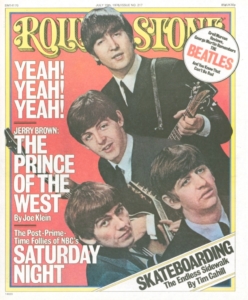
July 1976.
Since 1979-1986 was my deepest period of Beatle obsession, I can comment definitively only on that period. Having grown up saturated with Beatles- and Beatles-related music, I caught the end of a period of Seventies Beatle nostalgia. This had hit fever pitch around 1976, with the re-release of some Beatle material by EMI, Paul’s tour, and persistent Beatle reunion talk after the dissolution of the partnership. Its first glimmers can be seen in the first Beatlefest in 1974, but you can see it’s mainstream by July 1976, when it made the cover of Rolling Stone. That burst gave us “Beatlemania,” “Sgt. Pepper,” etc — including the Star-Club tapes in 1977. And it was all with the hope that the Beatles would reunite.
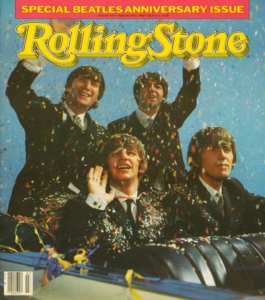
February 1984.
Then, after Lennon’s murder, fandom changed overnight. The Beatles became historical, and loving them became a kind of scholarship, or at least a rejection, implicit or explicit, of the present. I’d date that period from 1980 until, I guess, the release of the catalog on CD (1987). I’d put The Compleat Beatles in that period; Rolling Stone’s endless books and special issues; and the John Barrett Tapes/Sessions/EMI’s Rarities. It also encompasses “Here Today” from Tug of War, “All Those Years Ago,” Milk and Honey, and a bunch of other things. It’s a summation period. It’s much more elegiac than the Seventies period was. Beatlefest ’84 was wonderful, but…I recognize it now as post-coital sadness.:-)
The next period is kicked off by the release of various troves of bootleg material, with CD-quality sound. It all came in a rush: Yellow Dog’s “Unsurpassed Masters” set (beginning in 1990); Artifacts (1993); and Great Dane’s Complete BBC Sessions (1993). The success of these compilations (and Harrison’s need for money after being bilked by Denis O’Brien) practically forced the Anthology project in 1995.
After that, my own life accelerated to the point that I can’t track it. What do you guys think?
Related posts:
 Lights are back on.
 Los Angeles Beatles fans: Wanna go see a movie?
 Critics at Large reviews “The Fifth Beatle”
 “Poor old Buddy”
 I’m So Tired: Responsive Notes on the Phenomenon of Beatle Fatigue
 Why Your Favorite Celebrity Isn’t Who You Think They Are
 A few words about the latest Rolling Stone list…
 Deconstructing The Beatles, the movie
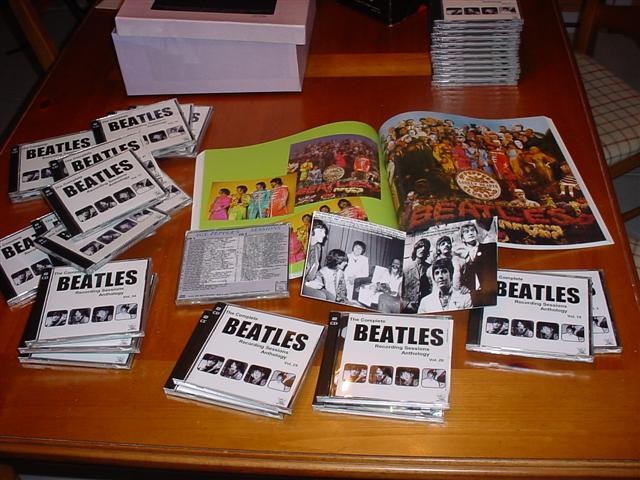 Mike’s Dream Bootleg: Beatles Complete Anthology Recording Sessions Box Set
 ELO is back
 Charles Taylor on A Hard Day’s Night
 Try it, you might like it
“Wouldn’t it be nice…” to add some of that old music, original footage, sounds, tapes, snippets, notes, has remained on my mind through decades of life and fluctuating fandom. Inciting ideas, trains of thought, and perspectives on Hey Dullblog, have been inspiring. —- .
From a historian’s perspective your notes on ‘Beatles folk-memory’, Michael, are another way to describe historiographic phases. Interestingly you perceive new historiographic phases emerge new material or formats are released. Erin Torkelson-Weber had a similar approach in the only historiography of TheBeatles published so far. Really influential. We’re in need of another one, not just a serious rewrite. Your approach is tempting. —- .
My first Beatles obsession phase was 1968-1980… I remember participating with a one-thousand or more Beatles and John Lennon fans in a commemoration parade for Lennon in December 1980 in Amsterdam, was dull and fake. Lennon was never sacred genius to me, his peace-nick phase surely effectively got in met head. But not life-changing. Lennon’s referencing to the early Beatles live music as the only real thing, has probably inspired if not guided me until today… concert tapes from 1964 and before are ‘grant, keep it’ and ‘tantalising’ … hair-raising experiencing, it really would be nice “to add some of the new old music to my day”.
Hi @Michael G! It’s amazing having you back, and coincidentally just when I started doing a deep dive on you incredible blog (not for anything but this is the best place to read Beatles opinions without the so very common avoidant topics in the majority of virtual spaces – romantic relationships, drugs and other ailments, the elephant that is yoko etc etc etc).
I was just reading your India post and I noticed in the Get Back Halftime you mentioned how John seemed better than you thought, so I was wondering if that affected at all you “kundalini” theory… it’s a good theory, one that could explain John’s massive change in such a short time. His treatment of Cynthia during and after the divorce is something I’ll never really understand. How do you stand on it after these years?
My stance (based on a personal experience I had in 2012-2015) remains that John Lennon’s intense, unsupervised meditation in India, combined with the abrupt cessation of all drugs other than marijuana in February-May 1968, caused him to have a kind of energetic imbalance called “a spiritual emergency” as described by Stan Grof in his book of the same name. (This can also be called “a Kundalini emergency.”) Grof’s book was written because so many young people from the late Sixties onward were having the same sorts of breakdowns and weird behavior, caused by drugs and esoteric practices. When you take stuff that is meant to exist within pretty circumscribed traditions — meditation and martial arts practices handed down in small pieces over time from teacher to student — and then add in drugs, sex, and the whole hubbub of the Western world, it’s a wonder more people didn’t get knocked out of whack.
Most of the time they were committed, medicated, or both. Had Lennon not been a world-famous rock star, he would’ve been institutionalized as soon as he declared himself the reincarnation of Jesus. Since he was a world-famous rock star, he was able to find his way — but his behavior after May 1968 is of a person in intense psychological discomfort, often lashing out, often acting erratically, changing one thing after another in an attempt to seek relief. He didn’t just divorce Cynthia, he was SAVAGE towards her, and nothing we know about their marriage suggest this is justified. Similarly when the break with Paul comes, it is SAVAGE.
I found “Get Back” the pleasant watch I expected it to be, but it’s important to remember that when speaking about this time Lennon always mentioned to the big psychic pain that he was in, and the role heroin played in relieving it. Where was this massive undefined pervasive pain coming from? Whqt was bugging him? I think it was an energetic imbalance, which is indeed profoundly uncomfortable. Even when John was campaigning for Peace, I think he was trying to soothe his internal disorder.
To fix this stuff, you need comprehensive treatment from an expert practitioner. The guys who helped me out were Chinese, but I suspect that any culture with a long tradition of energetic medicine would be able to identify whatever was going on with John, and treat it. I am not sure he ever got the treatment he needed — I’d like to think he did, he was seeing the right kinds of people by the 70s, and lots of good people did practice in NYC. But Yoko’s need to control him, and his medical care (which you can see in her opinion of Janov) may have made that impossible.
I am a lurker who stumbled on the blog again. Glad you are back. I was 5 months old in February 1964, so I didn’t really plug into the Beatles until the Red and Blue albums and the Beatles Forever book. I am the same age as Julian Lennon, so I was really affected by the assassination when I was a senior in high school. I tried to talk the school librarian into giving me the commemorative issue of Time magazine (!) and I bought the paperback version of the John and Yoko Playboy interviews. John was ” sixteen in the head’ himself IMHO, so he really resonated with me then. I would pore over that book and it seemed replete with wisdom and truth to me! I think you are right; people my age were nothing like the “first wave” baby boomers and our Beatles experience was quite different too.
I still have a library of Beatles books, but the concerns of adult life took hold by the 90s. But, I do think they are a band for the ages. The music itself and the stories and personalities behind it have an enduring and peculiar fascination for every succeeding generation , it seems. There are internet discussions about them all over the internet from every demographic. I am sure all the other bands would like to know the secret…
I still have that Nicholas Schaffner book; read it until it fell apart.
Difficult for fans raised on the internet to imagine, but in the late 70s and early 80s, just SEEING a copy of the Butcher cover (for example) was a thrill. In those days, being a Beatles fan was as much sleuthing as it was enjoying. Just like the young Fabs traveling across town to learn a new chord, fans of my generation would go to any record store or used bookstore to snap up some rarity. That’s why conventions had an urgency and magic that they just cannot have today; walking through Vendor Alley, you’d see and hear things that you’d literally dreamed about.