

- First Thoughts on “The Beatles – A Four-Film Cinematic Event” - August 17, 2026
- Last Recorded Audio of John Lennon, 12/8/80 - August 14, 2026
- Confessions of a Teenaged Beatleg Fanatic - August 10, 2026
Let’s begin here: Movie making is so collaborative, so expensive, and so many things can go wrong, that it’s a miracle any of them are any damn good. And I so want these to be good.
I’ve never seen a movie up close, but my wife worked on several high-profile prestige TV shows in the 2010s — “Mad Men” and “Breaking Bad.” I saw how the sausage was made on both projects, and the drama was as intense behind the cameras as in front of them. A big Hollywood production would be 10x more collaborative than that, with 10x more financial pressure on everyone.
So when I heard that Sam Mendes, director of American Beauty and Skyfall was attempting a quadrology of The Beatles’ story via four separate biopics all released simultaneously in April 2028, I was…concerned.
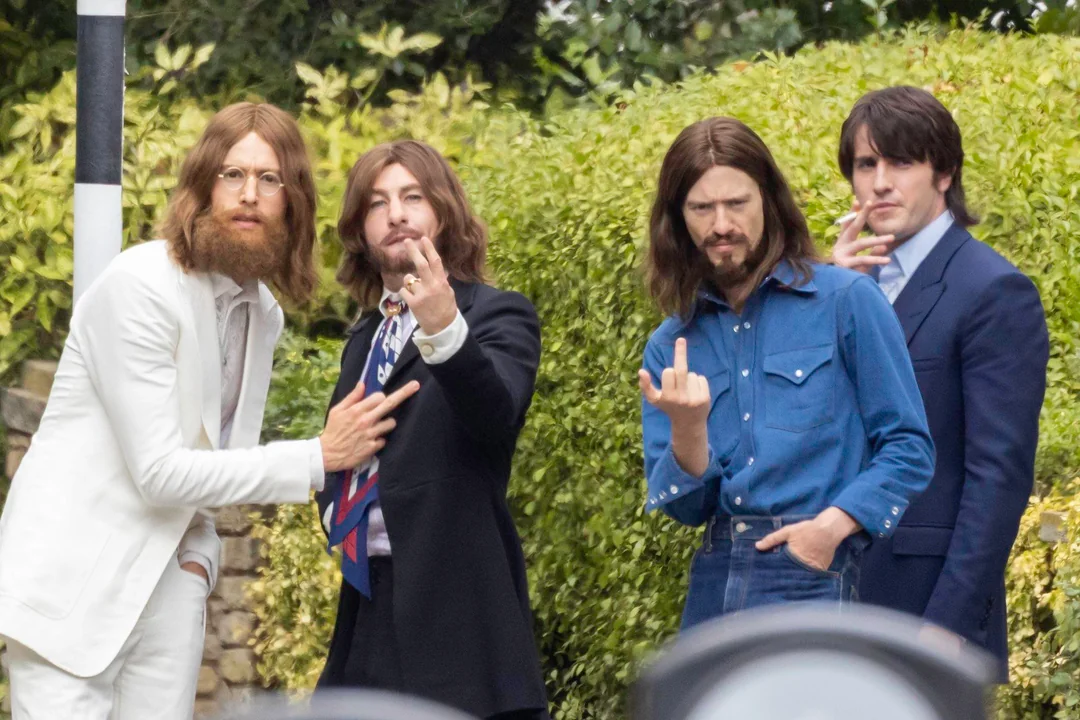
Concerning.
The first hurdle for Mendes’ films will be one you might not think of. We already have a superb movie version of The Beatles, which is called A Hard Day’s Night. The J/P/G/R in AHDN are not the real gents; they are characters, scripted by Alan Owun, and played quite successfully by John, Paul, George, and Ringo themselves. If you want to see what happens when they are less successful, watch HELP!. The problem with HELP! isn’t simply that the guys were swacked out of their minds on pot during the shoot; it’s that the unrealistic script puts much more pressure on the Fabs to act realistically as themselves, and since they weren’t actors and could only really play themselves (and the occasional “Mr. Papadopoulos”) with some effort, being high all the time robbed them of the ability to concentrate as they had for AHDN. The pot, plus the script, showed how hard it is for anybody to convincingly portray a Beatle, even the Beatles themselves.
But even a shaky Beatles performance is better than other actors playing them, for an obvious reason: The Beatles are the most photographed, most interviewed, best-known people of the modern era. This means that anyone who plays them besides them, will have to bridge an uncanny valley. Nearly every fan — and certainly any serious fan — carries around a version of each Beatle in their head, and woebetide the piece of fiction that does not line up. A movie like Nowhere Boy smartly sidesteps all this by telling the story of Lennon before he was a Beatle.
Mendes’ project is attacking this problem head on — the “uncanny valley” issue and our already having seen the perfect actors playing The Beatles — and he will need one hell of a script, supported by great acting, to get us to forget all that. Younger fans probably won’t care. But the older a fan is, the harder it’s going to be to make this leap. If any one of them doesn’t make the grade, all four movies will suffer. If all four actors get it 75% right, all four movies will be unwatchable.
Well, what about the script?
Here are the writers:
Jez Butterworth (b. 1969) wrote Ford vs. Ferrari, which I adored…but that’s a perfect example of a film based on historical events where accuracy doesn’t mean anything. Nobody went into that movie as a Carol Shelby superfan. Nobody settled into their seats with a bag of popcorn and really strongly held opinions about the relationship between Enzo Ferrari and Henry Ford II. Mendes’ Beatles movies are a completely different kettle of fish, where any deviation from the factual narrative is going to attract comment, and viewer resistance. People will “bump on stuff,” as they say in the biz.
Peter Straughan‘s (b. 1968) credits include Tinker, Tailor, Soldier, Spy and Conclave, once again really strong films…with no viewer opinion as to the subject matter. With TTSS, there might have been a few asses in seats who, like me, knew and loved the late 70s BBC version — starring a weary-looking Alec Guinness and an even wearier-looking England — well enough to bristle a bit at different choices in the movie. Conclave is a thoroughly gripping fictional look at a real process, the election of a Pope. It, unlike Mendes’ biopics, is completely untethered from a real story we all know and have opinions about. I was just rewatching Wolf Hall, which Straughan wrote, and it’s wonderful. But as long as his Henry VIII was entertaining, I wasn’t going to quibble over details; I didn’t know them, and didn’t care. When it comes to the life stories of The Beatles, viewers will.
As for Jack Thorne (b. 1978), I haven’t seen enough of his work to be able to comment intelligently or respectfully. Great resume, though.
All of these three seem like people working at the top of their field — splendid writers. If anybody can pull this off, these three can. But is it possible?
It’s a great story, that’s for sure. But we all know it — and once again, the older you are, the better you’ll know it, and the more you’ll have invested in the story, the more times you’ll have watched “Anthology,” or read a (or every) biography. These films can’t have the same relationship that say, Stranger Things has with the media of the early 80s. This is not an homage to The Beatles. They cannot feel like pastiche, and I’m saying that as a writer whose talent unquestionably tops out at pastiche. Each movie, and all four together, have to feel absolutely authentic. For the script to be truly great — if it’s going to tell us deeper truths than the ones we all know by heart — it will have to take liberties with real life; but the more liberties it takes, the more fans are going to be reminded of the artificiality of the whole endeavor. Yipes!
“The past is a foreign country; they do things differently there.” — L.P. Hartley, 1953
Until Brian Epstein’s death, one of the primary sources of Beatles magic was their splendid luck with collaborators. Joe Orton, one of the stellar playwrights of his generation, would’ve been entirely unsuitable; Al Brodax, who gave us the execrable Beatles cartoon, also gave us the immensely more consequential movie Yellow Submarine. I don’t know if AHDN would’ve even gotten off the ground without Alan Owun, the Welsh Liverpudlian and ace TV writer who captured the fellows’ banter so effortlessly.
Perhaps the best guide to understanding a person is another person from the same time and place. Whatever Liverpool is today, it’s not what it was in 1940; the same could be said for rock and roll in the 1950s; or England in the Swinging Sixties. Two Beatles — arguably the two most perceptive and insightful — are dead. The other two are deep into their 80s and notoriously flexible with their memories. There are simply very few people living today of the Beatles’ generation who grew up in Liverpool when/as they did; Mendes’ movies will require research, of a kind that probably very few people could do, and sympathy as great as any historian who ever lived. Does this sound like the skillset of a Hollywood scriptwriter? Not the ones I know. It’s one thing to create Don Draper out of a fanatical dedication to set-dec and telling details (I remember the day I got a phone call: “Hi, honey. Can you call up your old Yale Record friends and ask what the dues were for the Westchester Country Club in 1959?”). It’s quite another thing to recreate a famous person who we all think we know.
If people of the Beatles’ generation are fewer and fewer, the same can be said, sadly, for the Baby Boom generation. Even first-generation fans are quite long in the tooth, succumbing to the maladies of the flesh at an alarming rate. Three-score and ten is the time allotted in the Bible, and they are, one by one, hitting that limit. Could this help the movie, having lots of people who knew what it was really like, already dead? Perhaps.
Mendes and his writers are all second-generation fans, something I know a bit about. Second generation fans such as myself (b. 1969) can get you to some interesting places with The Beatles, as this site shows. For us, The Beatles story has always been historical, and we’ve had an ability to study it with more distance than first-generation fans; my opinion of Magical Mystery Tour isn’t colored by my memories of Christmas 1967. But second-gen Beatles fans aren’t completely trustworthy either — we’ve never lived in a world without the Beatles. The world changed massively in the wake of The Beatles, so they say — and while second-gen fans can collect sources confirming this, they can’t really feel it. Something as foundational to the Beatles’ story as long hair on men, we have no idea why that’s was a big deal…only that it was. The relationship of Yoko to a UK public still harboring memories of the Japanese during World War II? To a second-generation fan, that just looks like racism — but it’s not so simple, and that has to come out in drama. Yoko herself probably had/has very mixed feelings about English and Americans, based on her own childhood.
Finally, second-generation fandom was shaped by Lennon’s murder and its aftermath. Just as millennials tend to dismiss Lennon as a wife-beating asshole, we second-gens have a hard time not seeing him a some kind of secular saint, and his wife as a blessed widow, the rightful gatekeeper to his legacy. Which is a severe distortion/flattening of both of them.
Night and Day (1946), starring Cary Grant as Cole Porter
The Beatles’ story is strange and magical, the most magical one I know. The life of each man is deep and dark — full of the primal drives necessary to make the story happen, and occurences too dark for anyone else to imagine, balancing the light and sunny things we know. Even with these splendid writers and this director, it’s difficult to see how these movies won’t end up as hagiographies, tuned to the preferences of young moviegoers born and living in an entirely different world. Even if accuracy was their goal — and it cannot be, any more than Night and Day could haul Cole Porter out of the closet — Mendes’ pictures will contain only as much truth and strangeness as they can afford. And with so much money at stake, they can’t afford much.
These movies were inspired by a couple of successful biopics, one of Elton John (Rocketman, 2019) and the other of Queen frontman Freddie Mercury (Bohemian Rhapsody, 2018). I watched and enjoyed both, but neither subject transcends pop music. Neither Elton nor Queen — with the exception of their connection to gay culture — is historically important. Those movies have come and gone very happily as exercises in nostalgia, and a way to sell a lot of records, but that’s all.
Anything about The Beatles is inherently higher stakes. The Beatles are inextricably woven into the fabric of the Sixties, a decade that really kicked off, for better and worse, the modern era. This is why the US can’t seem to stop electing baby boomers as president; we are still stuck in the language of the Sixties, the fights of the Sixties, and even the media techniques of the Sixties. When you look at how Donald Trump interacts with his base, and especially how he uses social media — that “I tell you everything, they’re all squares, you can’t trust anybody but me” stance — it’s impossible not to think of John Lennon’s approach to fame and fandom, especially after Yoko.
Getting The Beatles’ story right is a big part of getting The Sixties story right, which in turn is a huge clue to how we’ve gotten to where we are today. Not just the good stuff (less snobbery, acceptance of alternative lifestyles), and the bad stuff (a reflexive distrust of authority, deep cynicism about everything really), but even the baseline conditions we can’t even perceive anymore (youth culture as the only culture, a tendency to mistake media for real life). Contemporary culture is very much the child of the Sixties…which is why four simultaneously released Beatles biopics are being produced in the first place. And why I’m writing about them, too.
Once Upon a Time in Liverpool
Recently I watched Quentin Tarentino’s Once Upon a Time in Hollywood, which shows how one can produce content about an epoch-making time and place, without distorting it. Briefly, the movie follows an television actor and his stunt double, as his career becomes progressively more doomed by the changes the Sixties wrought. The movie climaxes with (spoiler alert) the Mansons visiting the actor’s bungalow on Cielo Drive rather than showing up at Sharon Tate’s next door; and rather than being greeted by a bunch of vulnerable hippies ready for the slaughter, the Manson crew is mangled, beaten, and frizzled to death by a flamethrower.
This movie is in no way history. Yet one leaves the film knowing more about Los Angeles in 1969, not less, and because the crowd-pleasing revisionism is bright lined, audiences can enjoy it as a melancholy what-might-have-been, rather than mistake it, even for one second, for what was.
Once Upon a Time in Hollywood is fiction ending with one real event, changed to make a better movie; now think of an entire life, four of them. How is it possible for these pictures not to be…well, dishonest in the name of box office receipts? And if one cares about the history, how is it possible to see these films as yet more distortion of reality in an era already sickened, maybe mortally so, by its addiction to fantasy? I’m not suggesting that the Beatles movies will change history as blatantly as Tarentino did. They might be subtler, which is much, much worse.
The era in which I live is increasingly confusing and alarming to me; this is one of the sunk costs of getting old. But one of the most alarming facets of our current time is how people will do almost anything to avoid reading history. Mendes’ movies, no matter how wonderful, cannot help but continue our modern mania to have the stories we like replace facts we don’t.
Knowing the facts in this case drives one to a singular conclusion: to be worthy of the real story — what really happened to the real people, and how it changed life for all of us — each film will have to be an achievement roughly on the scale of Citizen Kane. Four times over, movies as brilliant as Kane…which, by the way, flopped at the box office. And, it must be remembered, wasn’t even the true story of William Randolph Hearst—sometimes, for the sake of art, commerce, or both, a clitoris needs to be turned into a sled.
Unfortunately, in the case of Mendes’ movies, we’ll all know it.
Related posts:
 Last Recorded Audio of John Lennon, 12/8/80
 I’m So Tired: Responsive Notes on the Phenomenon of Beatle Fatigue
 Try it, you might like it
 Ian Leslie: “Notes on Peter Jackson’s Get Back”
 Los Angeles Beatles fans: Wanna go see a movie?
 Beatles singles that never were?
 Shepard Fairey George Harrison Poster
 “Poor old Buddy”
 Various musings on Lennon and Addiction
 Allen Ginsberg: “Portland Coliseum” (1965)
 “Yesterday,” the film: slight but fun
Leave A Comment